Showing posts with label Bird Legend. Show all posts

Sunday, November 3, 2019

Yellow-eyed Junco


Yellow-eyed Junco
Madera Canyon, Arizona, USA
July 2019
Member of the American Sparrow Family
§A Meinie of Sparrows§

~True Bird Fact~ Yellow-eyed Juncos are, in their local range, abundant, sedentary, and often stick around the same location. They also do well with captivity, so, as a result, this bird has been used for a lot of scientific behavioral study. Not the kind of thing I would have guessed, as the bird itself looks like it might have firestarter powers.

~Real Bird Myth~ The native people of Mexico (within which most of this bird's range falls) had another name for it- Echa-lumbre, which means 'caster of fire' or 'lightning bird'. Here's an audio story on bird note about it. The Veracrucian people believed the bird absorbed sunlight by day and released it through its eyes at night. This is, to be honest, much more in line with the characterization I was imagining.

I guess in this case you can speculate about the Yellow-eyed Junco's personality as you choose. Do the scientists have it right? Or the Veracrucians? I know which one is more fun to think about, so I'm just going to picture this bird shooting lightning from it's eyeballs at scientists who try to do experiments on it.
 

Sunday, June 30, 2019

Horned Grebe


Horned Grebe aka. Slavonian Grebe (foreign)
Arrowhead Marsh, Oakland, California, USA
April 2019
Member of the Grebe Family
§A Waterdance of Grebes§

~true bird fact~ These Grebes swallow their own feathers in order to create a 'plug' in their stomach, which helps them filter out fish bones and other harder to digest materials. Parent Grebes will even feed their young these feathers, to get this system going earlier. Makes you wonder why we humans don't eat feathers.

 ~real bird legend~ According to the Blackfoot Native tribe, the Horned Grebe is always the first to spot danger. This is because the Old Man trickster fooled a bunch of ducks into dancing for him with their eyes closed. In this state he was able to bonk them on the head and kill them, but this Grebe, the smallest of the ducks present, peeked, and was able to escape and sound the alarm. This is also how he got his red eyes.

How Endangered Are They? Well, let's start with the good news- there are a lot of these Grebes still remaining- somewhere between 200 and 500,000. Another item to be optimistic about- they have a pretty global distribution living all across North America and Eurasia. However, these birds are going fast. Within the last 30 years, their global numbers have declined by 30%. The picture is much worse in North America where the declined is a much steeped 79%.  The reason? All the usual stuff, all our fault. Climate change, human disturbance of breeding habitat, the destruction of wetlands, and oil spills. We've even messed up their food supply of aquatic insects by introducing Rainbow Trout into bodies of water for fishing purposes. These birds are really getting it from every angle, sadly. My hope is that having survived the machinations of the trickster god, the Horned Grebes can survive us too.

Wednesday, July 11, 2018

Birding the World Cup Top 4: Our Birld Cup 2018 Exclusive Coverage

Hello sportsfans and birdsfans and welcome to Amateurnithologist's 2018 World Cup Coverage! Are you interested in having a little bit of bird trivia to help you make your top 4 bracket decisions? Good news if so, cause it's my GOOOOOOOOOOOOOOOOOOOAL to provide exactly that to you! Just like we did in 2014, we're going to compare teams based on a number of bird related factors, and then, through a process that combines state-of-the-art techniques from the fields of statistics, ornithology, alchemy, and sociology, determine the likely winner! As you may remember, we have a 100% record of predicting sporting events correctly based on birds, like, probably. So let's get off on the right FOOT and get this BALL rolling.

France


National Bird: Gallic Rooster
Say what you will about the French and their strange choice of national bird- they are strong and consistent in their love and appreciation of chickens. The Gallic Rooster or le coq gaulois, is not only the national bird, but a symbol of the nation itself. The rooster's french phonetic cry, cocorico, is sometimes shouted as an expression of patriotic pride. Think U! S! A! (French people sound off in the comments if you have every made this sound). This rooster love goes way, way back, like to the Middle Ages, and is more than I'm going to get into in a blog ostensibly about the World Cup, but you can check Wikipedia for more detail. Anyway, not only do they have a love of their national bird, it is already tied thematically into sports and football. The French National rugby team uses the coq as it's mascot, and when the World Cup was in France in 1998, the mascot was a rooster named Footix.


The Metrics:
Number of Bird Species: 591
Bird Liking Quotient: 1.629
What would soccer analysis be without reliance on some extremely dubious, but scientific sounding metrics. Here we've taken data from Avibase's Bird Checklists of the World. This number includes all sorts of rarities, introduced species, and migrants, making it hopefully the most optimistic possible number of types of birds you could see there. The bird liking quotient is a little less straightforward, but involves dividing the national population by the number of hits you get when you google "Birding in France". I know that sounds like a crazy way to measure something, but you can't argue with statistics. France, by the way, does pretty well by these metrics, being 2nd in bird diversity and 3rd in birding enthusiasm

The X-factors:
J. G. Keulemans, 1885

Endemic Species? Corsican Nuthatch, Corsican Finch
Best Birding Spot? Corsica obvs
The French island of Corsica has to be a lock for best place to go birding, since it has two species you'll find nowhere else in the world, along with a host of other rarities. The Mediterranean island gives you a good chance for a whole variety of seabirds, along with a bunch of others. France has put up a strong showing and is clearly the country to beat.

Belgium
Andreas Trepte, c/o Wikipedia

National Bird: Common Kestrel
Don't let the name fool you, this bird is anything but common. Closely related to your beloved friend, the American Kestrel, this bird is a master hunter of stealth and agility. The Kestrel has long been associated with prowess in battle and mastery of aerial combat. If you still don't know who this bird is maybe you'd prefer his latin name, which translates to Screeching Sickle, or his alternate names Eurasian Kestrel, Windhover, Windcuffer, or something even ruder that won't be making an appearance on this family-friendly blog.

The Metrics:
Number of Bird Species: 457
BLQ: 3.427

An impressive BLQ cannot hide a subpar number of birds for Belgium, leaving the relatively small nation at a disadvantage. What if we corrected for nation size by even more bird math? Dividing number of recorded bird species by area, we come up with a metric France scores .0024 while Belgium gets a much more respectable .0388 (the highest number among the competitors). We'll call this number Bird Species Density, of BSD.

The X-factors:
photo by Natuurpunt
Endemic Species? Nope
Best Place to Go Birding? Groenwaecke Polders
The first line of the first website hit by a google search was "Belgium is probably not the best country for birding" Thanks for the honesty, fatbirder.com, but that means it's not looking good for the underdogs and their delicious waffles. There are some choice spots though, including a shipping port that hosts the largest tern colonies in Western Europe. I'm going to go with Groenwaecke Polders, however, since in winter it attracts tens of thousands of pink-footed and white-fronted geese, along with a who's who of other European birds. I'd check it out for sure, if I was in Belgium.

Croatia
Carlos Delgado c/o Wikipedia
National Bird: Common Nightingale
So no, this is not a particularly interesting looking bird, but it is famous. The Nightingale's melancholy song has been described as one of the most beautiful sounds in nature, and this has given it prominence in a whole variety of classical art, literature, and poetry. An artist's bird, Shakespeare, Keats, and Shelley all had poems comparing the artist to the nightingale, and vise-versa. Even Beethoven got in on the act, mimicking the birds call with flutes in his Pastoral Symphony. The Nightingale appears on the Croatian 1 Kuna coin, making it analogous to America's positioning of Abraham Lincoln. A pretty great bird, but can it SPORTS?

The Metrics:
Number of Bird Species: 408
BLQ: 5.155
BSD: .0187

With the mightiest BLQ we've seen so far, and an impressive BSD, Croatia presents itself as a plucky challenger to it's competitors. Still, that's not a lotta birds. Let's see if Croatia can offer anything to make up for that deficit.

The X-factors:


Endemic Species? Nah
Best Place to Go Birding? The Lastovo Archipelago
Unlike Belgium, there seems to be a fair amount of info about birding Croatia on the internet- perhaps Croatia is in an active push to attract nature-based tourism in a way that Belgium isn't. Either way, CroatiaBirding.hr describes it as an 'emerging birding destination', and I'm inclined to believe them. The country's unique shape means that is has land in the mountains and a long stretch of Adriatic Sea coastline. It's also within both the central and western European migration corridor, leading to an unusual diversity of birds. The unique geographical features mean that Croatia is home to 78 endangered bird species, more than any other small or medium sized European country. Again I'll quote the Fat Birder "undoubtedly one of the pearls of European birding". If I had to pick one spot, it would be the Lastovo Archipelago, which houses the unique colonies unique in Europe of Yelkouan Shearwaters and Eleonoras Falcons.

England

Emmanuel Douzery c/o Wikipedia
National Bird: European Robin
My antipathy for the American Robin is well known by this point, but I just can't feel the same way about this little guy. What a cutie! A classic and classy choice for national bird for sure, and seems to capture the English character. One quibble- with Brexit looming, will a bird with 'European' in the name still be allowed in the country? The Robin is a prominent figure in folklore, and British folklore specifically (a good sign for a national bird). A couple great folkloric theories about the Robin's red breast- it sang into Jesus' ear to comfort him as he was up on the cross and was thus stained with his blood OR the Robin was bringing water to souls suffering in purgatory and his breast was singed. The Robin sure is metal in these conceptions. He is the symbol of several English and Welsh football clubs, so you know he's got experience.

The Metrics:
Number of Bird Species: 628
BLQ: 1.828
BSD: .007

The number of bird species just crushes here, and may be a deciding factor for England (which, for the purposes of these calculations, includes the greater United Kingdom). The BLQ and BSD are both higher than the other top 4 birding (and football) powerhouse France's are, but they still aren't close to the enthusiasm and sheer bird density seen in the smaller countries.

The X-factors:

Richard Crossley c/o Wikipedia (this picture was too wild not to use, sorry to your eyes)
Endemic Species? Scottish Crossbill
Best Place to Go Birding? Isle of Rum
Here again you can see the inherent advantage in birding that the UK gets for being a series of relatively widely spread island nations. If Scottland was an independent nation, we wouldn't even be having this conversation right now. Regardless of how England acquired it, the existence of an endemic species is a real leg up in the competition. While there are many great birds to be found across the varying islands of the UK (including Puffins in Northern Ireland!), I'm going to give it to the Isle of Rum, where you can find the White-tailed Eagle, a magnificent bird of prey even larger than the Golden Eagle (which you can also find there). The islands are also home to an insane number of Manx Shearwaters.

Alright, so that should be everything you need to figure out exactly how the final four will play out! Wait, you wanted ME to do the predicting? Fine, fine, let me just run all those numbers through the Football9000 Supercomputer

Beep Boop Borp

and here we go, the order of finish in the 2018 World Cup, based EXCLUSIVELY on bird data

1. England
2. France
3. Croatia
4. Belgium

Congratulations to England on it's victory (the Puffins pushed it over the top by .02%). The calculations were so close, however, that if England doesn't technically include Scottland, Wales, and Northern Ireland, it falls all the way to third place, behind Croatia. So it would look like

1. France
2. Croatia
3. England
4. Belgium

Of course we could also see a fluctuation in France's place in the standings, depending on whether or not the Island of Corsica should really count as France.It'd be an upset but we could be looking at

1. Croatia
2. France
3. England
4. Belgium

Well, with that definitively settled, we offer our congratulations to either England or France or Croatia, great job in the 2018 Birld Cup!

Friday, August 4, 2017

Cartoon Roadrunner vs. Real Roadrunner


Let's talk about the Road Runner. He was my favorite cartoon when I was a kid for sure, beating out even the antics of beloved proto-troll, Bugs Bunny. But as you age, you put away childish things, and now I probably prefer real road runners. This is a bird that's been on by bird-bucket list (birdcket list(TM)) for a while now, and on my recent Texas trip I finally got to see him, and in abundance. So I was thinking, just how does the Road Runner cartoon compare to the genuine article.


Appearance
Correct
Long, prominent tail
Dark crest
Darker wing than belly

Incorrect
Not really predominantly purple/blue
Wrong number of toes
Beak shape wrong
Neck too long

Behavior

Correct
Runs quickly, favoring roads (up to 15 miles per hour)
Doesn't really fly (flight is possible, but brief)
Lives in the Southwestern American Desert (per Chuck Jones)

Incorrect
Can outrun a coyote (they can get up to a whopping 43 miles per hour)
Would be hunted by coyote (coyote are voracious hunters and scavengers, but one of the few things that live in their range that they don't eat are Road Runners. Not worth the effort?)
Call is just extremely wrong

So how do we put this all together? Ultimately, I'm going to give him a passing grade because I think this cartoon succeeds in depicting a caricature of a roadrunner for the most part. The important part is that he is recognizable as his real-world inspiration, but just barely. The color is the real tricky part- it's just not a color these birds have (except in a small spot behind the eye). Most damningly, no other Looney Tune has a color scheme this unrealistic. Rabbits can be grey, ducks black, pigs pink, coyotes brown, etc. I guess what I'm saying is he's no Beaky Buzzard

Realism Score: C-

Also, have a profile, cause why not 


Greater Roadrunner aka. Chaparral Bird, aka. Chaparral Cock, aka. Ground Cuckoo aka. Snake Killer
Big Bend Ranch State Park, Presidio, Texas, USA
July 2017
Member of the Cuckoo Family
§A Race of Roadrunners§
★Excellent State Bird of New Mexico★

~real bird legend~ Road Runners have a special place in the belief systems of many Native North and Central American peoples. They are considered to be courageous, strong, and fast, perhaps because of their habit of taking on fearsome venomous prey like rattlesnakes, scorpions, and horned lizards. The X shaped mark their feet make (2 toes in front, 2 in back), is thought to ward off evil and has been used as a sacred symbol by the Pueblo tribes. The footprint disguises the direction you're going in, keeping evil spirits from following.

Adventurous, tends to rush in
Equally at ease by himself and around big groups. Either way he ends up talking a lot
Maybe should be a little more careful, seems to walk around like he's invincible
Sleeps well at night


Thursday, June 15, 2017

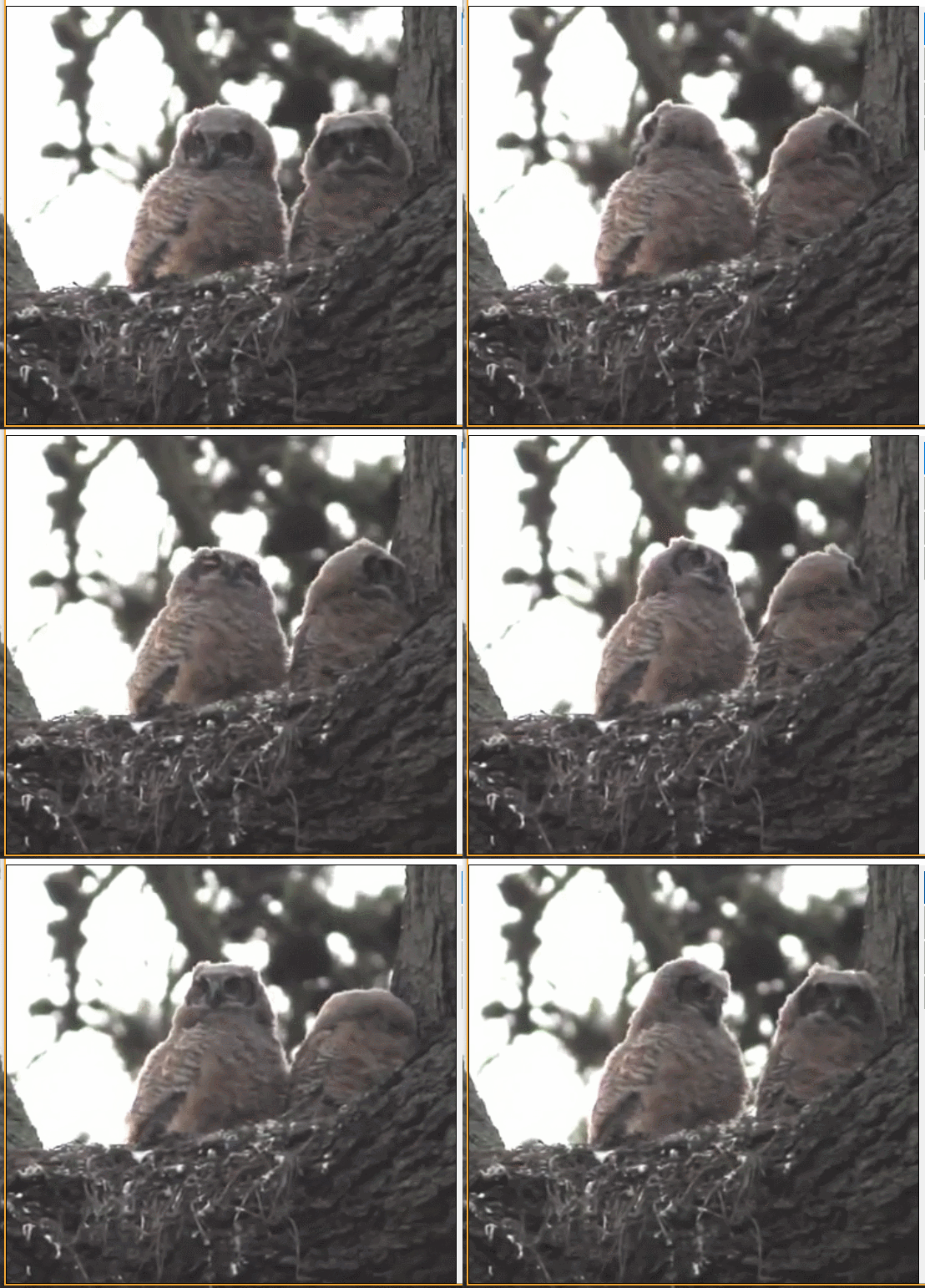
Baby Owls in Golden Gate Park


Great news everyone! And I do mean great, because Great Horned Owls are nesting in Golden Gate Park. Well, probably not anymore, because even at the time I took these shots, a few months ago, they were getting kinda close to fledging I think. Big shout out to local bird-friend Eliya who gave me the hot tip and showed me the owls. These good good baby owls were shot around sunset, so the pictures I took aren't the best. Go see them next spring, why not. They're very good.


Great Horned Owlet aka. Fluffems aka. Sweet Baby Owl aka. Robert "DOWNy" Jr.
Bison Paddock, Golden Gate Park, San Francisco, California, USA
April 2017
Member of the True Owl Family
§A Glaring of Owls§
★The Provincial Bird of Alberta, Canada★

~real bird myth~ Pretty much any group of people who came into contact with this bird came to believe it had some kind of supernatural powers. The Pima thought the owls were reincarnated warriors, while the Passamaquoddy thought of them as friendly spirits whose calls could make people fall in love. The Hopi saw them as harbingers of warm weather and good harvests, and the Zuni used their feathers in battle to imbue themselves with some of the owl's powers of stealth. If there's anything everyone seems to be able to agree on, it's that the owls are not what they seem.


This is their mother. She has had it up to here with their shenanigans.

And these are the babies. I think there were three all together, but I never got a good shot with all of them. They:

Are always attached to their phones
Just want things handed to them, must've been all those participation trophies
Use all this slang I don't understand
Why can't they work their way through college?

Just kidding, I love these baby owls, and to prove it, here's an amazing .gif I made of them from some of Eliya's footage. May it see you through some hard times.


Friday, May 5, 2017

Smooth-billed Ani


Smooth-billed Ani
Cabbage Beach, Paradise Island, The Bahamas
April 2017
Member of the Cuckoo Family
§A Silliness of Anis§ (disagreeable)

~true bird fact~ Lives a seriously communal life-style. Several pairs of birds build the nest together and all lay their eggs in it in layers. These nests are crazy multi-layered deals, and up to 35 eggs have been found in one nest. The birds incubate and defend the nest together, and raise the chicks. The chicks themselves, once old enough to do so, begin to care for the younger birds.

~real bird myth~ The meat of the Ani, reportedly gross tasting, is considered to be a cure for lung issues by the Surinamese native people, but only if you don't know that you're eating it.

Lots of strong feelings about whether having a smooth bill or a grooved bill is better. This conflict may originate from a sneetches-like situation.
Unflappable
Does a lot of starring out at the horizon, thinking about unrelated things
Doesn't see why you'd waste money going out to dinner


...Ok look, I don't usually do this, this is a friendly n positive blog, but I gotta say...

This bird looks like a blackbird fell into the ooze from Teenage Mutant Ninja Turtles II: Secret of the Ooze
Like if an unflattering caricature of a crow came to life
Bird looks like he's wearing a a big, novelty, Halloween mask of himself
If you asked a kid to draw a "dinosaur versio of a bird", this is what they'd come up with
I'm just saying, he looks like he told you that you wouldn't like him when he's angry, and then you went and made him angry anyway
Smooth-billed Ani looks like a gargoyle you made to ward away trespassers from your tomb. Carved him on a column
Kinda looks more like a lizard than a bird
Typed 'scary bird from a nightmare' into google search and he came up, is all I'm saying

#birdroasts

Thursday, February 23, 2017

Mute Swan


Mute Swan
Wetland's Edge Park, American Canyon, California, USA
Member of the Duck, Goose, and Swan Family
★The National Bird of Denmark★
§A Bevy of Swans§


~true bird fact~ Mute Swans are not native to the United States and are considered a widely disliked invasive species. All Mute Swans in the states are descended from birds brought from overseas to decorate estates, zoos, and parks. They eat a ton of aquatic plants, making survival more difficult for other waterbirds, and are exceptionally aggressive, often attacking humans and pets. The attacks are no joke either, these are very big, strong birds, and a wing-beat is strong enough to break a person's arm. A quick google search was able to confirm that they have killed, but couldn't establish in what numbers.

~alternative bird fact~ Not so fast, say several advocacy groups. There are disputes about whether or not Mute Swans could actually be native to the US in some fashion (flying over from Russia, perhaps). "Save The Mute Swans" presented fossil evidence to this effect to the US Department of the Interior, but their claim was rejected. Mute swans continue to be the subject of culling efforts or even a kill-on-site species, especially on the West Coast, where they have not established themselves as fully.


~true bird myth~ The phrase 'swan song', comes from the Mute Swan, who is fairly quiet, although not silent, throughout his life (this is where his name comes from). The legend says that this bird is silent up until the moment of his death, at which point he sings an unbelievably beautiful song before expiring. Poignant stuff.

~true bird history~ Insanely, all Mute Swans are owned by the Queen of England. They were "Claimed by the Crown" in the 12th century and the ownership is retained to this day, although it's not really used for much other than some weird annual Swan ceremony.


~haven't had enough true bird facts yet?~ This is also the lead character in The Ugly Duckling.


Friday, August 26, 2016

Blue Jay


Blue Jay aka. Jaybird
Peaks Island, Portland, Maine, USA
August 2016
Member of the Crow/Jay Family
§A Cast of Jays§
★The Provincial Bird of Prince Edward Island, Canada★

 ~true bird myth~ In old African American mythological traditions, the Blue Jay was thought to be in league with the devil. It was said that you wouldn't see a Blue Jay on a Friday because that was the day he was busy in hell, gathering sticks (for what purpose, who knows). Then, on Saturday, the Blue Jay was always in a very good mood and would be singing all day, due to the relief from, you know, not being in hell anymore. These pictures were taken on a... Tuesday, so I can neither confirm nor deny this theory.


~true bird fact~ Blue Jays are a member of the Corvid family, probably my favorite bird fam, and as such have all sorts of facts associated with how bright and inquisitive they are. They play with objects, use tools, and mimic the calls of other birds (either for communication or to scare others away). But that's not what I'm gonna talk about today, cause I feel like you've heard about most of those things before on this here blog. Let's talk about the color blue in a Blue Jay's feathers. Their coloring is unique in that it comes not from pigmentation, but because of light refracting on the crystalline structure of the feathers themselves. In other words, if you crush a Blue Jay's feathers, they lose their color completely. Neat!

Huge appetite, loves to eat. Never gains weight though, how annoying
Likes to take the contrarian opinion in arguments or debates, even if he doesn't feel that way. Finds this kind of verbal sparring entertaining
Thinks he might be a fish at heart
Popular with the ladies

Thursday, November 5, 2015

Domestic Greylag Goose


Domestic Greylag Goose
Kennedy Park, Napa, California, USA
October 2015
Member of the Ducks, Geese, and Swans Family
§A Skein of Geese§

~true bird fact~ Remember our African Goose from a few weeks ago? And how he was a descendant of the Swan Goose? Well, even if you don't, that's what happened. Anyway, this fancy gentleman here is the domestic form of the Greylag Goose, which is the species from which almost all domestic geese originate. All of them except those that came from the Swan Goose. Anyway, now that we've got our goose family tree straight, here's an interesting fact- The Greylag Goose was one of the first animals to be domesticated by humans. It happened at least 3000 years ago, and the ancient Egyptians are responsible.

~true bird myth~ This goose has held cultural significance for over 5000 years. It was considered a symbol of several gods and goddesses throughout history, including Ishtar, goddess of fertility in Sumeria, the sun god, Ra in Egypt, and Aphrodite, goddess of love in Rome. In fact, Geese have long held a sexual connotation, and Goose fat was once a major aphrodisiac.

~true bird history~ Konrad Lorenz, a German scientist who did seriously important research on the biological process of imprinting, used these Geese in his studies. Basically he postulated that many creatures form an intense and instinctual emotional bond with the first moving thing they see upon being born, and proved this theory by becoming surrogate mother to a flock of Geese. Lorenz's work was not only significant, but he also conducted it extremely ethically, only using natural settings and conducting his experiments in a non-invasive way. Unfortunately he was also a member of the Nazi party... as most Germans were during WWII, whether they wanted to be or not. After the war he did say he regretted the decision. An extremely important figure in the development of behavioral psychology, your blog author personally learned about this story during his undergrad days.


Wednesday, October 7, 2015

Eurasian Collared-Dove


Eurasian Collared Dove
Natural Bridges State Beach, Santa Cruz, California, USA
September 2015
Member of the Dove and Pigeon Family
§A Dole of Doves§


{Etymology Corner} Well, it's a dove native to Eurasian and it has this collar, so it appears to be case closed. Not so fast, gentle blog reader, there's more. We're finally delving (perhaps inadvisably) into the world of scientific names for this one. Streptopeleia decaocto is her name, and there are some interesting notes here. The first part, Stepto-whatever is just Latin for "Collared Dove". However, Decaocto is a name of Greek Mythological origin. She was a servant girl whose life was so terrible that the gods turned her into a dove so she could fly away from her whole existence. Thanks gods. It is said that this Dove's mournful cry is her weeping (you know the cry, you confuse it for an owl). Wikipedia disagrees, however, stating that Decaocto was chosen because it is phonologically similar to the coo-COO-coo cry. Uhhh... nice try, but I'm going to stick with the myth.


~true bird fact~ This bird, as you may have gathered from the name, is not a native species. It came to the US through the Bahamas after a pet store was robbed in the 80's and some of the birds escaped (of course a pet store in the Bahamas was robbed in the 80's). By 1982 the bird was spotted in Florida, and, spreading quickly, it was all the way in California by 2001. Now the bird is nearly everywhere in the states, some heading as far north as Alaska. The theory is that the Collared Dove was able to expand her range so quickly because she is filling a biological niche left by the extinction of the Carrier Pigeon. I, for one, am really proud of the Collared Dove and take a pro Collared Dove stance. Sometimes you just come upon a bird with a real interesting narrative. Or even two in this case. It's always a nice surprise.


Tuesday, May 19, 2015

Wood Stork


Wood Stork (FKA Wood Ibis [not an ibis])
Wakotahatchee Wetlands, Florida, USA
April 2015
Member of the Stork Family
§A Phalanx of Storks§

~true bird fact~ The Wood Stork's breeding system is timed to be during the dry season in the places he lives. This doesn't make sense at first, but the Wood Stork knows what's up. During the dry season, pools of water shrink, meaning that fish are concentrated in smaller areas and it's easier for him to find food.

~true bird myth~ Storks have long been associated with protection, wealth, and of course, child rearing. Storks are believed to hold high amounts of faithfulness and familial values. Not only are they associated with delivering babies (which they allegedly found in caves or marshes), but also with taking care of elderly relatives. Ancient Greeks had a law that punished anyone who killed a stork with death, and Muslims revered the birds because they made a pilgrimage to Mecca on their annual migrations. Many of these myths seem to come about because Storks are large, prominent birds that often nest among humans, but they also stem from the Stork's own behavior. They're very consistent birds- mostly monogamous, and they nest in the same site year after year.

Acts on emotion. Wears her heart on her sleeve
Finds enjoyment in the simple company of others
Doesn't think about 'the big questions'
Likes percussion instruments best


How endangered are they? They've never been a globally endangered species because they have such an enormous range, but Wood Storks had a hard time of it for a while. Back in 1984, their population was dropping by a precipitous 5% per year. However, a concentrated conservation effort over the past 30 years has brought them back up to healthier levels. In July of 2014, they were moved off the US Fish and Wildlife Endangered List and are now considered merely 'threatened'. There are now estimated to be somewhere between 6,000 and 10,000 storks in the States. Stork populations have followed a similar trajectory in Brazil. Good for you, storks.

Tuesday, October 14, 2014

Turkey Vulture

Mwahahaha! Welcome back to Amateurnithologist's Spooktacular Shocktober Birdstravaganza! We continue our exploration of the spookiest birds with a really prized find. That's right, Turkey Vulture is finally joining the blog as I've had a few lucky occasions lately to finally get a good picture of these guys. These two pictures were taken at Mount Diablo (scarily topical!).
What do you think of when you think of spooky birds? Probably owls first (and for good reason, they are heavily connected to the supernatural after all). Perhaps crows? At some point you start to think about the only bird that you ever hear about eating human flesh, the vulture. The Turkey Vulture is the western hemisphere's archetypal scavenger-bird. You might know him better as a Turkey Buzzard, or simply Buzzard. The bird that outlaws are left to in the desert. That guy.
It might not surprise you that we here at bird blog have a different perspective on vultures to offer you. First and foremost, Vultures serve an important purpose and occupy an otherwise empty rung of the avian food chain. In fact, vultures are so important to the ecosystem that on other continents, there are convergently evolved bird that are almost identical. Furthermore, some cultures see the Vulture as a sacred being because of his role in the intersection between life and death. Zoroastrians in India and Tibetan Buddhists are both known to practice "sky burials", in which the dead are left somewhere high up for Vultures to consume them, thus releasing their souls. Great job vultures!

Turkey Vulture aka. Turkey Buzzard aka. aka. Buzzard aka. John Crow aka. Carrion Crow
Cambria, California, USA
Member of the Vulture Family
§A Committee of Vultures§

~true bird fact~ They really are harbingers of death though. Turkey Vultures have an extremely refined sense of smell, assisted by an unusually large 'smell section' in their brains, which allows them to sniff out a special gas emitted by newly dead corpses. Very few birds use their sense of smell for much of anything, but Turkey Vultures can find their food using smell alone.

Meticulously organized. A real bean counter
Appreciates the chance to 'let loose' with coworkers every once in a while
Never showy, but contributes a lot
Knowledge gained through studying and reading a lot, not through innate talent

Saturday, June 28, 2014

World Cup! Bird Cup! Birld Cup!

Welcome to amateurnithologist's bird cup special! Today we present to you a guide to the top 16 of the world cup as only we can- in an arbitrarily bird related way! Since we have a perfect record of predicting sporting events, I'm not saying you want to put money down, but statistically, you can't lose. So how do we figure out who's going to win this thing? By looking at national birds of course! It's so obvious that no one has done it yet. Game on!

Brazil vs. China
Dario Sanchez, wikipedia                                                                           Alastair Ray, wikipedia
Rufous-bellied thrush (sabiá-laranjeira) vs. Red-crowned crane (xian he (lit. fairy crane))
Brazil's glorified robin knock-off versus an animal sometimes called THE CRANE OF THE IMMORTALS? Sounds like an easy victory for China. There's more here, however, than meets the eye. The Rufous-bellied thrush is uniquely nationalistic, given his prominent placement in a famous national poem called Canção do exílio, and since Brazil is hosting this year's World Cup, he has a sizable home field advantage. However, the real reason that China is going to lose is that the Red-crowned Crane is not even truly their national bird. In 2008 China attempted to select a national bird, and was considering this crane or the Eurasian Tree Sparrow (who even knows). However, the contest was called off in controversy after it was reported that this crane's latin name translates to Japanese Crane. The country has never recovered from the indignity, and therefor is a lock to lose in the first round.
Brazil Wins!

Colombia vs. Uruguay
Emilio del Prado, Flickr                               Patricia Carabelli, Wikipedia

Andean condor (cóndor andino) vs. Southern lapwing (avefría tero)
The Southern Lapwing is a cool bird, and it deserves respect for being an incredibly old species that survived the ice age. However, he's going up against the Andean Condor here, a bird that has been worshiped in andean cultures since at least 2500 bc. He was once believed to rule the upper world, and was closely associated with the sun god. And why not, as he's something like the 4th largest bird in the world. Sorry lapwing, you're not coming back from that one.
Colombia Wins!

Netherlands vs. Mexico
Andreas Trepte, Wikipedia                                                              'Rocky', Flickr
Eurasian Spoonbill (Skestorken) vs. Golden Eagle (águila mexicana)
Once again the game comes down to preparation, with Mexico fielding an extremely bad ass and well established national bird in the Golden Eagle, and the Netherlands appearing to not really have an official national bird. The Eurasian Spoonbill here, while a nifty bird, is claimed to be the national bird of the netherlands only by an un-sourced ask.com user. Another blog claimed the Netherlands national bird is the Caribbean Flamingo, but I think that may have been a joke. The golden eagle, or, as he's called in Mexico, the Mexican Eagle, is a well known bad ass. The national bird of fully five countries, he was once used by humans to hunt down wolves. Wolves! Mexico may just win this whole thing.
Mexico Wins!

Costa Rica vs. Greece
Amateurnithologist, This Blog                                              Arturo Nikolai, Wikipedia

Clay-colored thrush (Yigüirro) vs. Little owl (Αθηνά η νυκτία (lit. Athena's Owl))Despite your amateurnithologist's personal affection for Costa Rica, they've got a hard road ahead of them in this match against Greece. The Yigüirro may start the rainy season with his call, but in Greek Myth the little owl sits on the shoulder of, and is occasionally the avatar for, Athena herself. Ultimately their place in their respective cultures' mythologies is a wash, and Greece squeaks by (squawks by?) in a narrow victory.
Greece Wins!

France vs. Nigeria
Gandalf le Blanc (uh-huh), Wikipedia                                                        Fabien Khan, Wikipedia

Gallic rooster (Chanteclair) vs. Black crowned crane
How do you know when a country loves it national bird? That's what this match-up comes down to. Frankly you want to give it to Nigeria right out of the gate, with that super cool and distinctly Nigerian bird (found out that the national language of Nigeria is English in doing my research for this article, so... the more you know, I guess). Nigeria even has this crane on a beautifully illustrated stamp. And France's bird is a rooster. I mean, come on. However, as I research, France slowly won me over. The wikipedia article is voluminous, and chock-full of interesting information (as well as instances of the phrase "sacred cock"). This is the rooster, for example, that appears on weather-vanes. He is not just a national bird, but a national symbol of France. That kind of dedication is rare. What sealed the deal for me, however, was when I found out that France had a Gallic Rooster named Footix as its World Cup Mascot back in 1998. With that kind of football history, how can you lose?
France Wins!

Germany vs. Algeria
'Karlo', Picassa                                                                    Umberto Salvagnin, Flickr
White-tailed eagle (Seeadler (lit. Sea Eagle)) vs. ...Fennec Fox? ((فنك
Not only does Algeria not have a national bird, it doesn't even have an unofficial or widely considered national bird. Furthermore, these tiny foxes (who are nominated by virtue of being Algeria's national animal) have to face the fearsome German terror of the skies. No, not The Red Barron, the Sea Eagle, who is basically a European version of our very own Bald Eagle. This is a bird so tough that it was nearly extinct in 1970, but has made a dramatic recovery since then. None of that matters, however, since Algeria hasn't even fielded a bird. I hate to say this, but Algeria simply does not care about birds. Get it together Algeria.
Germany Wins!

Argentina vs. Switzerland
Dario Sanchez, Wikipedia                                                                        CJ Hughson, Wikipedia
Rufous hornero (hornero rojo) vs. Goldcrest (Wintergoldhähnchen)
Is that Costa Rica's national bird again? No, of course not, how could you make such an obvious mistake? The Hornero Rojo is actually pretty distinct because he's an ovenbird, one of the more architecturally inclined families. He builds his nest with transported mud, and it's sturdy enough that other bird species can use it too after he's departed. Switzerland, shockingly, does not have a bird. I have selected nearby (?) Luxembourg's national bird to represent him, but he just doesn't want to play. The Goldcrest is sometimes called The King of Birds in European Folklore. Is he the king of birds? Maybe someday we'll find out. He is a great bird, but it's inexcusable that a large and real country like Switzerland hasn't chosen a bird yet. In fact, they don't have a national motto or animal either, claiming that "Switzerland is a country formed of originally distinct linguistic groups, and it can be difficult to find symbols of importance to all such groups". Yeah, that's nice Switzerland, but you just lost the World Cup.
Argentina Wins!

USA vs. Belarus
Yathin S Krishnappa, Wikipedia                                                            Carlos Delgado, Wikipedia
Bald Eagle vs. White Stork (Бусел белы)
White storks are really cool and have a unique cultural place almost everywhere they are found. In Egypt they are depicted as The Soul in heiroglyphs, in Hebrew their name means Kind, and in Greek and Roman mythology they are symbols of parental devotion. Yeah, this is the stork that caries the babies. However, and this Bald Eagle is totally cool and is also culturally important to the native people in the places he lives. Considered to be a messenger between the gods and humans by some cultures and his feathers are given as gifts upon the completion of a great task. It's a close one that I think the stork probably ultimately wins, but I'm a dumb american who doesn't know anything about soccer, and I want to believe. USA! USA! USA!
USA Wins! (Just kidding, we are totally gonna lose)

Check out our twitter handle for predictions on later rounds of the tournament. Happy World Cup everyone!