Showing posts with label Nonsense. Show all posts

Wednesday, September 1, 2021

The Definitive Bird Name Tier List

 Greetings bird fans. You know, something I've learned over the years of doing this blog is that all birds are great, but not all bird names are equally great. We've done a little bit of grousing about this in the past, but today I'm going to really dive into this topic and do my best to determine what it takes to name a bird really really well. 

Ready? Let's get to the ranking, which is sure not to upset anyone

F minus Tier: Birds named for people (problematic)

Hoo boy, do I even have to say it? #BirdNamesForBirds of course, obviously. Yes. There's nothing that sours a birding experience quicker than remembering that the person who assigned his name to this bird was a real piece of work. If you can google your bird name + problematic and come up with results? You've goofed on the bird naming. What do we mean by awful people? Usually, because of the time period in which we got most of our commonly used bird names, we're talking about the colonialists, racists, and general genocide-enjoyers of the Age of Manifest Destiny.

Best Examples: Bachman's Sparrow, named for slavery-defender John Bachman

Audubon's Oriole, named after famous bird painter, slave owner, and white supremacist, John James Audubon. 

McCown's Longspur, which was named after a confederate general and staunch slavery advocate. Oops! This one was so bad that the American Ornithological Society actually did something for once, and now it's called the Thick-billed Longspur, which is probably like a C-Tier Name (so, much better).

Birds of this category that have appeared on this blog: Townsend's Warbler (Grave robber! Phrenologist! read more here) Steller's Jay (the Steller tea, admittedly somewhat milder)

F Tier: Birds named for people (non-problematic)

Rivoli's Hummingbird

Although some don't, I do make a minor distinction here. In my very cursory research there are some birds named after legitimately cool conservationist types and early birdwatching enthusiasts. That is, to me, less bad. However, what is the compelling case to mess around with eponyms in the first place? The idea of someone 'naming' a bird after themselves or someone else, when it almost certainly has a name from the native people of the area, is pure colonialism. Honestly, if you go back and read my blog entries for some of the eponymous birds above, you won't find a lot of these details, because a lot of the time those details are absent from their wikipedia summaries. I guess what I'm saying is that all of these old people are going to get cancelled for something eventually. Let's just get ahead of it now. Also, these names have zero flare. (PS, sign the bird names for birds petition, and read more about the villains of history who somehow get birds named after them.)

The Argument for: In this case, I kind of get the idea. If someone was important to naturalism or conservation, you might want to name a bird in their honor. For the bird watcher or enjoyer these names are basically useless, but they do give you a little sense of curiosity and mystery, and sometimes make you want to look up old historic figures who you may not know much about. Sometimes you might even find out those historic figures were slave owners. If you really want to do this, save it for the Latin name.

Examples: Wilson's Warbler, Allen's Hummingbird

D Tier: Birds named for a feature or location (inaccurate)


The Palm Warbler, who does not live in Palm Trees, and the Inca Dove, who does not live anywhere within the former lands of the Incan Empire are prime examples of this. A milder version would be The Connecticut Warbler, which has a range that includes Connecticut, but also the entire East Coast, and Mid-West, and parts of Central Canada. Even worse are the birds with inaccurate field markings. The Ring-necked Duck, with it's invisible cinnamon ring springs to mind, as does the Red-bellied Woodpecker, which has a belly that is only visibly red when the bird is "dead, in your hand", as one naturalist was quoted as saying.

The Argument for: There is no good reason to name a bird like this. Maybe it's kind of fun to have a very confusing and unintuitive name once in a while. Makes birding an exclusive club where we get to roll our eyes at newcomers who ask "Wait, why is that called a Ring-necked Duck?" That doesn't sound like a very compelling case in favor to me. Like the eponyms, you also get a little homework assignment where you feel compelled to investigate why these birds have such bad names. Show me a birder who doesn't like homework.

C Tier: Comparative Bird names


Greater this, lesser that, common whatever. These names are boring and not usually particularly helpful. Pass, throw them all away. I will say that there are some descriptor or modifier names that I kind of like, like Elegant Trogon or Magnificent Frigatebird. These are more like superlatives, but they do introduce kind of a wrinkle, since I think they fit best into this category. That's why it's time for me to introduce the "Poetic Modifier".  Any category from here on out gets a full bump in tier by taking a bird name from mundane to poetic. I.e. Magnificent Frigatebird is more like a B name, whereas Common Loon is a C name.

The Argument for: I guess if you live in a place where two birds look very similar, but one is larger, and one is smaller, you have a little bit of a useful name on your hands. I'm looking at you, Yellowlegs. The useless but flattering names are kind of fun. Maybe you just loved the bird so much when you saw it you needed to let everyone know it was extremely elegant. I can accept that.

B Tier: Birds named for a location (accurate)

Western Bluebird

This is the most boring name that a bird can have while still retaining some level of utility for the bird watcher. You run into the problem the problem fairly quickly that birds are generally pretty famous for moving around a lot, so it's hard to lock it down with just one place name. So you end up with a lot of birds being named for whole countries they are in, which doesn't really narrow it down. The habitats are better, and I especially like the Wren series- Marsh, Rock, Cactus, etc. I will admit that some location based named are cooler than others. My own personal scale puts Prairie Warbler and Gila Woodpecker well above American Wigeon and Island Scrub Jay, but your mileage may vary.

A Tier: Birds named for how they look/their physical features

I think this is your clear go-to, right? The number one way you would intuitively name most birds if you were asked to do so. Mostly this is not flashy, but it's certainly memorable and helpful. Great Blue Heron, got it. Roseate Spoonbill. Ok! I know what that's going to look like! The low end of this is probably, like, Black Phoebe, but you can get very very creative. Some of my personal favorites are Razorbill, Rhinocerous Auklet, Canvasback, and Vermillion Cardinal (yes, they are named after the Catholic clergy)

A+ Tier: Onomatopoeic Names/Birds named for how they sound

You get into trouble with the physical names eventually because there are, let's face it, a lot of birds that are at least a little bit boring looking. You can only have so many Little Brown Sparrows before you start running out of ways to describe the streaks. When you get there, you have some options, and a really fun one is the audio description. This ranges from Catbird (one of the best, sounds like a cat!) to Mourning Dove to Black-bellied Whistling Duck. All terrific names. If you want to take it up another notch further, you can dig into the Onomatopoeia. Bobwhite, Curlew, Chachalaca, Chickadee, Killdeer, and Whip-poor-will are all named for the sounds they make. You can see why every bird can't be named like this, but it's a great option when you have a distinctive call and a not-that-distinctive looking bird. Perhaps my favorite is the Nene. In my view, a bird named in the language of a place's native people also deserves to go up a tier.

S Tier: Birds named for how they behave

                                                                       Burrowing Owl

This is, to me, the absolute zenith of bird name quality. Don't tell me how the bird appears, tell me who the bird IS. What do they DO? What do you imagine their personality is LIKE? The more abstract and loaded with imagery the better. Hermit Thrush? Yes please. Happy Wren? Don't mind if I do. This also applies to birds that have descriptions of their behavior- many family or subfamily names are laid out like this, Creeper, Roadrunner, Skimmer, Flycatcher, Hummingbird, etc. Names like this are fairly rare, but they are always so great. It is also, in my opinion, the area that has the most room for expansion, perfect for renaming some of those eponymous birds. We don't need a Brandt's Cormorant, but an Ambitious Cormorant? Now I'm interested. Just a simple proposal, and I'd be happy to make up personality traits for as many birds as you like, if you're looking for an expert in the field of making stuff up about birds.

Post Script: Birds whose names I have no opinions on: Booby, Dickcissel, Bushtit, etc. These are often listed among the worst bird names, but I think it's ok that some things are funny. None of the birds are actually named after dirty words, except for the Windf*cker. They really meant it with that guy. Anyway, sometimes the etymology is pretty interesting for these birds. Leave them alone!

Tuesday, June 15, 2021

If Birds Were The Friends from the TV Show Friends

Friends! It's back in the news for it's historic reunion special, and that means it's time for one of my blogs infrequent and ill-timed stabs at relevancy. We might have all just found out what the cast of characters from the show have been up to for the last 15 years, but you know what we haven't found out? What birds they would be if the characters on the show were birds. Or.. I guess... B•I•R•D•S


And who better to tell you about it than me, a mid-level bird enthusiast and a person who never really watched the show? It's here that I would insert a midi of the friends theme song but done with bird chirps, but honestly, I can't play keyboard and my wife won't do it for me. Let's get to those Birds!

Starring Ross's Goose as... Ross

Bird Image: Andrew C, Wikipedia

RG... Ross Geller... Ross's Goose. Put the pieces together people, this blog is what the creators of friends always intended. Aside from the obvious physical similarities, I think this is another slam dunk bird comparison. Ross is a lovable goofball, much like this Goose. Smaller and nerdier than other geese, and also extremely white, Ross's is a goose that it's easy to imagine being pushed around and made fun of, like Ross is by the other friends (despite being well known as the largest friend, the comparison still stands). Also, listen to this audio clip and see if you can tell whether it's a goose or David Schwimmer's voice. Uncanny! Ross's Goose is also distinguished by his vigorous defense of the nest and the young from predators, a fitting quality for the most paternal of the Friends. And just like in Ross's life, it is not uncommon for these usually long-term bonded partners to split up. Sorry Ross (and Goose), better luck next time.

Starring Mandarin Duck as... Rachel

Bird Image: James Devaney, The Cut

For Rachel you need a really charismatic bird that people love, the kind of bird that could support a 10 season TV show. A fancy looking bird that had to get real and mature fast to make it in the big city. And, most importantly, the bird needs to have a really iconic haircut. Who else could I have gone for other than That Hot Duck? The comparison is nearly perfect. The Duck: famous for moving unexpectedly to New York, Rachel: famous for unexpectedly moving to New York. Rachel: works in Central Perk, Duck: lives in Central Park. I could go on, but really, the haircut sells the comparison by itself. A few more notes of similarity- ducks are well known for their prominent bills, like Rachel was known for her prominent nose. Both this duck and Rachel have small beaks. We also know that Rachel is famous for her complicated relationship with Ross. I would believe that this duck has a complicated relationship with Ross('s Geese). Finally, during Friends's first episode, Rachel flies the coup, leaving her husband Barry at the altar. Ducks... also fly.

Starring Great Cormorant as... Joey

Bird Image: JJ Harrison, wikipedia

Great Cormorant is such a Joey. A lovable lunkhead, this bird is a bulky, but handsome (in my opinion) looking cormorant. The physical comparisons don't end there, with the oily black feathers reminding one of Joey's slicked-back hair. In America this cormorant is unique to the Atlantic coast, in Europe they have a range that includes the Italy. Joey's background is a similar combination of distinctly New York, but also Italian. The Great Cormorant, much like Joey, is famous for his overindulgence, frequently photographed trying to swallow humorously large fish whole. Is this so different from Joey's beloved pizzas and meatball subs? Well, yes, these foods are very different, but each subject approaches them from a philosophically similar place- they want to eat as much of them as quickly as possible. A widespread and compelling bird, there are no shortages of myths and stories about great cormorants. Joey too, yearns to be a star, as most famously seen on equally-good TV show, Joey. And while both he and the cormorant he so resembles are never the smartest or most beloved, people are compelled to watch.

Starring Great Egret as... Monica


Monica is best known for her fastidiousness and beauty, not unlike a certain Egret who never has a feather out of place. I don't know, the vibe just feels right for these two 'main characters' of their respective universes. Like Monica, the Great Egret is a popular and well-liked bird, and they each have a certain put together glamour. Monica is often thought of as the lead friend, her apartment playing host to most of the show, and to each of the other characters at some point. Great Egrets tend to nest in colonies, with nests high above the other birds, which helps to keep their personal spaces clean and desirable to their own family. Do a sense a bit of Monica-esque neuroticism in the Egret? Great Egrets were once hunted nearly to extinction for their fashionable plumes, so they certainly deserve to have some hang ups, much like Monica's history with disordered eating. Best known for her role as Monica, Courtney Cox is a potent symbol of the show, much like the Great Egret is the symbol of the Audubon Society, which has often been called "The Friends of Bird Organizations", in that it is more popular and well known than it really needs to be, but no one can argue with it's success or ubiquity.

Starring Blue Jay as... Chandler


Smart, sarcastic, pragmatic- that is SO Chandler, and that is SO a member of the corvid family. Why Blue Jay exactly? Well, I wanted to emphasize some of Chandler's estrangement from his family as in the popular meme contrasting the darker/broodier famous corvids (Crows, Ravens, Magpies) with the Blue Jay. And I've been doing my best to make the Friendsbirds native to New York when possible (unless otherwise noted), so really, it's a no-brainer. You know who's not a no-brainer? The Blue Jay! Smart enough to use tools, remember individuals, mourn friends, and store food, this corvid has a lot in common with Chandler, who can also do all those things. You might recall that Chandler was a big planner, and that he had painstaking saved up his money, much like a Blue Jay preparing for winter might store food in caches. Chandler also always had a little bit of a chip on his shoulder, especially about his job- kind of like how Jays are known to be territorial and aggressive, but also social and gregarious. Gregarious- friendly- Friends- the character Chandler from the TV show Friends. It's easy to see the connections.

Starring Say's Phoebe as... Phoebe


This one's just too easy, and not just because the bird is named Phoebe (partly because of the name, yes). Like Phoebe the character, Phoebe the bird sings a tinny, tuneless song. Lovable and easily recognizable, Phoebes are seen constantly in motion, hovering and flitting about, infrequently landing for long. Phoebe's regularly make their nests underneath bridges or in abandoned mineshafts, which reminds one of Phoebe's frequently-alluded-to life on the streets  Interestingly, the Say's Phoebe has a migratory habit of ending up thousands of miles outside of their usual habitats, which is a clear analogue to the wild flights of fancy Phoebe is prone to. So, like, a couldn't be more obvious, right? The question, though, was which Phoebe was right. You might think Eastern Phoebe, since she is a New Yorker after all, but I think Phoebe really comes from the Western spirit of bohemianism and free-thinking. She is a Californian at heart, if not on the the TV show. Plus this allows for the presence of a dark twin in the Black Phoebe, which can represent her twin sister Ursula.

Well, there you have it. 6 indisputable pairings arrived at through the most rigorous scientific methods. Join us next time, where we learn which birds the characters from Seinfeld would be or something.

Monday, July 29, 2019

Identifying All the Birds in the Lion King (1994)

With the new Lion King burning up the theaters (?) with it's commitment to photorealism, I thought it might be a nice time to revisit the 1994 original. I'm doing this both because this was a real favorite of your amateurnithologist when he was a kid, and because Optimized Content bay-bee! My first idea was to make a bunch of wonderful .gifs to show off the beautiful animation, but then I thought why not take remake's efforts to create the most realistic possible animals and try to hold the original to the same standard. So we'll be having it both ways today, as we do our best to both show off The Lion King and identify All The Birds.

I'm going to level with you blog fans, basically 90% of the bird content in this movie comes from the opening number, the show-stopping Circle of Life. Which is fair, the movie's not called The Bird King after all.

By Charles J Sharp - Own work, from Sharp Photography, sharpphotography.co.uk, CC BY-SA 4.0, https://commons.wikimedia.org/w/index.php?curid=66179038

We open with a couple of pretty easy ID's- a trio of Marabou Storks fly to Simba's presentation ceremony. Now would be a good time to talk about where The Lion King takes place (and hence, where we're drawing our IDs from). The most common answer you find doing this research is Central-Eastern Africa. Specifically Disney's animators took a trip to Kenya's Hell's Gate National Park to prepare for the project. This is the bird list I'm going to attempt to draw from first. However, there are other signs that the movie takes place in South Africa. These very storks appear to fly over Victoria Falls a moment after this clip. Also, Simba later ends up in a desert, which doesn't really exist in Kenya. So the movie's not perfect, but it's certainly Africa, mostly Kenya, with a few incongruities. I wonder if new Lion King is more accurate..

By Yathin S Krishnappa - Own work, CC BY-SA 3.0, https://commons.wikimedia.org/w/index.php?curid=25062828

Hitting all the classics early as you can see with the group of Flamingos. These appear, from the two-toned bill, to be Greater Flamingo. Do they live in Kenya? Yes, they do! So far, so good. Maybe this blog is gonna be super easy, huh?

Vulturine Guineafowl at Samburu.jpg
By Sumeet Moghe - Own work, CC BY-SA 4.0, https://commons.wikimedia.org/w/index.php?curid=64855531
Slightly more of a challenge, but I can do this! Clearly Guineafowl, and we can narrow it down to the species that are native to Kenya (although you could make a case that animals from neighboring countries are making it to this important ceremony), the Crested, The Helmeted, and the Vulturine Guineafowl. The most accurate answer is probably Vulturine, seeing as these guineafowl have the prominent blue color and pointed breast feathers. They also lack the noticeable head ornamentation that both the crested and helmeted have. Now the wing-bar doesn't really add up, but I guess we can't be perfect.


Oh. Oh no. That's a lotta birds Disney's The Lion King. Do I gotta identify em' all? [looks at title I chose for blog that I certainly can't change now]. Ok, let's give it a go.

-An hour passes-


Ok, so these are my best guesses. To be honest with you, it became clear pretty quickly that most of these weren't *real* birds. However, the illustrator certainly had something in mind, at least in terms or family, for most of these. There are clear parrot, bird of paradise, kingfisher, flycatcher inspired shapes, and sometimes that's the best you can hope for. The truth is that this 2 second shot of an elephant with a ridiculous array of birds on his tusks is the real dark underbelly of The Lion King. Must've been the work of a rogue animator. Let's shake it off and move on, shall we?

By Atamari, CC BY-SA 3.0, https://commons.wikimedia.org/w/index.php?curid=2479447
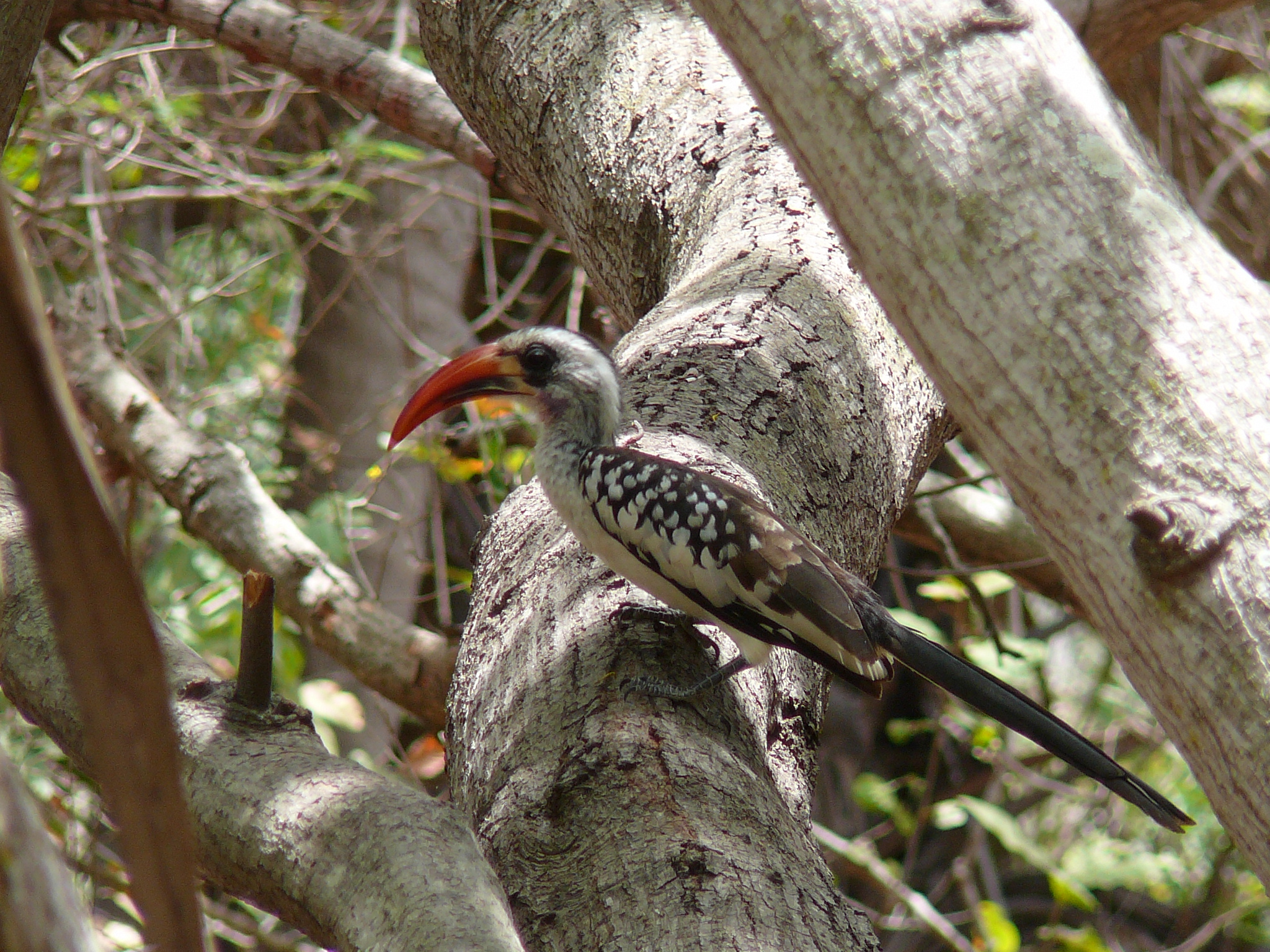
Wow, that was a lot of effort. Let's get back to something easy! Zazu, the only named bird character in the movie (offensive!) is identified as a hornbill in an upcoming musical number by Simba ("Kings don't need advice from little hornbills for a start"). What kind of hornbill is he? The internet seems really convinced that he's a Red-billed Hornbill. This fact is quoted on several zoo webpages (Oregon, Sacramento), Aviary.org, the Disney Wiki, and Zazu's own wikipedia entry. This is good enough for me, but I will register that the Crowned Hornbill might match his color pattern a little better and account for his raised crest. Whatever, you can't argue with the experts.


Speaking of "Just Can't Wait to Be King". This is where we get our Ostrich sequence. There are only two Ostrich-options, the Common Ostrich and the Somali Ostrich. Because this bird doesn't have a prominent blue neck, it's safe to call it the Common Ostrich. This one's easy. Ostrich.

By hyper7pro - Flickr: Vulture, CC BY 2.0, https://commons.wikimedia.org/w/index.php?curid=17194438

Time for another challenge! When fortunes have turned for Simba and he ends up wandering through a mystery desert, he is beset by Vultures. Do we have vulture options? Yes friends, we do. These vultures are drawn in the traditional Disney house-vulture-style, so we're looking for a bald headed bird that is black on top, white from underneath, ideally with a bit of fluff around the neck. I'm going to go with White-headed Vulture- even though they're not totally bald, they do have the best color matching of the options (if you wish to make your own decision, I was also considering Ruppel's Vulture, Lappet-faced Vulture, Hooded Vutlure, and African White-backed Vulture). Please note that Pumba calls these buzzards when he disperses them ("Bowling for Buzzards!"), but that shouldn't change anything about our ID, as he is clearly not even a hobbiest bird watcher.

Left: By Alandmanson - Own work, CC BY-SA 4.0, https://commons.wikimedia.org/w/index.php?curid=52834294
 Right: Me
After this, the action of the movie picks up, and there's largely not time for random birds any more. I know I was hoping for some action during the Hakuna Matata sequence, but no dice. They do appear one more time, right before the end title card pops up. Here Simba stands with Nala and presents his baby to the world, and once again, birds are in attendance. This scene may finally be where I throw in the towel.


As you can see a number of little white birds fly up to circle the young family. If we ZOOM and ENHANCE we can see at least a featured Egret, but the other birds look a lot like white doves, aka. Release Doves, aka. specially bred Rock Doves. And while Africa does have Rock Doves, they probably would not all coincidentally be white. It is theoretically possible that Rafiki went and bought some Release Doves from the magician store as a special treat for this presentation ceremony. If we were gonna go nature, the Emerald Spotted Dove is probably the lightest dove you could get around here. As for the Egret, Cattle Egret is the only choice that makes sense given the yellow-ish feet and beak.

Phew! We did it! And it only took like a whole day that I could've done other things during. Still, my conclusion is that the original animators definitely had really birds in mind when they created this Disney masterpiece, and perhaps most importantly to our core question, I felt they were identifiable. For the most part it's a testament to the expressive and suggestive powers of animation as an art. The original captures the essence of a thing without necessarily needing to recreate it perfectly. My only real gripe would probably be with Zazu, who is way too blue. I wonder if they fixed this in the new Lion King..


Oh! Well there you have it, never mind all that stuff I was saying before. The remake is officially better than the original! Goodnight folks.

Monday, February 25, 2019

Red America Vs. Blue America, Who Has Better Birding?

The year is 2019, the month is any month, and that means it's Politics Season! Yes, that's right, Politics, the thing that we all love to hear and talk about. Take a deep breath, that's politics on the wind. What else is on the wind? Birds of course, which is another thing we all love, except unironically this time. What if birds and politics were... combined? Is there any quicker way to get a bunch of negative comments on my blog? Let's harvest those hate-clicks and talk some politics!

Bald Eagle, also known as "The Politics Bird"
Friends, in our modern era, sometimes it can feel like we live in two different countries, increasingly in our own sectarian bubbles- Red America or Blue America. Sure this is a big problem for us as a culture and has led to increased radicalization and feelings of hopelessness and isolation. But also, it would be fun to pretend those countries were real places, and try to bird in them, right? That's the premise of today's blog, at least. We're going to solve the political debate once and for all by determining which 'side' has the best birding.

METHODOLOGY: I determined which states were Red and Blue by looking at the last 4 elections (conveniently, 2 of which were won by Democrats and 2 by Republicans). If your state voted the same way in all 4 elections it was determined to fall into one of those categories. We want current data, right? So no reason to go back to 1972 or whatever. In terms of the birds, I have to issue a massive thank you once again to the powerful data engine at ebird.org, where most of this information was gleaned from. In order to get combined checklists of specific combinations of states I had the manually 'hack' the URL, because there was no other way to select that many locations at once. I also used the last 16 years of reports for this, to make sure that all the birds being reported were from a state that was the 'right color' at the time the report was made.

Blue America
An unknown politician with a House Finch
Is made up of, in no particular order: Washington, California, Oregon, Hawaii, Minnesota, Illinois, Massachusetts, Rhode Island, Connecticut, New Jersey, Delaware, Maryland, Washington DC, New York, Vermont, New Hampshire, and Maine*

*-Maine, and Nebraska below, have proportional electoral college votes, meaning they can 'split' their votes between both sides. In each case, the state in question has offered exactly 1 (one) electoral college vote to the other side in the past 16 years, so I decided to count them in their respective blocks. You could probably strike both of these states if you wanted to and have it not effect the totals, but go for it if you really wanna crunch the numbers.

The Data
Number of States: 17
Total Square Miles to Bird in: 639,050
Bird Species to be Found: 849
Biggest Contributor: California, with 660 bird species

California Quail, State Bird, California
An impressive showing! You can see around 85% of the United State's approximately 1000 birds in the Liberal States of America. Leading the charge, both politically and birdually is the Amateurnithologist's adoptive home state of California! California has the most bird species of any state in the nation, but honestly it makes sense. Birds flock to California because 1) it's enormous, 2) has a long stretch of coast line, 3) it borders Mexico [always good for species diversity], 4) it's got a tremendous array of climates and habitats, and 5) great quality of life. We also pick up some notable endemic species from Hawaii, America's asterisk.

Red America 
Funny, sure, but you'd be flinching too
Is made up of: Mississippi, Alabama, Georgia, Kentucky, South Carolina, West Virginia, Tennessee, Missouri, Arkansas, Louisiana, Idaho, Utah, Arizona, Montana, Wyoming, North Dakota, South Dakota, Nebraska*, Kansas, Oklahoma, Texas, and Alaska

The Data
Number of States: 22
Square Miles of Birding: 2,281,021
Species of Birds: 888
Heaviest Hitter: Texas, with 640 bird species

Greater Roadrunner, State Bird, Texas
In some ways it's shocking to me that the numbers are so close, but I guess that's to be expected. While Red America dominates in number of states and sheer size, the amount of birds you could potentially tick in each 'country' is really comparable. Still, it's right there in black and white, Red America has more birds. A lot of this has to do with its massive size, but Texas does a lot of the heavy lifting, mostly by (ironic?) virtue of being practically part of Central American. Birds don't know politics, so you'll find plenty of species you'd normally only find in Mexico and south along the border. Alaska also contributes many West Coast, Asian, and Canadian birds that would otherwise be missed.

So there you have it, the case for Red America as the better birding destination


Unless we consider....

Bird Density


So where is it actually better to go birding in? Like, where is the best bang for your buck? Which place is densest with bird species? Well, the numbers below don't lie

Blue State Species/Square Mile .00133
Red State Species/Square Mile .0000417

Because the blue states are so concentrated on the coasts (major flyways), and their states are relatively small, they are much denser with bird species. Sure, if you had unlimited time you might see more birds in Red America, but Blue America is going give you your best odds for a big day.

So one point red, one point blue. Where does that leave us?


Well, not exactly.

Bird Enthusiasm


You see, here at Five-Bird-y-Eight, we've developed an advanced formula to determine bird enthusiasm, which we'll use as our tie-breaker. Our team of bored scientists has taken the number of e-bird lists submitted from these states this year and divided them by the quality of their state birds (using our irrefutable and indispensable State Bird power rankings). The number yielded by this operation makes up the Best Bird Quotient (or BBQ), which is then multiplied by a thousand, to make it a more parsable number.

Red State Bird Enthusiasm: 10.45
Blue State Bird Enthusiasm: 19.45

Texas may have the best in the nation State Bird, but quantity of E-bird lists is what really sealed the deal here, led by extremely enthusiastic California and New York. It turns out that Blue America just cares more about birds, at a nearly 2 to 1 rate, and really, shouldn't that determine the winner?


Ok, ok, ok, one more thing. If you're like me, you're probably wondering how the Independent states fared. Those brave 12 states that go their own way, or, depending on your interpretation, just absolutely cannot figure it out, year after year. Those states have a total of 766 species in them.They boast, if nothing else by far the greatest bird species density per state at an impressive 63.8. Blue comes in at 49.9, Red at 40.36. Wow. I think if there's one thing we learned today, it's that depending on how you look at things, you could make the case that your chosen political bubble is the best one. I'll also point out that the only way you're going to get all the birds in America is by taking it all in, Red, Blue, and all the colors in between. And isn't that a message we could all learn a little something from? Birding-wise, I mean. This is just about birding.


PPS- The Red States are really in trouble if Puerto Rico is granted statehood, since they have 17 endemic species and really high bird diversity (342 species across 3515 square miles). If I were a congressional Democrat, this would be a real priority for me. Again, only for bird reasons.

Wednesday, July 11, 2018

Birding the World Cup Top 4: Our Birld Cup 2018 Exclusive Coverage

Hello sportsfans and birdsfans and welcome to Amateurnithologist's 2018 World Cup Coverage! Are you interested in having a little bit of bird trivia to help you make your top 4 bracket decisions? Good news if so, cause it's my GOOOOOOOOOOOOOOOOOOOAL to provide exactly that to you! Just like we did in 2014, we're going to compare teams based on a number of bird related factors, and then, through a process that combines state-of-the-art techniques from the fields of statistics, ornithology, alchemy, and sociology, determine the likely winner! As you may remember, we have a 100% record of predicting sporting events correctly based on birds, like, probably. So let's get off on the right FOOT and get this BALL rolling.

France


National Bird: Gallic Rooster
Say what you will about the French and their strange choice of national bird- they are strong and consistent in their love and appreciation of chickens. The Gallic Rooster or le coq gaulois, is not only the national bird, but a symbol of the nation itself. The rooster's french phonetic cry, cocorico, is sometimes shouted as an expression of patriotic pride. Think U! S! A! (French people sound off in the comments if you have every made this sound). This rooster love goes way, way back, like to the Middle Ages, and is more than I'm going to get into in a blog ostensibly about the World Cup, but you can check Wikipedia for more detail. Anyway, not only do they have a love of their national bird, it is already tied thematically into sports and football. The French National rugby team uses the coq as it's mascot, and when the World Cup was in France in 1998, the mascot was a rooster named Footix.


The Metrics:
Number of Bird Species: 591
Bird Liking Quotient: 1.629
What would soccer analysis be without reliance on some extremely dubious, but scientific sounding metrics. Here we've taken data from Avibase's Bird Checklists of the World. This number includes all sorts of rarities, introduced species, and migrants, making it hopefully the most optimistic possible number of types of birds you could see there. The bird liking quotient is a little less straightforward, but involves dividing the national population by the number of hits you get when you google "Birding in France". I know that sounds like a crazy way to measure something, but you can't argue with statistics. France, by the way, does pretty well by these metrics, being 2nd in bird diversity and 3rd in birding enthusiasm

The X-factors:
J. G. Keulemans, 1885

Endemic Species? Corsican Nuthatch, Corsican Finch
Best Birding Spot? Corsica obvs
The French island of Corsica has to be a lock for best place to go birding, since it has two species you'll find nowhere else in the world, along with a host of other rarities. The Mediterranean island gives you a good chance for a whole variety of seabirds, along with a bunch of others. France has put up a strong showing and is clearly the country to beat.

Belgium
Andreas Trepte, c/o Wikipedia

National Bird: Common Kestrel
Don't let the name fool you, this bird is anything but common. Closely related to your beloved friend, the American Kestrel, this bird is a master hunter of stealth and agility. The Kestrel has long been associated with prowess in battle and mastery of aerial combat. If you still don't know who this bird is maybe you'd prefer his latin name, which translates to Screeching Sickle, or his alternate names Eurasian Kestrel, Windhover, Windcuffer, or something even ruder that won't be making an appearance on this family-friendly blog.

The Metrics:
Number of Bird Species: 457
BLQ: 3.427

An impressive BLQ cannot hide a subpar number of birds for Belgium, leaving the relatively small nation at a disadvantage. What if we corrected for nation size by even more bird math? Dividing number of recorded bird species by area, we come up with a metric France scores .0024 while Belgium gets a much more respectable .0388 (the highest number among the competitors). We'll call this number Bird Species Density, of BSD.

The X-factors:
photo by Natuurpunt
Endemic Species? Nope
Best Place to Go Birding? Groenwaecke Polders
The first line of the first website hit by a google search was "Belgium is probably not the best country for birding" Thanks for the honesty, fatbirder.com, but that means it's not looking good for the underdogs and their delicious waffles. There are some choice spots though, including a shipping port that hosts the largest tern colonies in Western Europe. I'm going to go with Groenwaecke Polders, however, since in winter it attracts tens of thousands of pink-footed and white-fronted geese, along with a who's who of other European birds. I'd check it out for sure, if I was in Belgium.

Croatia
Carlos Delgado c/o Wikipedia
National Bird: Common Nightingale
So no, this is not a particularly interesting looking bird, but it is famous. The Nightingale's melancholy song has been described as one of the most beautiful sounds in nature, and this has given it prominence in a whole variety of classical art, literature, and poetry. An artist's bird, Shakespeare, Keats, and Shelley all had poems comparing the artist to the nightingale, and vise-versa. Even Beethoven got in on the act, mimicking the birds call with flutes in his Pastoral Symphony. The Nightingale appears on the Croatian 1 Kuna coin, making it analogous to America's positioning of Abraham Lincoln. A pretty great bird, but can it SPORTS?

The Metrics:
Number of Bird Species: 408
BLQ: 5.155
BSD: .0187

With the mightiest BLQ we've seen so far, and an impressive BSD, Croatia presents itself as a plucky challenger to it's competitors. Still, that's not a lotta birds. Let's see if Croatia can offer anything to make up for that deficit.

The X-factors:


Endemic Species? Nah
Best Place to Go Birding? The Lastovo Archipelago
Unlike Belgium, there seems to be a fair amount of info about birding Croatia on the internet- perhaps Croatia is in an active push to attract nature-based tourism in a way that Belgium isn't. Either way, CroatiaBirding.hr describes it as an 'emerging birding destination', and I'm inclined to believe them. The country's unique shape means that is has land in the mountains and a long stretch of Adriatic Sea coastline. It's also within both the central and western European migration corridor, leading to an unusual diversity of birds. The unique geographical features mean that Croatia is home to 78 endangered bird species, more than any other small or medium sized European country. Again I'll quote the Fat Birder "undoubtedly one of the pearls of European birding". If I had to pick one spot, it would be the Lastovo Archipelago, which houses the unique colonies unique in Europe of Yelkouan Shearwaters and Eleonoras Falcons.

England

Emmanuel Douzery c/o Wikipedia
National Bird: European Robin
My antipathy for the American Robin is well known by this point, but I just can't feel the same way about this little guy. What a cutie! A classic and classy choice for national bird for sure, and seems to capture the English character. One quibble- with Brexit looming, will a bird with 'European' in the name still be allowed in the country? The Robin is a prominent figure in folklore, and British folklore specifically (a good sign for a national bird). A couple great folkloric theories about the Robin's red breast- it sang into Jesus' ear to comfort him as he was up on the cross and was thus stained with his blood OR the Robin was bringing water to souls suffering in purgatory and his breast was singed. The Robin sure is metal in these conceptions. He is the symbol of several English and Welsh football clubs, so you know he's got experience.

The Metrics:
Number of Bird Species: 628
BLQ: 1.828
BSD: .007

The number of bird species just crushes here, and may be a deciding factor for England (which, for the purposes of these calculations, includes the greater United Kingdom). The BLQ and BSD are both higher than the other top 4 birding (and football) powerhouse France's are, but they still aren't close to the enthusiasm and sheer bird density seen in the smaller countries.

The X-factors:

Richard Crossley c/o Wikipedia (this picture was too wild not to use, sorry to your eyes)
Endemic Species? Scottish Crossbill
Best Place to Go Birding? Isle of Rum
Here again you can see the inherent advantage in birding that the UK gets for being a series of relatively widely spread island nations. If Scottland was an independent nation, we wouldn't even be having this conversation right now. Regardless of how England acquired it, the existence of an endemic species is a real leg up in the competition. While there are many great birds to be found across the varying islands of the UK (including Puffins in Northern Ireland!), I'm going to give it to the Isle of Rum, where you can find the White-tailed Eagle, a magnificent bird of prey even larger than the Golden Eagle (which you can also find there). The islands are also home to an insane number of Manx Shearwaters.

Alright, so that should be everything you need to figure out exactly how the final four will play out! Wait, you wanted ME to do the predicting? Fine, fine, let me just run all those numbers through the Football9000 Supercomputer

Beep Boop Borp

and here we go, the order of finish in the 2018 World Cup, based EXCLUSIVELY on bird data

1. England
2. France
3. Croatia
4. Belgium

Congratulations to England on it's victory (the Puffins pushed it over the top by .02%). The calculations were so close, however, that if England doesn't technically include Scottland, Wales, and Northern Ireland, it falls all the way to third place, behind Croatia. So it would look like

1. France
2. Croatia
3. England
4. Belgium

Of course we could also see a fluctuation in France's place in the standings, depending on whether or not the Island of Corsica should really count as France.It'd be an upset but we could be looking at

1. Croatia
2. France
3. England
4. Belgium

Well, with that definitively settled, we offer our congratulations to either England or France or Croatia, great job in the 2018 Birld Cup!