Showing posts with label Sandpipers. Show all posts

Friday, September 4, 2026

Eurasian Oystercatcher//Eurasian Whimbrel

We got a double header for you fine folks today, really back at it and firing on all cylinders. Today's birds have a theme, and you're only likely to detect it if you're a real bird sicko. See if you can figure it out, but if you want spoilers, you can scroll right to the end to the 'lessons learned' section.


Eurasian Oystercatcher aka. European Oystercatcher aka. Common Pied Oystercatcher aka. Sea Pie (historic) (Icelandic -Tjaldur)
Þingvellir National Park, Þingvellir, Iceland
Member of the Oystercatcher Family
★National Bird of the Faroe Islands★
§A Parcel of Oystercatchers§

~True Bird Fact~ This bird's joining the good-parents-club, and not just because she's pictured above with baby. In fact, Oystercatchers are lifetime monogamous and they're a long-lived bird, so that can mean a 40 year commitment. Both male and female birds contribute to the defense of the nest. They take a two pronged approach of attacking flying predators by air, and distracting or leading away ground predators. This can look like trying to lure the attacker away by taking short flights, making loud calls, or even pretending to be injured.


Eurasian Whimbrel aka. White Rumped Whimbrel (historic) (Icelandic - Spói)
Þingvellir National Park, Þingvellir, Iceland
Member of the Sandpiper Family
§A Curfew of Whimbrels§

~True Bird Fact~ In an exciting and unexpected twist (for me), the Whimbrel seems to be a pretty important bird in Iceland. This is a migratory bird, which spends it's summers in Iceland (and winters in West Africa). As such, it's heavily associated with Spring and the arrival of warmer weather, which, as you might imagine, is a pretty big deal for Icelanders. They go so far as to call his cry the sound of the summer, and even have a name for it, Vell. There's a whole system around this call that icelanders use (used?) to predict the weather, so it's considered something of a 'fortune teller bird' there. There's also a charming saying that I'm going to attempt to work into my own life, "The whimbrel sings porridge" ("Spóinn syngur graut"), which means 'warm weather is coming'. Wish me luck in that endeavor.


So what is it that we were supposed to learn today? Well, aside from a surprising amount about Whimbrels, the lesson here is 'always take a picture of a boring looking bird you've seen a million times when you're in a new place'. I had 100% assumed that these were my traditional American Black Oystercatcher and Hudsonian Whimbrel (a bird I've certainly seen and photographed, but surprisingly never blogged). But I took a picture anyway, because 'what if?', and I was right! The Whimbrel I didn't even really bother to get a 'good' picture of. So anyway, the moral here is 'it counts anyway' even if you've seen a nearly identical bird before. Pump up those life lists people.

And for edification purposes, the difference between the Back Oystercatcher and the Eurasian is.. (waiting for you to check the other blog and report back)


The eye color! Incredible stuff.

As for the whimbrel? All in the rump, specifically, whether it's white or brown. Ok,  so maybe they weren't that identical after all, but they were to my tired eyes.

Sunday, May 2, 2021

Least Sandpiper


Least Sandpiper
Clipper Yacht Harbor, Sausalito, California, USA
January 2021
Member of the Sandpiper and Pharalope Family
§A Time Step of Sandpipers§ (?)
★The Smallest Shorebird★ (always nice when the name is accurate)

~True Bird Fact~ What more do you want they're the world's smallest shorebird? About the size of a sparrow, weighing less than an ounce! Ok, fine, they also are impressive migrators, traveling about 2000 miles over the ocean without stopping between their winter and summer homes.
No thoughts
No desires
Just serene stillness of mind

Sunday, October 18, 2020

Good Birds, Bad Pics: Mono Lake Edition

 Hello bird fans! As you might have known from my Grouse Grousing last month, I recently took a trip to Mono Lake. It was a wonderful trip, but to be honest, not as bird-bountiful as I might've wanted. It was a little early to catch the big migrations, but still, it's away from home, and that means new birds. Just not, like, a lot of new birds. And certainly not cooperative new birds. So below I present to you some of the finds that I'm happiest about having seen, even if I didn't exactly nail it in the picture department. These days it feels like the busy amateur birder should feel pretty good about having even tried, right?

Clark's Nutcracker
Mono Lake County Park, Lee Vining, California, USA
July 2020
Member of the Crows and Jays Family
§A Jar of Nutcrackers§ (the other ones are worse)

~True Bird Fact~ Yup, he's named after That Clark, of Lewis and Clark fame. I'm not going to do a naturalist profile in this one. I just did one of those. Go read about how birds shouldn't be named after these guys anyway.

Picture Crime: Far away, in shadow. Basically you can barely see it well enough to ID.

Wilson's Phalarope
Mono Lake Tufa State Natural Preserve, Lee Vining, California, USA
July 2020
Member of the Sandpipers and Phalaropes Family
§A Dopping of Phalaropes§
★The Largest Phalaropes★ (of...3)

[Etymology Corner] Phalarope, that's a weird word, huh? It comes from the Latin name of the bird, and it breaks down to mean Coot-footed. So this bird is named after having lobed feet, similar to a coot. Ironically, this member of the Phalarope genus actually doesn't even have the lobed feet. Pretty messed up that the birds have similar feet but one is named after the other. If only the cards had been dealt a different way, perhaps the coot would've been named Phalarope-footed (but this would cause a time paradox, unfortunately). 

~True Bird Fact~ Unlike most birds, the female is the dominant member of the species. She is larger, more colorful, and males watch the nest while she is out finding more partners. Girlboss!

Picture Crime: Far away, in a group, breeding plumage appears to have not quite come all the way in yet. Other birds nearby confuse me and make me less confident in my ID. They could be juveniles, non-breeding birds, or even non-breeding Red-necked Phalaropes.

Brewer's Sparrow
Gem Lake Trail, June Lake, California, USA
July 2020
Member of the American Sparrows Family
§A Ubiquity of Sparrows§

~Interesting Bird Facts?~ None. Hey, it's named after that same guy from Brewer's Blackbird. That's something, I guess.

Picture Crime: Obstructed behind a branch. Slightly out of focus. Sparrow, so, inherently boring. I already forgot which one it is. 

Well, thanks for slogging through those medium pictures. Still, it's 3 birds I didn't know before, and sort of know now. See you next time when we get into some of the birds I got slightly better shots of.

Sunday, June 25, 2017

Dunlin


Dunlin
Hayward Regional Shorelines, Hayward, California, USA
April 2017
Member of the Sandpiper Family
§A Trip of Dunlins§


{Etymology Corner} Derives from 'dun' the color, which is a dull, greyish brownish number. It's basically a name that means 'boring-colored'. There are way, way drabber shorebirds than this, so I don't know what they*'re on about.

*- The 'They' of the previous sentence refers to the international bird-naming consortium.


~true bird fact~ The Dunlin is a very successful shorebird and has a mind-boggling range that most other birds could only dream of. He can be found on most shorelines around the Northern Hemisphere, making him a very common bird. Take a look for yourself! Still, he was one your amatuernithologist hadn't quite 'gotten' until he did this blog. If you, dear reader, are looking to up your Dunlin-Identifying game know that he has a distinctive black belly-patch and reddish back, but only in summer. The real trick is the slightly droopy bill that makes him look a bit sad or melty. He is, apparently, a good one to learn to ID other shorebirds by.


A bit 'judgy' of shorebirds who haven't traveled as much as him. Not everyone has that much disposable income, Dunlin
Long periods of inaction, followed by bursts of manic productivity
Still acts like a young adult despite being well into adulthood. This is a problem that could get worse with time
Thinks he can just tell what's true and what isn't by gut instinct, but honestly doesn't have that good of a radar


Thursday, April 14, 2016

Hermosa Beach Bird Pics + Marbled Godwit


Hey there Fanateurnithologists (fanateurnithologists is what fans of this website call themselves). It's been a while since I did a miscellaneous bird picture post, or a trip report, so I thought I'd combine them into one handy blog. Unlike many past birding destinations, today's locale is not a wildlife sanctuary or park or anything like that. Just a place I had the pleasure of spending a few hours at a little while ago. And like any birder on the road, I used that time to take pictures... of birds. Without further ado- Hermosa Beach.


Marbled Godwit (this guy has never had his own profile?? How incredibly disrespectful of me, let's fix that now)
Hermosa Beach, California, USA
February 2016
Member of the Sandpiper Family
§A Prayer of Godwits§


~true bird fact~ Many birds will flee their nest when approached, but these guys are so protective of their eggs that you can often walk right up to them and pick em' up. The amateurnithologist would recommend against you doing this, as it is a real jerk move.

Not afraid to get his hands dirty
Gets his sense of meaning from his work life
Uncomplaining
Believes in the afterlife


Foreground: Royal Tern (originally incorrectly identified as Elegant Tern, but with assistance from @TheBirdist on Twitter, this correct ID was made. Evidently, Elegant's bills are thinner. Very tough birds to ID)
Idealistic

Background: Ring-billed Gull
Dull


Sanderling
Temperamental


Foreground: Heerman's Gull 
World-weary
 
Background: Western Gull
Avaricious

Thursday, October 15, 2015

Birds in Motion (by the Ocean)

Going with a much more picture heavy format today, amateurnitholofans. You see, I have all these birds pictures that I like, that don't really fall into the categories I've established for this blog. They're not really good enough to be portraiture, or I've already explored the bird in question. However, I think a lot of these are really great moments worth sharing. Today they all share a theme of exploring the ways in which birds move. All photos taken in Santa Cruz, California, USA in September of 2015.

Brown Pelican Quatrych (surveying, diving, takeoff, rising)


Brewers Blackbird- fix up, look sharp


Elegant Tern - hate to see you leave


Sooty Shearwater -  going someplace


Whimbrel - beak uses


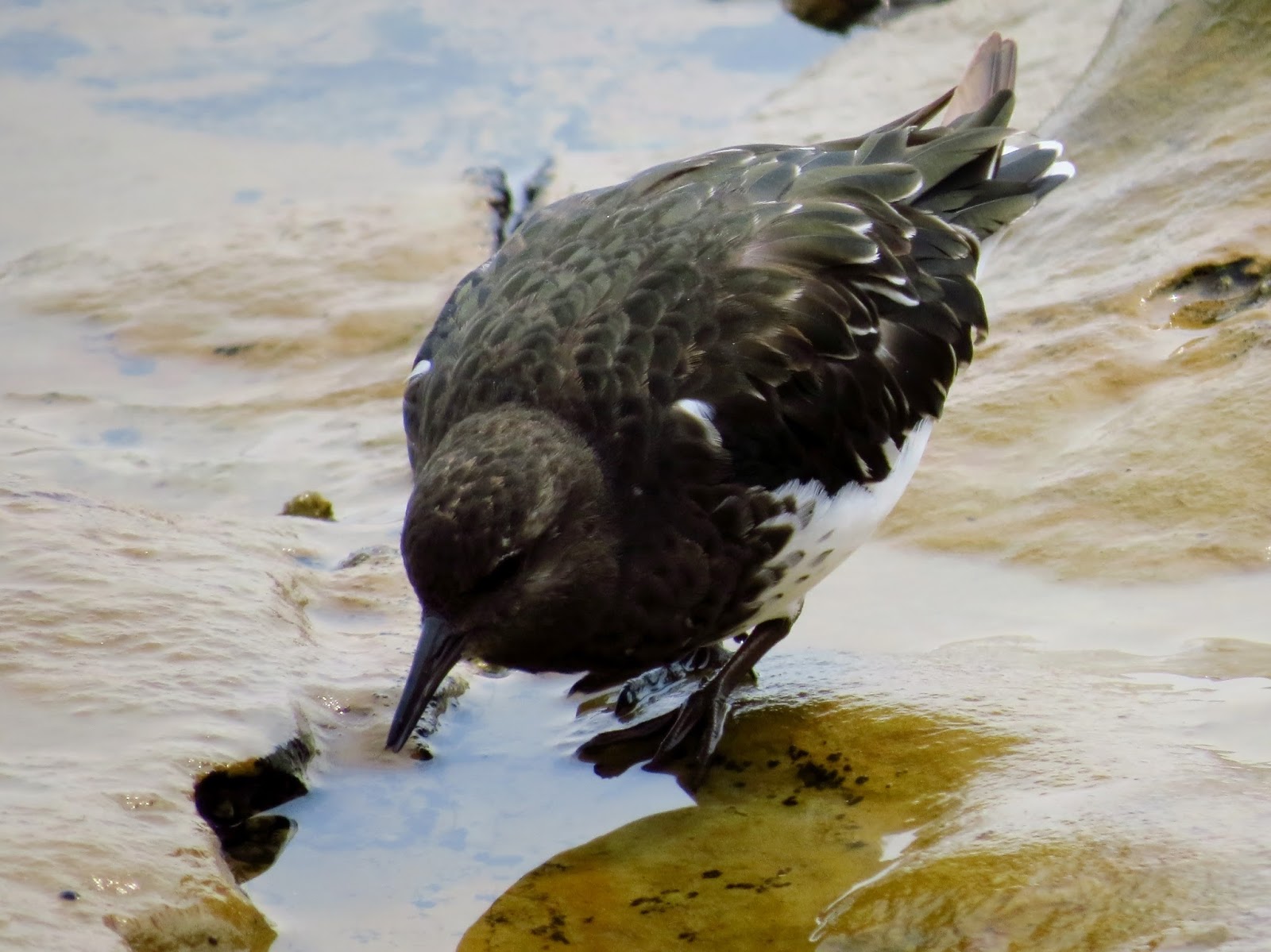
Black Turnstone- bad water, good water

Thursday, September 17, 2015

Black Turnstone


Black Turnstone
Natural Bridges State Beach, Santa Cruz, California, USA
September 2015
Member of the Sandpiper Family
§A Bind of Sandpipers§

{Etymology Corner} This is a very good name, since this bird hunts by using his unusually shaped beak (ed. note- it doesn't look that unusual to me..) to turn over stones. Also, it is a black bird. You almost couldn't do any better, but I'm a little disappointed he can't petrify things like a gorgon. 9/10


 ~true bird fact~ Females in a breeding pair often leave after just two weeks, leaving remaining parenting responsibilities to the father. It's hard being a single dad, especially when you inexplicably lack the ability to turn predators to stone.


Affectless
Cool as a cucumber
Wouldn't be comfortable relaxing or taking a day off
Doesn't often explain her actions


Thursday, December 11, 2014

Elsie Roemer Bird Sanctuary

Let's be frank, your amateurnithologist is in over his head here. I never realized how difficult shorebirds could be until I visited the Elsie Roemer Bird Sanctuary in beautiful Alameda, California. They are pretty much innumerable here.

That's a lotta birds. But not only that, dear reader, that's a lotta different types of birds.


When I visited, back in October, I kind of assumed I had see probably 4 or 5 different species of shorebirds. Once I started doing my research, I wasn't so sure. According to very reliable sources at ebird.com, the Else Roemer Bird Sanctuary is home to no less than 147 species of birds. What??? I didn't even know there were that many birds.

Rather than attempt to profile all of them now, I'll share a few that I saw and share my current best guess. Did I egregiously mislabel a bird? Sound off in the comments! I promise I won't get mad at you.

Marbled Godwit
pragmatic


Elegant Tern (center)

OR Caspian Tern OR Royal Tern (distinguished based on size of tern and color of bill. But who knows, life is uncertain)
Jocular


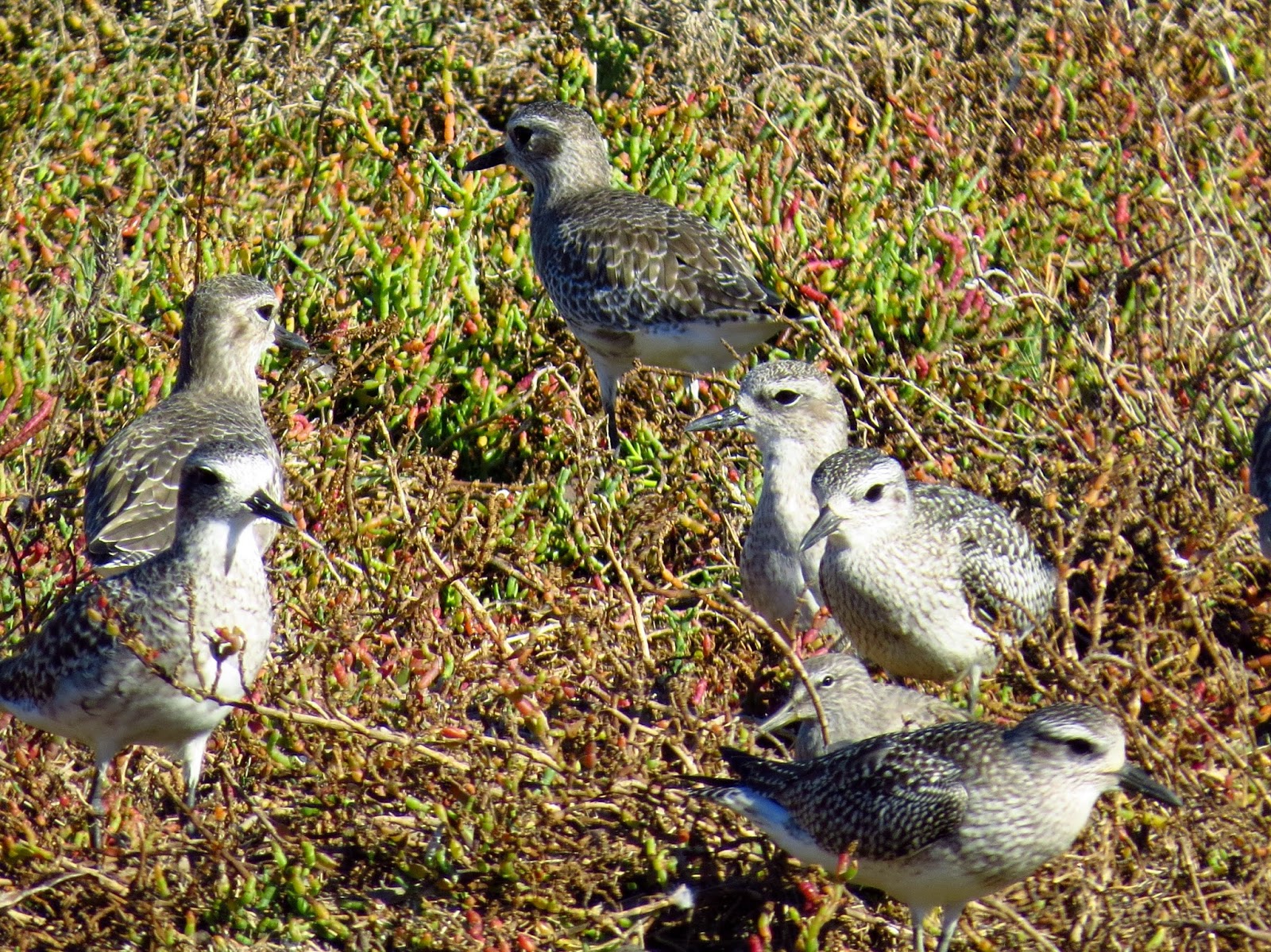
Black-bellied Plover
OR Pacific Golden Plover (could be really anything, apparently distinguishable by his "white rump", but your amateurnithologist is dubious)
Constantly looks annoyed, even when not

Also spotted at the sanctuary were our old friends
Long-billed Curlew (aka. Candlestick Bird)
Willet (ft. above in 2nd picture along with godwits)
Black Phoebe
& Snowy Egret
Among probably many others

We attempt to capture the utter bird chaos with the follow .gif

By the way, this bird sanctuary is named after a local conservationist, best known for her efforts to preserve the San Francisco Bay's natural salt marsh habitat, which was being drained and developed at a breakneck pace in her time. Her park now provides shelter for, the aforementioned 147 birds, including endangered species like Heerman's Gull and the California Clapper Rail, which is kind the ultimate reward for a fighter for birds, I suppose.

Tuesday, November 25, 2014

Long-billed Curlew

Long-billed Curlew aka. Sicklebird aka. Candlestick Bird
Cambria, California, USA
Member of the Sandpiper Family
★Largest Shorebird in North America★
★Largest Bill of Any Shorebird★
§A Skein of Curlews§

~true bird fact~ This is an especially interesting one for me, your amateurnithologist, as a San Francisco Bay Area emigree. Candlestick Point was named for these birds, which once lived there in the thousands. By the time Candlestick Park (home of the Giants) was completed, the birds were all but extinct in the area. In fact, they were so overhunted (and have such a restricted range) that they were once considered Near Threatened by the IUCN. Happily Curlews have made something of a comeback in the last 50 years or so.


Would decorate her home with a lot of native art
Thinks a long time before speaking. Goes 'hmmmmmm'
Smiles when being spoken to
Introduces you to new foods and teas

Wednesday, November 5, 2014

Sanderling


Sanderling
Oceano Dunes Natural Preserve, Oceano, California, USA
Member of the Sandpiper Family
§A Grain of Sanderlings§

~true bird fact~ Sanderlings are one of those extremely long distance migrators. They only breed in the high-arctic tundra, but they spend the winter in a variety of southern locales. Some travel as many as 6000 miles in a season to winter in sunny South America. You gotta go what you gotta do!

Tax dodger
Cares first and foremost about taking care of his friends
Thinks his nonsense is way funnier than it actually is
People are secretly intimidated by his bad temper, but no one is willing to bring it up, so he doesn't even know it's a problem

Tuesday, December 10, 2013

Totally Different Birds: Greater Yellowlegs vs. Willet

Greater Yellowlegs
Berkeley, California, USA
Member of the Sandpiper Family

~true bird fact~ Greater Yellowlegs are notoriously understudied by scientists because they generally live in such inhospitable, mosquito-ridden, and generally unpleasant-to-hang-out-in places. Yup, that's all it takes.

Idiosyncratic taste in music and movies (likes things that are really trash)
Says "woop! woop!" over and over again. No one knows why.
Has his own ideas about morality, which may be confusing to some, but are at least internally consistent
Lives this way because he wants to, not because he must

Willet
Berkeley, California, USA
Member of the Sandpiper Family
Is into scrapbooking now

You remember Willet, don't you? Our very own third bird portraiture subject. My how far we've come, in terms of photography at least. Anyway, your Amateurnithologist was taking a walk at the Berkeley Marina and took what he believed was a nice picture of our friend Willet. Cause you can't have too many pictures of birds, right?

On a whim, I decided to check if there were any other birds that looked like a Willet, and found out about Sir Yellowlegs up there. Care to take a guess about the only visible difference between a Willet and a Greater Yellowlegs? I am left to what has become my mantra of bird identification lately- "always get good light on the feet." So there I was with a new bird to feature on the blog, but I felt like I would be remiss to not tell this story and to point out the at-times ridiculously minor differences that separate one bird from another. I mean really, it's like one of those 'can you spot 5 differences?' puzzles for children. This is what I see as one of the major barriers to entry into the hobby and we here at your bird blog want to do our best to normalize your birding experiences. At amateurnithologist "we're dumb too" is our motto.

Any pair of birds that make me say "C'mon! That is SO not a different bird!" will get featured in this way. Thanks for tuning in birdfans and til' next week- may all your birds be noticeably different looking.

Sunday, April 22, 2012

Bird Portraiture Series #3 of X, Western Willet


Western Willet
Berkeley, California, USA
member of the Sandpiper Family
*true bird fact* ~ If you startle a Willet it will probably spread its wings and squawk at you, rather than flying away like most birds would. How brave!

Fastidious, likes to keep things in order
Something of an amateur philosopher
A picky eater; you can't take him anywhere
Patient
Can and will do jigsaw puzzles given enough time