Sunday, March 31, 2019

Black Scoter


Black Scoter aka. Common Scoter
Richmond Marina, Richmond, California, USA
January 2019
Member of the Ducks, Geese, and Swans Family
§A Flush of Ducks§

[Etymology Corner] Common Scoter is a little bit of an archaic name, but it's also grossly inaccurate, since this is the least common of the three North American scoters. The Eastern Hemisphere version of this duck is still called that over there. I bet you thought I was going to tell you where the word 'Scoter' came from here, but nope. There doesn't seem to be any explanation of the origin out there, it's just a word that's used for this genus of sea ducks.

~True Bird Fact~ In France, Roman Catholics were allowed by their church to eat this bird on Fridays (on which you normally can't eat non-fish meats). The reasoning is that they have a 'fishy' taste to them, which raises some questions for me about what Catholics thought makes something a fish, and also makes me even less likely to eat this duck.

Another quote I saw a lot while researching this bird was a description of his call as a 'constant mellow, plaintive whistling', so to me that says that this bird has a real Jeff Bridges vibe, and I don't think any more personality speculation is needed.


How Endangered Are They? Well, not that endangered. They are considered near-threatened by the IUCN with a global population between 350,000 and half a million. However, their population is slowly declining, and they are threatened by oil and gas drilling, as well as climate change. So something to watch out for, at the very least.

Thursday, March 14, 2019

Ruby-crowned Kinglet


Ruby-crowned Kinglet
Nisenan Tribute Site, Nevada City, California, USA
February 2019
Member of the Kinglet Family
§A Princedom of Kinglets§

[Etymology Corner] So, who exactly thought to name this bird (and his accompanying family) Kinglet? It's in the scientific name too, the latin name, Regulidae, literally translates to 'little king'. This is not because of a regal quality that this bird has (unlike kingbirds), but because of the physical trait of the colorful crest the adult birds of this family share. You can see the crest on this guy, just barely, here. It looks like someone drew a little line on his head with a highlighter. They do get more dramatic than this and flare up, when the bird is either courting or defending territory.

~True Bird Fact~ The Ruby-crowned Kinglet lays an enormous clutch of eggs for such a small bird- up to 12! And although they are admittedly really small eggs, taken together, they can add up to the weight of the female bird herself.

Likes fiddly little hand puzzles, like Jacob's Ladders or Rubik's Cubes
Has a nerd voice (you know what I mean)
Has petitioned, without success to get the -let removed from the end of his name. Embarrassed by this

Monday, February 25, 2019

Red America Vs. Blue America, Who Has Better Birding?

The year is 2019, the month is any month, and that means it's Politics Season! Yes, that's right, Politics, the thing that we all love to hear and talk about. Take a deep breath, that's politics on the wind. What else is on the wind? Birds of course, which is another thing we all love, except unironically this time. What if birds and politics were... combined? Is there any quicker way to get a bunch of negative comments on my blog? Let's harvest those hate-clicks and talk some politics!

Bald Eagle, also known as "The Politics Bird"
Friends, in our modern era, sometimes it can feel like we live in two different countries, increasingly in our own sectarian bubbles- Red America or Blue America. Sure this is a big problem for us as a culture and has led to increased radicalization and feelings of hopelessness and isolation. But also, it would be fun to pretend those countries were real places, and try to bird in them, right? That's the premise of today's blog, at least. We're going to solve the political debate once and for all by determining which 'side' has the best birding.

METHODOLOGY: I determined which states were Red and Blue by looking at the last 4 elections (conveniently, 2 of which were won by Democrats and 2 by Republicans). If your state voted the same way in all 4 elections it was determined to fall into one of those categories. We want current data, right? So no reason to go back to 1972 or whatever. In terms of the birds, I have to issue a massive thank you once again to the powerful data engine at ebird.org, where most of this information was gleaned from. In order to get combined checklists of specific combinations of states I had the manually 'hack' the URL, because there was no other way to select that many locations at once. I also used the last 16 years of reports for this, to make sure that all the birds being reported were from a state that was the 'right color' at the time the report was made.

Blue America
An unknown politician with a House Finch
Is made up of, in no particular order: Washington, California, Oregon, Hawaii, Minnesota, Illinois, Massachusetts, Rhode Island, Connecticut, New Jersey, Delaware, Maryland, Washington DC, New York, Vermont, New Hampshire, and Maine*

*-Maine, and Nebraska below, have proportional electoral college votes, meaning they can 'split' their votes between both sides. In each case, the state in question has offered exactly 1 (one) electoral college vote to the other side in the past 16 years, so I decided to count them in their respective blocks. You could probably strike both of these states if you wanted to and have it not effect the totals, but go for it if you really wanna crunch the numbers.

The Data
Number of States: 17
Total Square Miles to Bird in: 639,050
Bird Species to be Found: 849
Biggest Contributor: California, with 660 bird species

California Quail, State Bird, California
An impressive showing! You can see around 85% of the United State's approximately 1000 birds in the Liberal States of America. Leading the charge, both politically and birdually is the Amateurnithologist's adoptive home state of California! California has the most bird species of any state in the nation, but honestly it makes sense. Birds flock to California because 1) it's enormous, 2) has a long stretch of coast line, 3) it borders Mexico [always good for species diversity], 4) it's got a tremendous array of climates and habitats, and 5) great quality of life. We also pick up some notable endemic species from Hawaii, America's asterisk.

Red America 
Funny, sure, but you'd be flinching too
Is made up of: Mississippi, Alabama, Georgia, Kentucky, South Carolina, West Virginia, Tennessee, Missouri, Arkansas, Louisiana, Idaho, Utah, Arizona, Montana, Wyoming, North Dakota, South Dakota, Nebraska*, Kansas, Oklahoma, Texas, and Alaska

The Data
Number of States: 22
Square Miles of Birding: 2,281,021
Species of Birds: 888
Heaviest Hitter: Texas, with 640 bird species

Greater Roadrunner, State Bird, Texas
In some ways it's shocking to me that the numbers are so close, but I guess that's to be expected. While Red America dominates in number of states and sheer size, the amount of birds you could potentially tick in each 'country' is really comparable. Still, it's right there in black and white, Red America has more birds. A lot of this has to do with its massive size, but Texas does a lot of the heavy lifting, mostly by (ironic?) virtue of being practically part of Central American. Birds don't know politics, so you'll find plenty of species you'd normally only find in Mexico and south along the border. Alaska also contributes many West Coast, Asian, and Canadian birds that would otherwise be missed.

So there you have it, the case for Red America as the better birding destination


Unless we consider....

Bird Density


So where is it actually better to go birding in? Like, where is the best bang for your buck? Which place is densest with bird species? Well, the numbers below don't lie

Blue State Species/Square Mile .00133
Red State Species/Square Mile .0000417

Because the blue states are so concentrated on the coasts (major flyways), and their states are relatively small, they are much denser with bird species. Sure, if you had unlimited time you might see more birds in Red America, but Blue America is going give you your best odds for a big day.

So one point red, one point blue. Where does that leave us?


Well, not exactly.

Bird Enthusiasm


You see, here at Five-Bird-y-Eight, we've developed an advanced formula to determine bird enthusiasm, which we'll use as our tie-breaker. Our team of bored scientists has taken the number of e-bird lists submitted from these states this year and divided them by the quality of their state birds (using our irrefutable and indispensable State Bird power rankings). The number yielded by this operation makes up the Best Bird Quotient (or BBQ), which is then multiplied by a thousand, to make it a more parsable number.

Red State Bird Enthusiasm: 10.45
Blue State Bird Enthusiasm: 19.45

Texas may have the best in the nation State Bird, but quantity of E-bird lists is what really sealed the deal here, led by extremely enthusiastic California and New York. It turns out that Blue America just cares more about birds, at a nearly 2 to 1 rate, and really, shouldn't that determine the winner?


Ok, ok, ok, one more thing. If you're like me, you're probably wondering how the Independent states fared. Those brave 12 states that go their own way, or, depending on your interpretation, just absolutely cannot figure it out, year after year. Those states have a total of 766 species in them.They boast, if nothing else by far the greatest bird species density per state at an impressive 63.8. Blue comes in at 49.9, Red at 40.36. Wow. I think if there's one thing we learned today, it's that depending on how you look at things, you could make the case that your chosen political bubble is the best one. I'll also point out that the only way you're going to get all the birds in America is by taking it all in, Red, Blue, and all the colors in between. And isn't that a message we could all learn a little something from? Birding-wise, I mean. This is just about birding.


PPS- The Red States are really in trouble if Puerto Rico is granted statehood, since they have 17 endemic species and really high bird diversity (342 species across 3515 square miles). If I were a congressional Democrat, this would be a real priority for me. Again, only for bird reasons.

Saturday, January 26, 2019

For Owl'd Lang Syne: The 2018 Birding Year in Review

Happy New Year!
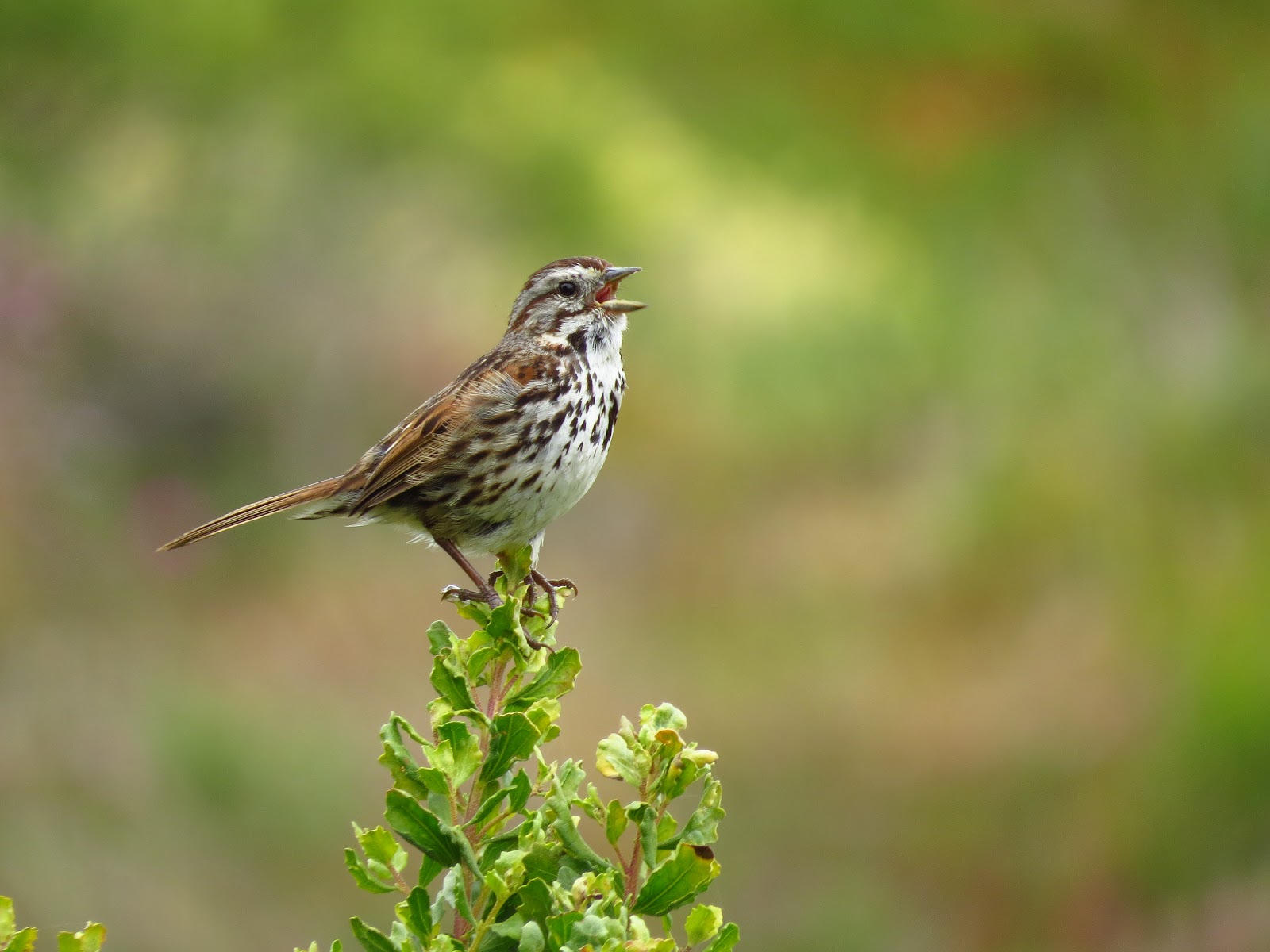
Song Sparrow
 It may be almost February in the rest of the world, but here on bird blog we're still processing the events (and birds) of 2018. That's right, it's time for the hotly anticipated annual 'year in review' post, now with less to review than ever before! But fewer blog posts doesn't necessarily make a not-as-good blog, as we'll hopefully see today.

American Robin

To start with, let's crunch some numbers. To start with, it should probably be acknowledged that only 26 posts were made last year, about half of the average from previous years. What happened? Well, I had a baby, and looking at the number of posts, you can probably tell precisely when. I talked a little bit about fatherhood on my first post-baby blog on the Nanday Parakeet, but my baby has been (shockingly) a slightly higher priority than birds these last few months.

Above: A Rock Wren, the first bird I got a good picture of while having a baby strapped to me
That's not to say we're looking at a permanent dip in blog productivity (or blogductivity [of blogducktivity, when I'm blogging about ducks specifically). I think we'll get better, in the coming year, and maybe get this bad boy back up to bi-weekly.

Great Egret

Birding Highlights 2018

But enough about boring stuff like new human life and having a complete shift of self and perspective, let's talk about the birds! Undoubtedly the highlight of my birding year was a trip down to LA and the nearby Channel Islands National Park. Did I see the Island Scrub Jay? Yes I did, and it was a peak birding experience for me that probably non-bird-people will not understand. Can't see this little guy anywhere else. That's where many of my most exciting birds came from this year, although there were also some cool leftovers from my November 2017 trip to Mexico that didn't get posted until this year.

Double-crested Cormorant

The most popular blog of the year was without a doubt the marginally topical If Birds Were Tracks on Kanye's College Drop Out, followed pretty quickly by the extremely nonsense-filled Bird Cup/World Cup Prediction post (spookily accurate though!) Another favorite of mine was the interest-combining The Birdchelor, which imagined birds as The Bachelor contestants. Did I perhaps cause someone to start a new twitter account with my constant #birdingthebachelor tweets or was it just fortuitous timing? We'll probably never know.

House Finch, my vote for 'bird most likely to be confused for something interesting on first glance'


The exciting thing about these blogs, which were some of my favorites of the year, is that they were ambitious and funny, and crucially did not rely heavily on me having good pictures of new birds. I talked about this last year a little, but it's been harder to find unique birds locally, and my travel perspectives are only looking more restrictive. These posts give me an ideal way forward, and I already have my idea for the next two posts of 2019. Also filed to good news is that the blog actually appears to be getting (slightly) (gradually) more popular, with each post getting a good deal more hits on average than in previous years. Shocking, but nice to see.

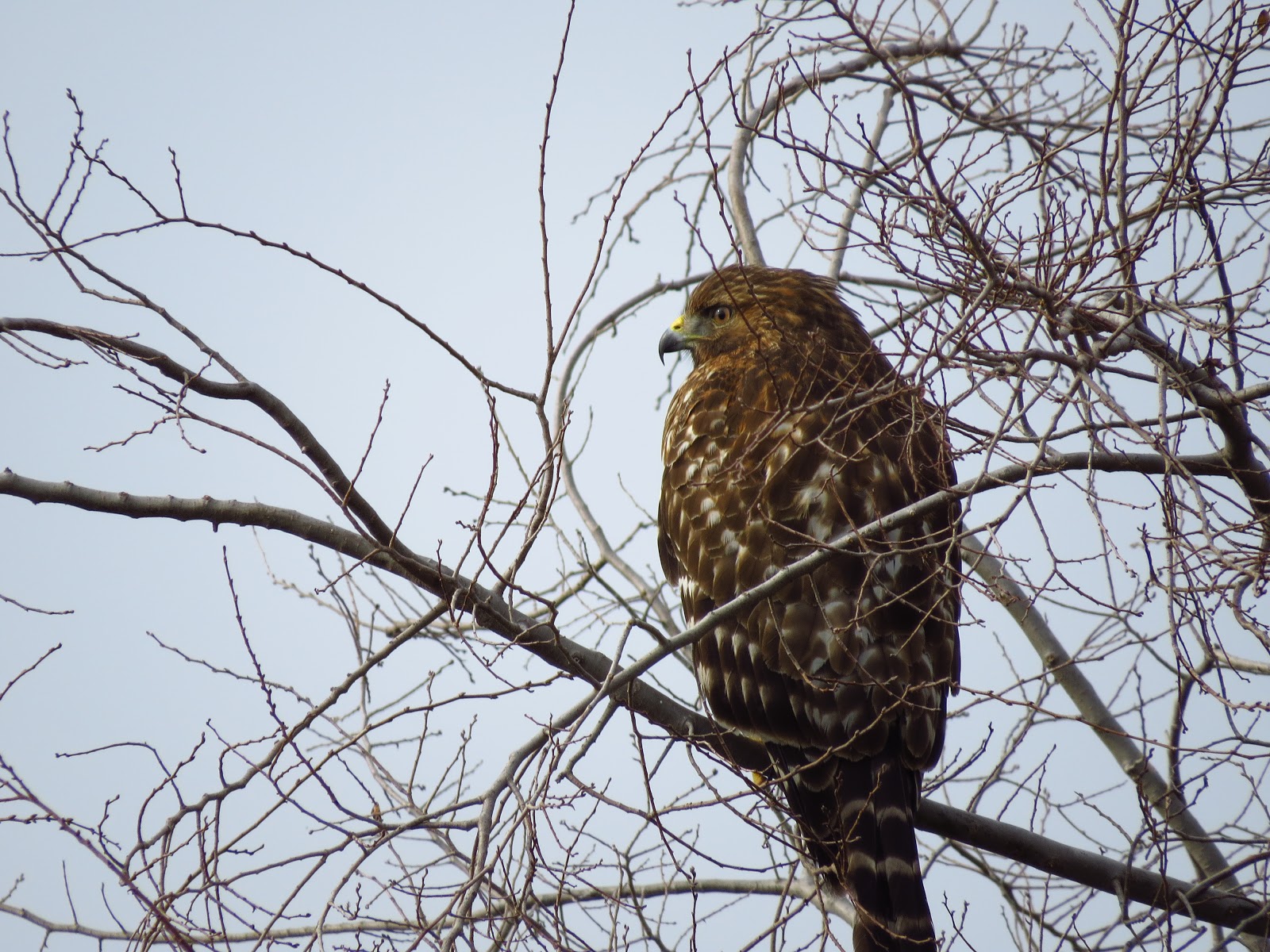
Red-shouldered Hawk (?Probably?)

What else do we do on this year review thing? Uhhh, pictures! Yes, those! I like my Wrentit pictures, which is a challenging bird to photograph, and took quite a lot of patience to get. I also was excited to get the Bullock's Oriole shot at Mount Burdall, which quickly joined Wetlands Edge as one of my favorite local birding spots. That's where a lot of the photos that accompany this essay are from, by the way. Wood Duck was good too. Some of my best pictures were in those Birdchelor and Kanye posts, actually, since they didn't have the restriction of needing to be pictures of new birds.

White-tailed Kite


Birding Resolutions

Lastly, let's talk resolutions. I'll start by saying I'm glad I set the bar really low for myself last year. The resolutions, in case you don't want to click the link, were 'find a new schedule that works for my changing life', and 'bird local'. And honestly, I think I kinda did both, sort of. Like, given the circumstances. For 2018 I give my self a B- for Effort! So what do I want to do this year?

American Kestrel


Well, as I've been alluding to, I want to get back up to 1. 2 posts per month, eventually. And for my other goal, let's try to 2. recommit to filling in the more common birds from my area that I still haven't posted here year. It's gonna mean squinting at some photos of gulls and sparrows, but I figure I'll have to do the work eventually. Jen Sanford has been making some really interesting points on Instagram (which I'm still not on) on the value and ethics of birding close to home, and I might try to go into it with that attitude (although maybe I'll go with more like a 20 mile radius). And I think that'll do it. Anything more ambitious would just be hubris.... although... I do really want to try and get that Snail Kite when I go to visit family in Florida this year. A blogger can dream, after all.

American Crow

See you all next month!