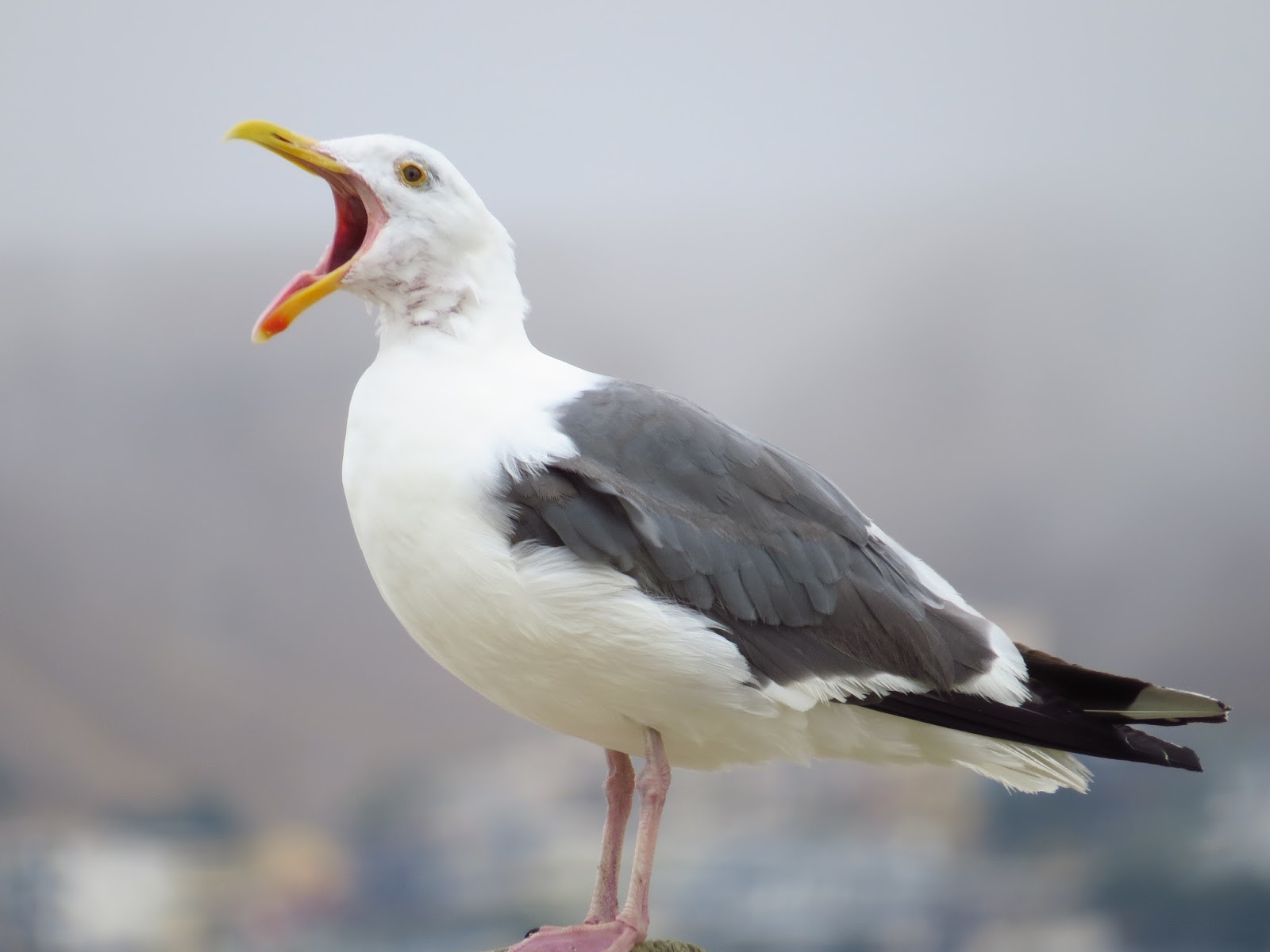
Showing posts with label Gulls. Show all posts

Sunday, May 11, 2014

It's a Very Special Mother's day Bird Blog

Happy Mothbirds day! No, not some kind of combination of moths and birds (aka. hummingbirds). Today is mother's day, celebration of all things momish. Human moms, like the one that your amateurnithologist has, and bird moms. Let's take a look at some birdmoms and bird babies in honor of this special day. This one's for you mom (aka. the Momateurnithologist, aka. Amateurnimomlogist, aka. Momateurnimomlogist).
 Baby Canada Goose (aka. Gosling) & Mom (background)
~true mom fact~ Why do Canada Geese love grassy lawns so much? Well, two reasons- number one, they can eat grass (unlike many other birds) and two, they like to build their nests in wide open, unobstructed places. This lets them see threats coming from a long way away. Young goslings often stay with their family for an entire year.

The type of mom who will have a really hard time moving on when the kids are no longer at home
 Baby Seagull (no one knows what kind) & Mom (very unofficial guess is Herring Gull)
~true mom fact~ Feeding a baby gull is exhausting work. Mom and dad alike work in shifts, feeding the baby gull up to half a pound of food a day, day and night for 12 weeks. The mother gull has already lost much calcium and protein by this point, so she must alter her diet by eating a lot of invertebrates and fish.

The type of mom who doesn't let childbearing slow her down. She'll be posting gym selfies within a week of giving birth.
Baby Mallard Duckling & Mom
~true mom fact~ rather than leaving her nest to gather lining material, the malard mom plucks feathers from her own breast to line the nest and cover her eggs. A selfless mom.

A 'cool' mom who wants to do a lot of stuff with her kids

Tuesday, March 18, 2014

8 Tips to Take your Amateur Birding Game to the Next Level that They Don't Want you to Know. You Won't Believe Number 6!

Today it is our second anniversary on amateurnithologist dot blogspot dot com. While we proudly maintain our amateur status, after two years of looking at birds, it is safe to say we've learned a lot. Are you an armchair birder too? Here are some of the things we've learned along the way. Maybe you'll find something helpful here too.


1. We are all Time's Subjects
By this I mean get to know what different times of the day mean for birding. Most people probably know already that close to dawn is when birds are most easily observed. "The early bird gets the early bird", as the old saying goes. However, late afternoon can be just as rewarding of a time to go birding, and a much less annoying one to be awake during. I recommend the last hour and a half or so before sunset. Your mileage may vary for different birds. Try going on the same hike a few times during different times of the day and making observations about what you see.

2. Become a Seasoned Birding Expert
I also recommend that you start paying attention to seasons. You might think you've seen all the birds a local spot has to offer, but if you just went in fall, you're going to miss out on all the spring birds. Little know fact: birds fly around, and live in different places, you know? There should be a word for this behavior. Another assumption is that birding is most profitable during the Spring, but because birds migrate in lots of different directions it's really worth it to look year round. Your chilly lake may be just the right temperature for a bird who summers in the arctic.

3. Learn the Hot Birding Spots in your Area, but Don't Ignore Everywhere Else
Where do birds live? The answer is basically everywhere. Birding starts in your own neighborhood, on your city streets, in the drainage pool behind the mall. Some of the rarest bird's I've seen have just been spotted wandering around residential neighborhoods or college campuses. While ebird.com's got a great database of birding hotspots that I can't recommend enough, it's also important to do some looking on your own. One general tip about birds: bodies of water are always a great place to start.

4. Hurry Up and Do Nothing
Our most exciting sounding tip yet! While the hobbies of birding and hiking intersect, there is a key difference in goal and generally in pace. When you walk through a park looking for birds, make it a leisurely stroll. Observing your environment carefully, rather than giving it the casual once-over, will increase the number of birds you see dramatically. Found a nice spot where you can hear some birdsong? Stop and sit a while. Relax. Birds will appreciate you more if you're a chill dude or lady.
5. Go by Yourself (or with Very Laid-Back People)
Let's face it, birding is not an inherently social activity. Maybe a group of birders can pull this one off, but if you plan on going someplace mainly to look at birds, and you're inviting some of the uninitiated, you'd better give some fair warning. Either your friends are going to get super bored while you stare at some bird and take a million pictures of it, or the bird is going to fly away and you will secretly resent them for breathing too loud. Anyway, one of the greatest pleasures of this hobby (to me at least) is peace and space to think that you can get from a little bit of solitude.

6. Think Like a Bird
Does a bird want you to point at it and shout? Probably not, right? My frequent walking partner, N, can always tell I've spotted a really neat bird because I go completely quiet. If a bird is flying away from you, don't pursue it. It can be hard to ignore this impulse, but you have to be willing to let the birds come to you. When a bird really wants to be photographed, he'll come by and pose for you. You just have to wait for the right moment. Another part of this tip is to be logical in where you are looking for birds. Birds of prey often hang out on the unobstructed branches of tall trees or telephone poles because those are the best places to spot prey from. If you never look up there, you'll never see one.
7. Preparation is 9/10ths of the Bird
This is probably a tip only for people as dumb as your amateurnithologist, but don't forget all your stuff at home. A shameful number of times I've brought my camera with me, but accidentally left the memory card at home, or neglected to charge the batteries. It can also be a good idea to take your birding stuff with you even when you aren't planning on spotting a bird, because sometimes they just show up. Lately I've noticed a family of Orioles at my work and started bringing my camera with me, just in case I get a good opportunity to take a picture. Ancillary tip: Don't leave expensive looking birding equipment in your car. Ever.


8. Be Patient with Yourself
This tip won't necessarily help you bird better, but it'll prevent you from birding burnout (or birdout, as it's known in the community). I can still remember the first time I successfully identified a bird without the use of a guide. That was less than 3 years ago, and just this past weekend I was walking along the bay shore and was impressed by just how many of the birds I recognized immediately. You have to be willing to give yourself time to grow and improve, and be aware that you're going to make a lot of mistakes at the beginning. Unless you really cram and study (and who wants to do that) you're going to remain an amateur for some time. And that's great. Remember, we are all on this amateurnithological journey together. And you know what they say about the journey and the destination. For the bird blog, this is A., signing off.

Tuesday, October 22, 2013

Birds dot gif: Seagulls Sip


Gulls. Graceful, straightforward, with just a little bit of melancholy to them. Wonderful birds. And yet your amateurnithologist begins to feel a sense of dread whenever he tries to blog about them. They are, simply put, ridiculously difficult to ID correctly. For me, at least. Using this absurd flowchart (from a website published in the year 2000!) and google image search, I have come to the conclusion that today's Gulls are Western Gulls, which I've already written about, all the way back in blog post 3.

But what's this? It seems I identified that previous gull as a Pacific Gull. Pacific, Western.. synonymous really. Except one of them lives in Australia. Oops. Add to this embarrassment that the blog in question was already about how I had probably misidentified an earlier Gull and you have the makings of a real debacle (debirdcle?)

Call today's blog post a new beginning. I still don't feel like someone who can actually identify gulls, but that isn't going to stop me from posting them. Let's catch up with our old friend, The Western Gull, and see how he's doing.

Hard times have fallen on Western Gull's extended family and he recently has had a brother, his mother, and his brothers kids move in with him, making for a cramped and tense living situation. Somehow Western Gull is coping with the chaos. He likes the busy atmosphere and finds it harder to fall into a negative cycle with so many people around.

Oh.. and if you want to see the full video:
http://www.youtube.com/watch?v=g0r5AnQFTz0&feature=youtu.be

Tuesday, August 20, 2013

AAAAAAAAAAAA

 AAAAAaaaaaaaaaaAAAAAAAAAaaaaaaa
 UUUUUUUUUUUuuuu
 EEEEHHHHHHHHHHK
 HYEEEEEEEHHHHHH
 ZRRRRRRRRRRRRRRRRP
AAAAAAAAAAAAAAAAAAAAAA

Thursday, December 6, 2012

Hey Man, Nice Bird: Heermann's Gull

Before we move on to today's bird, a brief peek behind the scenes of the workings of Amateurnithologist dot blogspot dot com. The way we, the Amateurnithologist, work, is we take nice pictures of birds, and then do our best to identify them later. The resource we use for this generally has been spectacular webpage whatbird.com, which has a remarkable bird identifier tool. When your amateurnithologist cannot find a bird using this, it generally means the bird in question is something worth looking into. Like perhaps the bird he is of an unusual coloration (non-breeding season, juvenile, female). Or the bird is not really considered a species at all. Or the bird is uncommon enough that it doesn't come up in searches as a likely result. Such was the case with today's bird, who your bird blogger had to identify through a thrifty combination of google image match and wikipedia. Prepare yourself for Amateurnithologist's second ever (semi) endangered bird:
Heermann's Gull
Pacific Grove, California, USA
Member of the Gull Family
*~true bird fact~ He gets a lot of his food by means of piracy, mainly stealing fish from Brown Pelicans and California Sea Lions (!) This means he is brave, or maybe a jerk. Perhaps both.
How Rare is He? Estimates are that there are about 300,000 individuals. Which sounds like a lot until you hear that 90% of them live on a small Island called Isla Rasa in the Gulf of California, and that they breed nowhere else in the world. They are classified as Near Threatened, but are expected to be ok, unless something drastic changes.

Exotic and Impressive, like a foreign street performer
Never had much formal education
Seldom troubled by the problems of the world
A bird to call if you need some dirty work done
Kind of reminds you of a ninja, actually

Wednesday, October 10, 2012

Birds.gif: Seagull Stomp


You better just click on this
The video that this striking .gif image comes from was taken long before the amateurnithologist had a nice camera or was indeed an amateurnithologist at all. Identifying him is hard with quality this low, but current bet is that he is a Herring Gull, most common gull in Scotland (where this video was taken). This odd and enticing behavior is likely intended to draw worms or other insects out of the ground (perhaps by mimicking the sound of rain), but it's all speculation at this point.


And just for fun..

Oh yeah, and bird blog is back, act like you know

Sunday, March 25, 2012

Apologies and Retractions: Gulls and feet

Bird Blog regrets to inform you that, in our journalistic zeal, we may have misidentified a Pacific Gull as a Yellow-footed Gull
 THE GULL IN QUESTION

As you can see from the above picture, the feet are of dubious color. After reviewing our records, we at Amateurnithologist are divided as to the color of this gull's feet. To be honest, our intrepid photographer was not really aware of the importance that the color of feet have when gull-identifying, and certainly would have made sure to get some more light on the feet, had he known. The whole staff here at Bird Blog are deeply sorrowful over any confusion or consternation we may have caused the bird-picture-looking-at community. As a means of apology, we present another bird portrait, this time of a bird that is most assuredly a Pacific Gull. Is this the same sort of bird as the one pictured above? You, faithful readers, make the call.
Pacific Gull
Alcatraz Island, San Francisco Bay, California, USA
member of the Gull family
*true bird fact* ~ He is entirely different than Yellow-Footed Gull

Contemptfull of people, but justifiably so
Has an active family life, works hard for his kids
Humorless
Enjoys swooping and gliding. A flying expert.

Sunday, March 18, 2012

Bird Portraiture Series #1 of X,Yellow-Footed Gull

Yellow-Footed Gull
Berkeley, California, USA
member of the Gull family
Likes junk food, especially popcorn
Likes nautical people
Enjoys dreary, grey weather
Has a love-hate relationship with Dolphins