Showing posts with label Seasonal Birds. Show all posts

Saturday, December 23, 2017

Bird Ornament Detective

Happy Holidays nerds! One of the nicest things about the holiday season for your amateurnithologist is the prominent placement of birds in decoration and festive embellishment around this time of year. Whether they're adorning your Christmas Tree, Hanukkah Bush, or your Kwanzaa Kinora, these birds embody the spirit of peace and love the holidays are meant to represent.

But what are they though? A question only asked by the most compulsive of birders, sure, but one still worth considering, at least academically. Could a bird ornament be IDed? It turns out there's a lot of variety in how much veracity these ornaments have. The core philosophies of creation seem to range from extremely intentional recreation of a specific species to "make a bird". Today we're going to be looking at a couple of examples. Pull a cozy chair up to the fireplace and sip your hot cocoa as you join us for this pedantic holiday exercise.

As a fun bonus we're going to be running the very impressive Merlin Bird ID app through its paces to see if it can offer any additional insights beyond my own arcane system.

Key Features: Drab coloration, rufous crown, brown streak across chest, sparrow-shaped
Best Guess: Bachman's SparrowMerlin says:  Brown Thrasher
illustrated images copyright whatbird.com

I feel it's clear they were going for a certain type of bird at least, but how much further they went than that is anybody's guess. There are a few defining features that could be used for identification, but sadly most of them rule out real birds. The yellow eye is most damning, but the small black beak also doesn't help. At this point it's worth noting that many bird ornaments don't have feet, but rather flexible wires, which to my knowledge is not consistent with any known bird species. Still, the red crown and brown streaked breast make me fairly confident of my identification. This raises another question however- why would anyone make an ornament that looks like a Bachman's Sparrow?
Ornament Rating: 🐦🐦🐦

Key Features: Prominent red coloration, black features including crown, chest, eye stripe [left]
Yellow head, black, curved bill, blue wing spot [right]
Best Guesses: Cardinal [left] Yellow-headed Blackbird [right]
Merlin Says: Northern Red Bishop [left] Yellow-throated Toucan [right]


Terrible, just terrible, in both cases. The red bird, to me, is clearly meant to represent a Cardinal (the crest really gives it away), a really Christmas-y bird. However, it's got these needless features that make it completely incompatible with any real bird. If you were already 90% of the way to making a serviceable cardinal, why would you make a black crest and eye stripe? The other bird is just as bad, having a combination of colors and body shape that make it mostly impossible. The most prominent feature is the yellow head and dark body, which rules out pretty much everything other than the Yellow-headed blackbird all by itself. You could be extremely generous and assume that the blue wing is a kind of opalescent sheen that you can sometimes seen on black birds. I did find some examples of budgies with yellow heads and blue bodies, but the tail and beak take this too far away from the essential shape of the bird to be what they intended.
Ornament Ratings: 🐦 (each scored half a bird, together they get 1)

Key Features: Owl shape, prominent white mask, black eye ring, dark wings
Best Guess: Northern Saw-whet Owl
Merlin Says: Northern Saw-whet Owl (We got one!!)
"What if Bratz, but an Owl" a criticism of this ornament (which may or may not be a promotional item from the ill-fated owl adventure, Guardians of Ga'hoole) might go. But then you remember that a Northern Saw-Whet Owl is actually a thing, and that this looks almost exactly like it. While I'm not fully convinced that they thought they were making anything other than a cute owl, this ornament gets high marks for accuracy. Needs a little more streaking and a lighter breast, but the face is pretty darn close.
Ornament Ratings: 🐦🐦🐦🐦

Key Features:  Bluish back, yellow belly, white eye mask, upturned tail
Best Guess: Blue Tit 
Merlin says: Bananaquit (?!)

Blue Tit Body Illustration
This is really close, in my opinion, to a real Chickadee or Nuthatch of some type. The only issue is really the shape of the white eye mask. The shape of the bird is just right, and for the most part the colors are all within throwing distance of the real thing. In fact the ornament's so detailed that I'm almost feeling like my ID is the problem, and there's some real bird that looks just like this.
Ornament Ratings:🐦🐦🐦🐦

Key Features: Silvery-grey, prominent tuft, black beak, darker wing
Best Guess: Black-crested Titmouse
Merlin Says: Black-crested Titmouse!

Apologies for the very bad photo, call this one a #worstbirdornamentpic. To be honest, this ornament is just about perfect. The only criticism that I'd make is that as a group of birds, the titmouse family is not particularly distinctive, with really only the crest and overall shape being what clues me in.
Ornament Ratings:🐦🐦🐦🐦

Key Features: White, crested, black ring around the neck, spotted wings, striped tail
Best Guess: Leucistic Bluejay
Merlin Says: Mourning Dove

This is undeniably a leucistic Bluejay, and was clearly made either by someone with an obsessive knowledge of birds or someone who was trying to make a bluejay, but ran out of blue dye. That black necklace really is what gives it away. Either way, a brilliant post-modern deconstruction of our ideas about the bird ornament genre.
Ornament Ratings:🐦🐦🐦🐦🐦

There you have it birdfans. Now you have all the example you need for how to irritate your friends and relatives by flailingly 'identifying' the birds hanging on your own tree at Christmastime. And I was pretty impressed by Merlin as well, although it's got a long way to go before I can start using it to identify pokemon and stuff.

Saturday, December 24, 2016

Could you Bird the 12 Days of Christmas?

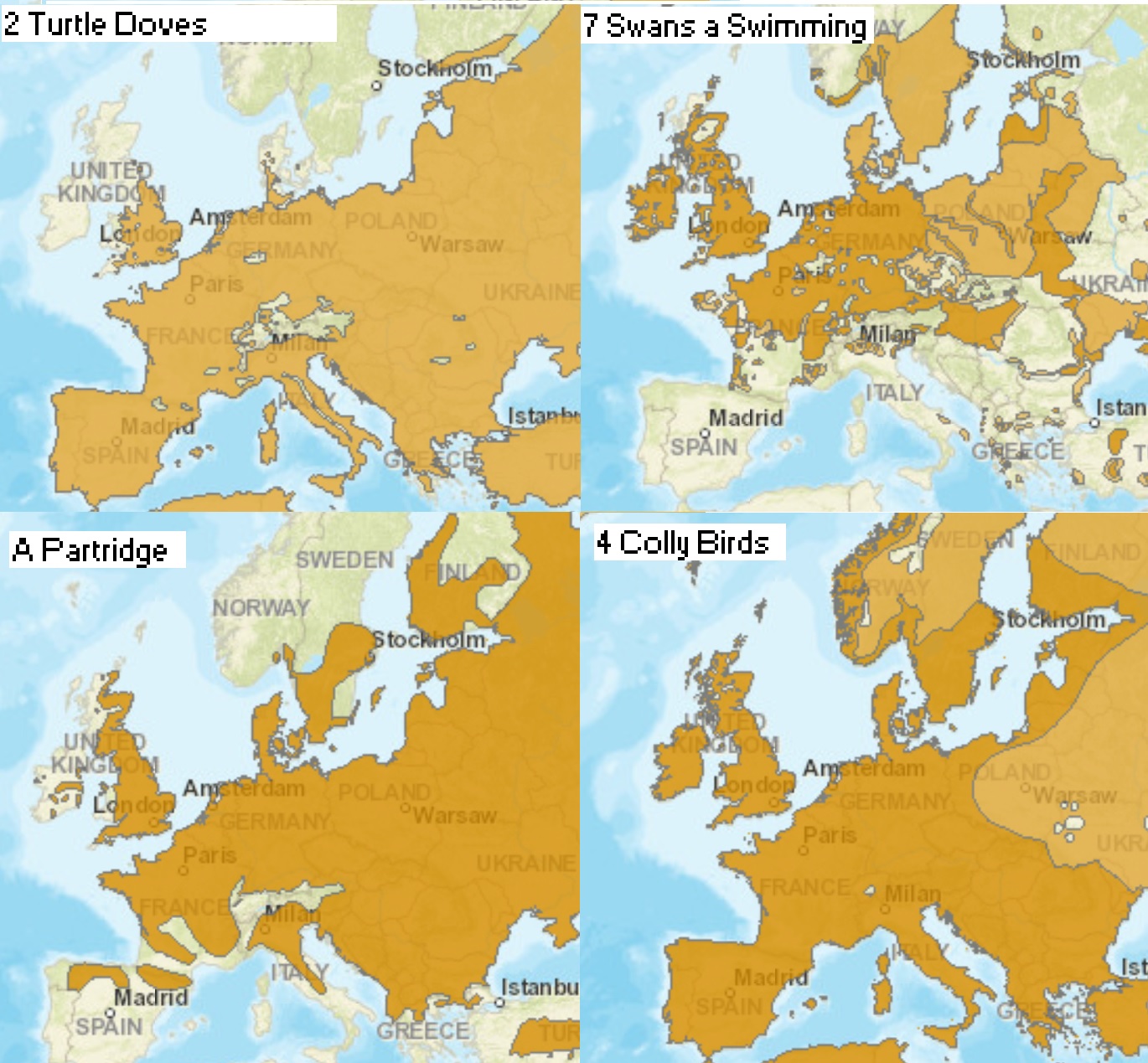
It's always been an interesting quirk to me that the 12 Days of Christmas (abbreviated hereafter as Xmas, in line with personal tradition) is so bird-heavy. I mean, aside from those rings (the real thing everyone wants), it's all birds or weird performers. I don't know how I would even deal with eleven pipers piping at me. But anyway, I think it's a fairly short leap from that realization to wondering how likely it is to actually see all those birds oneself. At least for birders, who are naturally competitive and achievement-oriented types. So could you or I get all those birds? And if so, where? Could we do it on Xmas? We're going to attempt to answer that question today. First, let's define our birds.

Seven Swans a Swimming


We don't have a lot to work with here as far as identifying the swans, since all we know about them is that they're swimming, which all swans do. Fortunately, there are basically only 6 types of swans: Black, Black-necked, Mute, Trumpeter, Whooper, and Tundra. Swans can live most places, but they aren't generally equatorial birds, meaning we can eliminate the most of the Mediterranean, Middle East, and Central America. Furthermore, you are unlikely to be able to complete the Xmas birding challenge if you are in Africa. We've made some progress, but that's still a lot of ground to cover.

Six Geese a Laying


These are probably domestic Geese, since they are given the designation of 'laying'. Unfortunately, this means they could be almost anywhere. Fortunately, this means it should be pretty easy to find 6 of them. While I will generally try to only count birds in their native habitat, even this degree of nit-picking will not help up, since Geese occur naturally almost everywhere. The consensus best goose for laying is the China Goose, so maybe we're talking about Asia here. Let's keep going.

Four Cally Birds


Yes, I said 'cally birds'. I am assured by multiple internet sources that these aren't 'calling' birds as I have always assumed. And we might finally have our big break in the case, since a Cally Bird is unambiguously an anachronistic name for a member of the Thrush family called (ironically) the Common Blackbird. Coal-y bird. Get it? Anyway, they're native to most of Europe and have a sizable population in Southeast Australia and New Zealand. Now we're getting somewhere!

Three French Hens


Sigh, another domestic bird.. You can find domestic female chickens that originated in France anywhere in the world, as evidenced by this handy list of French Chicken Breeds. But let me make a supposition here. Would you really call it a French Hen if you were in France? Like, in that case, it would just be a Hen, right? Not the strongest evidence, but it could be a tie-breaker.

Two Turtle Doves

pictured above: Not a Turtle Dove (a Collared Dove)
Turtle Doves. Finally, someone has something specific to say. While Turtle Dove can sometimes refer to the whole family of Collared Doves, there's not a reason to be broad when what we want is specificity. There are 4 birds with Turtle Dove in their name, and fortunately 3 of them are ruled out by their ranges. Our also-rans, by the way, are the Oriental Turtle Dove (most of Asia), Dusky Turtle Dove and Adamawa Turtle Dove (both African). The one we're looking for is the European Turtle Dove. They live throughout Europe in fairly high numbers, as long as you don't go too far north.

A Partridge


Oh god, there are 56 types of partridge. They live on grasslands throughout Eurasia, and I've been able to verify that you're going to find partridges just about anywhere we've already got on our shortlist. Between the Grey and Red-legged varieties, you'll be able to find a partridge anywhere in Europe.

The Pear Tree


Finding the partridge in a pear tree might be a little more difficult, but pears grow just about everywhere we're already considering. If you really want to play the odds though, you'll want to go to Spain, Italy, Belgium, The Netherlands, or Austria. These are the big pear-producing regions of
Europe.


So could you bird all the birds in the 12 Days of Xmas? It seems like you definitely could, as long as you live in Central Europe (or even parts of Turkey). However, given that the origin of this Xmas carol is 1780's England and France, we can confirm that you could do this birding challenge in the song's country of origin. If you really want to maximize your odds, we can combine our pear data with our bird data, and come to the conclusion that Belgium is your best bet. Big shout-outs to the IUCN Red List website for its unparalleled animal range data. Merry Xmas everyone, and may all your presents be bird-related again.

Thursday, November 24, 2016

Revisiting the Turkey


My first portrait of a Turkey is from very early on in this blog's lifetime, 2012 to be exact. Back then I described the Turkey as a haughty blowhard and an awful dinner guest. I still sort of feel this way, and get the sense that I'm not alone in my interpretation of the bird. Why is the Turkey a disliked bird? Maybe it's that many people have had personal negative experiences with Turkeys (being attacked by them is not uncommon in some parts of America). Maybe we need to malign them to separate ourselves from the guilt we feel (subliminally or consciously) for farming them and eating them. Maybe we resent them for encroaching on human territory in an unapologetic and successful way (we also treat pigeons with scorn for doing the same). Today I'm going to focus on a different, more positive interpretation of the Turkey- with some Turkey quotes from my favorite website and yours, backyardchickens.com


"i have a tom who just follows me around like a puppy and he is the nicest turkey ever."

"i got a red bourbon hen about a month ago at auction and she is so sweet she doesnt exactly run up to you she just kind of stays out of your way but she will sit there and talk to you."

"Pros: sweet, docile, and good looking
Cons: none"

"never actually flogged me"

"We named all of our turkeys this year for dragons, so his name, due to respiratory issues, is Puff the Magic"

"In the video is my Royal Palm tom, Gerald, walking in his harness and leash. I have taken him to the pet store, to 4-H meetings and just down the road. Very friendly and easily trained to do about anything." 

And if that's not enough to convince you to take a second look at your Turkey bias, maybe a quote from one of our nation's founders will. Benjamin Franklin's  antipathy toward the Bald Eagle is well documented on this blog, as is his preference for the Turkey. Here is his justification from a letter to his daughter.

There you have it bird fans, if Ben Franklin can love the Turkey for its positive qualities, maybe we can learn to as well. With a perspective, The Amateurnithologist. Happy Thanksgiving everyone.

Saturday, October 29, 2016

5 Crow .gifs for all your Ominous Portension Needs

Boo! Spooked you didn't I? No, not with my 'boo', but you were spooked that your beloved bird blog website (this one) hadn't posted any killer Halloween content yet. Don't worry reader, the website has not been a ghost the whole time, it's alive and well. But at this time of the year it's more like.. undead. That's why we're back at you for the annual spooktacular with some haunted bird .gifs. This year we're focusing on the most dreaded of birds, the crow. Never mind this writer's love of the corvid family, there's nothing we can do for them now, for they've been forever symbologised in pop-culture as signs of misfortune, death, and disaster. Today we present five examples from recent(ish) film in convenient .gif form.
Beetlejuice (1988)
Suggested use: Reaction .gif for negative birding experiences
Jurassic World (2015)
Suggested use: 1) For any conversation that turns to dinosaurs being related to birds 2) Any time you want to say the phrase 'putting my foot down'
Mad Max: Fury Road (2015)
Suggested use: Road trips
Pirates of the Caribbean: Dead Man's Chest (2006)
Suggested use: To show displeasure when someone wakes you up too early or texts you at a time when you're sleeping
Snow White and the Huntsman (2012)
Suggested use: 1) When you're feeling like a style icon 2) A triumphant 'haters can't stop me' moment

Do with these .gifs what you will, dear reader. However, be warned that townsfolk whisper that these .gifs are cursed. MWAHAHAHAHahahahaha ha ha ha

Friday, October 30, 2015

6 Spooky Bird gifs for your Halloween

Think of a creature spookier than a bird. It can't be done, right? Well, directors of horror and suspense have known this for a long time. Images of birds in film are often a stand in for death, doom, and despair. Today we bring you 6 fiendish examples to chill your blood on this, the spookiest of holidays. Use em' on your facebook or play em' at your halloween party. Whatever, I'm not gonna tell you how to live your life.


No discussion of cinematic bird scares would be complete without The Birds. This is probably the only time a movie has actually made people fear our feathered friends, and you can see why in this climactic final attack scene.

I also love this scene from True Detective, in which a mysterious murmuration mystifies Matthew Mcconaughey. Is it a hallucinatory flashback or a sign of potentially supernatural involvement?

Crows and ravens usually get the lions share of the horror bird imagery. Even in otherwise upbeat kids cartoon, We're Back, crows straight up vanish a guy.
 
A crow is also employed in the one actually scare-ifying scene in the otherwise hilarious Wicker Man remake, starring personal hero Nicholas Cage. Hmm.. maybe one day I'll try and write a blog about all the times he's interacted with birds in film. I hope it's more than just this once.

Of course birds are not always used effectively in horror. Who can forget the time Jaden Smith fought a giant bird in After Earth? Oh please let me forget.

And we end where we started, with a movie that has become synonymous with bird attacks, Birdemic: Shock and Terror. If you haven't seen this movie and have any love for awful film, you should probably go watch it now. These birds also have the capacity to explode, FYI. I think we'll leave it there for this week blog fans. Stay safe out there blog fans, and may all your costumes involve birds.

Tuesday, December 23, 2014

Northern Cardinal


male
Northern Cardinal aka. Common Cardinal aka. Redbird (colloq.)
Chicago, Illinois, USA
November 2014
Member of the Cardinals and Piranaga Tanagers (whatever that means) family
§A Conclave of Cardinals§
★State bird of Illinois, Indiana, Kentucky, North Carolina, Ohio, Virginia, and West Virginia. More state bird titles than any other bird★

~true bird fact~ One of the more territorial birds, Cardinals will aggressively attack their own reflections in windows and other reflective surfaces. These imaginary battles can last for hours. 


female

Male
Totally buff (and a big showoff about it)
Both starts and resolves conflicts very easily
Drove girlfriend's car into a ditch recently

Female
The brains of the relationship
Coffee aficionado
Kind of a nag, but it's really for his benefit

Sunday, December 7, 2014

Trumpeter Swan


Trumpeter Swan
Lincoln Park, Chicago, Illinois, USA
Member of the Duck, Goose, and Swan Family
★Largest Waterfowl★
★Heaviest North American Bird★
§A Regatta of Swans§

~true bird fact~ Trumpeter Swans are one of the few birds to come back from the brink of extinction. By 1900 it was believed that they had been hunted to extinction for their meat, skin, eggs, and feathers (which were believed to make the best possible quill for a quill pen). However, small populations still survived in sparsely inhabited and hard to reach places like Alaska, central Canada, and small mountain valleys in middle America. Efforts to preserve the remaining swans and reintroduce them began, and at first populations remained dangerous small. Recently however, populations have begun to rebound, quadrupling in the past 35 years. Today Trumpeter Swans are again beginning to live in some of the places they were once hunted out of. An inspiring and hopeful story for your holiday season!

A mind like a steel trap
Finds weird things to be fun or entertaining, like doing her taxes
Gets stressed out on long trips. Not a good travel companion
Introvert

Tuesday, October 14, 2014

Turkey Vulture

Mwahahaha! Welcome back to Amateurnithologist's Spooktacular Shocktober Birdstravaganza! We continue our exploration of the spookiest birds with a really prized find. That's right, Turkey Vulture is finally joining the blog as I've had a few lucky occasions lately to finally get a good picture of these guys. These two pictures were taken at Mount Diablo (scarily topical!).
What do you think of when you think of spooky birds? Probably owls first (and for good reason, they are heavily connected to the supernatural after all). Perhaps crows? At some point you start to think about the only bird that you ever hear about eating human flesh, the vulture. The Turkey Vulture is the western hemisphere's archetypal scavenger-bird. You might know him better as a Turkey Buzzard, or simply Buzzard. The bird that outlaws are left to in the desert. That guy.
It might not surprise you that we here at bird blog have a different perspective on vultures to offer you. First and foremost, Vultures serve an important purpose and occupy an otherwise empty rung of the avian food chain. In fact, vultures are so important to the ecosystem that on other continents, there are convergently evolved bird that are almost identical. Furthermore, some cultures see the Vulture as a sacred being because of his role in the intersection between life and death. Zoroastrians in India and Tibetan Buddhists are both known to practice "sky burials", in which the dead are left somewhere high up for Vultures to consume them, thus releasing their souls. Great job vultures!

Turkey Vulture aka. Turkey Buzzard aka. aka. Buzzard aka. John Crow aka. Carrion Crow
Cambria, California, USA
Member of the Vulture Family
§A Committee of Vultures§

~true bird fact~ They really are harbingers of death though. Turkey Vultures have an extremely refined sense of smell, assisted by an unusually large 'smell section' in their brains, which allows them to sniff out a special gas emitted by newly dead corpses. Very few birds use their sense of smell for much of anything, but Turkey Vultures can find their food using smell alone.

Meticulously organized. A real bean counter
Appreciates the chance to 'let loose' with coworkers every once in a while
Never showy, but contributes a lot
Knowledge gained through studying and reading a lot, not through innate talent

Tuesday, February 26, 2013

American Robin

American Robin
Member of the Thrush Family (unfortunate scientific name: Turdidae)
West Palm Beach, Florida, USA
*true bird fact*~ The American Robin is ever-present in our culture, and is one of the most widely spread and easily recognized land birds. He symbolizes the start of spring, mostly because he is one of the birds who lays his eggs earliest in the year. Furthermore, he has one of the most distinctive and well known bird songs, and his eggs are famously blue in color. The robin is super boring.

Pleasant enough
Is a blank slate that you can kind of project the qualities you want him to have onto him, which is sort of unhealthy, actually
Not troubled by 'the big questions' of life
Encountering one will lead to good luck in your upcoming romantic endeavors, but nobody's sure why