Showing posts with label Gulls/Terns. Show all posts

Friday, December 1, 2023

Good Birds, Bad Pics: Florida edition

For a lot of reasons, it's looking like I probably won't be going back to my home state of Florida for quite some time. Although I have a complicated relationship with the place, I increasingly enjoyed my regular visits, and was able to develop an appreciation for the things that make it special. Arguable (and certainly for the purposes of this blog) the best thing about Florida is the birds. A great state for birds in general, but also, one where there is relatively little overlap with my adoptive home state of California. 

So every time I've gone back I've tried to get a bit of birding done, despite how little time I actually get to spend there. This past April was my last trip, and while it produced some good bird pictures (to be posted at the usual rate that things go around here), it also produced some real stinkers. However, given that this was my last trip for a while, I'm going to go ahead and say 'still counts'! So here, without further equivocating, are some really terrific and cool birds that I was so happy to see, but that I was unable to get anything but the #WorstBirdPics of.


Caspian Tern
Arthur R. Marshall Loxahatchee National Wildlife Refuge, Boynton Beach, Florida, USA
April 2023
Member of the Gull, Tern, and Skimmer Family
§A Committee of Terns§
The World's Largest Tern

{Etymology Corner} Yes, they are named after the Caspian sea. And yes, a lot of these terns do live there. They really get around, huh?

What went wrong? Man, you know how these things fly around. It's hard to get a picture of them in flight, and they weren't landing. Also, the light was getting a little tough by this point.


Cape May Warbler
Arthur R. Marshall Loxahatchee National Wildlife Refuge, Boynton Beach, Florida, USA
April 2023
Member of the Wood Warbler Family
§A Confusion of Warblers§

{Etymology Corner} Yes, they are named after Cape May, New Jersey, which was where the bird was first collected by European colonizer types. However, unlike the Caspian Tern (above), they do not actually really live in Cape May. In fact, it took a hundred years for another Cape May Warbler to be sited there, although today it's recognized as an uncommon visitor. Maybe don't go for just your first idea on these things, when you're naming birds. And yet, still better than being named after some guy..  Shoutout to the Bird Names for Birds movement on their recent victory.

~True Bird Fact~ They have a curled semi-tubular tongue, which is unique among warblers, and enables their seasonally varied diets. In the summer, they're up North, mostly eating bugs, but in the Winter, they live in the Caribbean, where flower nectar and fruit end up being a large part of their diet. I wonder if they like the winter better. I know which of those two diets sounds more appetizing to me.

What went wrong? This guy was hoping around everywhere, going nuts. Also, I get reluctant to hold other people up when I'm trying to take a picture of a bird around other people. Maybe my camera settings were funky? I think the light was also starting to go a little here as well.


Worm-eating Warbler

Lantana Nature Preserve, Florida, USA
April 2023
Member of the Wood Warbler Family
§A Confusion of Warblers§

{Etymology Corner} They don't eat worms! Not even a little. They do eat caterpillars, but not more than any other warbler. The reaction to this information across the bird internet is muted, sort of a 'eh, what are you gonna do?' vibe. I find this distressing information. To make matters worse, the Worm-eating Warbler has a range that includes Cape May much more regularly than the Cape May Warbler, and the Cape May Warbler is known for it's favored food source to be an insect called the Spruce Budworms, to the point where Cape May populations increase when there's a Budworm outbreak. Who is naming these things? We need to shut this whole thing down.

What went wrong? I saw this guy out in the open for about 5 seconds before he completely disappeared. I followed his chirping around for a bit, but he never came out in the open again. Also, it was raining


And lastly, a very special welcome back to the American Redstart in his unprecedented second appearance in the Good Birds, Bad Pics series. Go to hell American Redstart.

What went wrong? Personal hatred for me, I'm assuming

Thursday, August 11, 2016

Ring-billed Gull


Ring-billed Gull aka. "Fast Food Gull" (derogatory?)
Hirtle's Beach, Nova Scotia, Canada
August 2016
Member of the Gull/Tern Family
§A Scavenging of Gulls§
Most common gull in North America (probably)

~true bird fact~ Many have wondered about some birds ability to migrate long distances and come back to the same exact spots year after year for nesting. It turns (or terns) out that they have something of a sixth sense for magnetism. Ring-billed Gull chicks as young as two days old could identify a magnetic bearing that pointed in the direction for their fall migration. This was probably one of the "cuter" science experiments.
Burning hatred for man and his evils
Aside from this few motivations or interests, almost nihilistic
Unlike many gulls, he doesn't even enjoy the junk food he pilfers, doing it only because he hopes it will upset or disgust us
Ongoing alliance with rats, ants, roaches


Thursday, April 14, 2016

Hermosa Beach Bird Pics + Marbled Godwit


Hey there Fanateurnithologists (fanateurnithologists is what fans of this website call themselves). It's been a while since I did a miscellaneous bird picture post, or a trip report, so I thought I'd combine them into one handy blog. Unlike many past birding destinations, today's locale is not a wildlife sanctuary or park or anything like that. Just a place I had the pleasure of spending a few hours at a little while ago. And like any birder on the road, I used that time to take pictures... of birds. Without further ado- Hermosa Beach.


Marbled Godwit (this guy has never had his own profile?? How incredibly disrespectful of me, let's fix that now)
Hermosa Beach, California, USA
February 2016
Member of the Sandpiper Family
§A Prayer of Godwits§


~true bird fact~ Many birds will flee their nest when approached, but these guys are so protective of their eggs that you can often walk right up to them and pick em' up. The amateurnithologist would recommend against you doing this, as it is a real jerk move.

Not afraid to get his hands dirty
Gets his sense of meaning from his work life
Uncomplaining
Believes in the afterlife


Foreground: Royal Tern (originally incorrectly identified as Elegant Tern, but with assistance from @TheBirdist on Twitter, this correct ID was made. Evidently, Elegant's bills are thinner. Very tough birds to ID)
Idealistic

Background: Ring-billed Gull
Dull


Sanderling
Temperamental


Foreground: Heerman's Gull 
World-weary
 
Background: Western Gull
Avaricious

Thursday, October 15, 2015

Birds in Motion (by the Ocean)

Going with a much more picture heavy format today, amateurnitholofans. You see, I have all these birds pictures that I like, that don't really fall into the categories I've established for this blog. They're not really good enough to be portraiture, or I've already explored the bird in question. However, I think a lot of these are really great moments worth sharing. Today they all share a theme of exploring the ways in which birds move. All photos taken in Santa Cruz, California, USA in September of 2015.

Brown Pelican Quatrych (surveying, diving, takeoff, rising)


Brewers Blackbird- fix up, look sharp


Elegant Tern - hate to see you leave


Sooty Shearwater -  going someplace


Whimbrel - beak uses


Black Turnstone- bad water, good water

Wednesday, September 30, 2015

Elegant Tern


Elegant Tern
Mitchell Cove, Santa Cruz, California, USA
September 2015
Member of the Gull, Tern, and Skimmer Family
§A Cotillion of Terns§

~true bird fact~ Unlike many Terns, this Elegant gentleman is not very aggressive. Instead he builds his nest in the company of other birds that are more likely to drive away intruders, like our friend Heerman's Gull. An Elegant Tern doesn't like to get his hands dirty, that's what 'The Help' is for.

Classically trained in manners and scholastics
Makes a lot of little 'jokes' about his name. They're not really jokes, he thinks of himself as quite elegant
Can't stand the Royal Tern. A good way to get fired is to confuse the two of them
Spends a lot of money on beauty products

Friday, August 28, 2015

Common Tern

Common Tern aka. Sea Swallow (n.b. is not a type of swallow)

Battery Park, Manhattan, New York City, New York, USA
July 2015
Member of the Gulls, Terns, and Skimmers Family
§A Committee of Terns§
The Most Widespread Tern in North America

~true bird fact~ You ever wonder where these birds that pretty live at sea drink from? The answer is, actually, The Ocean. Like many sea birds, they have special glands that deal with the excess salt in their water source by excreting it. They don't even drink fresh water when it's around. As a Californian, I wish we could learn from these Terns, cause maybe it would help with the drought.

Has a list of priorities. Actually has a lot of lists
Envious of his simpler relatives, the Seagulls
Suffers nobly (even when it's probably not necessary)
Always feels like he's forgotten something

Tuesday, June 30, 2015

Laughing Gull

Laughing Gull
Key Largo, Florida, USA
April 2015
Member of the Gulls and Terns Family
§A Scavenging of Gulls§

~true bird fact~ Another bird that was the target of egg and plume hunting in the 19th century and saw a dramatic decline, to the point where there were basically no nesting colonies in the Northeastern US at all. Since all that business stopped, they're doing just fine. It's interesting that something that was once such a major industry, like bird feathers, can just stop abruptly to the point where it now seems like a strange thing to do. Maybe it's a little bit of hope for the future- what natural resources are we exploiting now that we won't be in 200 years?

~and one more thing~ Also, the 'laughing'. Yeah, that's what his call sounds like. I don't know if I should even bother with bird facts so well known, but I guess some people who come to the blog probably are even less bird-knowledgeable than me? Sound off in the comments.

Rude and crude. Doesn't listen to authority figures
Had to grow up early to take care of his family
Seeks support from friends to survive life's struggles
Has few opportunities to express vulnerability and express self

Thursday, December 11, 2014

Elsie Roemer Bird Sanctuary

Let's be frank, your amateurnithologist is in over his head here. I never realized how difficult shorebirds could be until I visited the Elsie Roemer Bird Sanctuary in beautiful Alameda, California. They are pretty much innumerable here.

That's a lotta birds. But not only that, dear reader, that's a lotta different types of birds.


When I visited, back in October, I kind of assumed I had see probably 4 or 5 different species of shorebirds. Once I started doing my research, I wasn't so sure. According to very reliable sources at ebird.com, the Else Roemer Bird Sanctuary is home to no less than 147 species of birds. What??? I didn't even know there were that many birds.

Rather than attempt to profile all of them now, I'll share a few that I saw and share my current best guess. Did I egregiously mislabel a bird? Sound off in the comments! I promise I won't get mad at you.

Marbled Godwit
pragmatic


Elegant Tern (center)

OR Caspian Tern OR Royal Tern (distinguished based on size of tern and color of bill. But who knows, life is uncertain)
Jocular


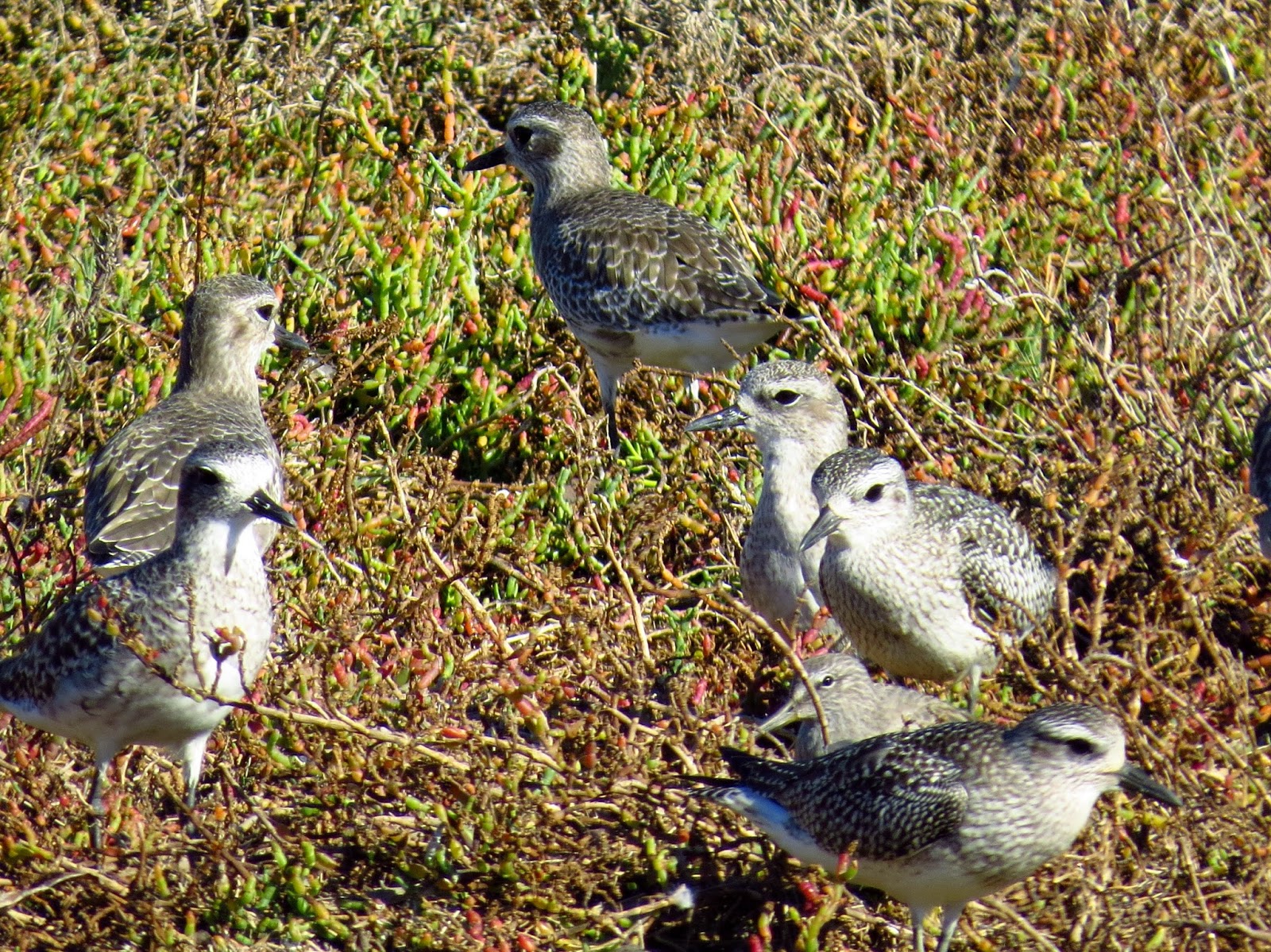
Black-bellied Plover
OR Pacific Golden Plover (could be really anything, apparently distinguishable by his "white rump", but your amateurnithologist is dubious)
Constantly looks annoyed, even when not

Also spotted at the sanctuary were our old friends
Long-billed Curlew (aka. Candlestick Bird)
Willet (ft. above in 2nd picture along with godwits)
Black Phoebe
& Snowy Egret
Among probably many others

We attempt to capture the utter bird chaos with the follow .gif

By the way, this bird sanctuary is named after a local conservationist, best known for her efforts to preserve the San Francisco Bay's natural salt marsh habitat, which was being drained and developed at a breakneck pace in her time. Her park now provides shelter for, the aforementioned 147 birds, including endangered species like Heerman's Gull and the California Clapper Rail, which is kind the ultimate reward for a fighter for birds, I suppose.

Tuesday, September 23, 2014

Great Black-backed Gull

A lot of people say to me "Amateurnithologist, huh? Maybe you should change your name since you're such a bird expert now!" Then they usually take my lunch and shove me into a locker, because the world is filled with mean bullies. On the other hand though, I can see the point they're trying to make. I have gotten better at this birding thing. I mean, probably, right? I'm correctly identifying more birds in the field, people are asking me bird related questions in my real life, and I recently got accepted into an awesome bird picture calendar. But something still nags at me, keeping me from saying I'm truly a moderately-well-versed-nithologist. If I want to figure out if I've really gotten better, I'll need a rematch with my old foe, seagulls. For a brief perusal of my embarrassing history with seagulls, click here, here, and definitely here. Ok, that was demoralizing, but let's give it a try~


Great Black-backed Gull
Bird Island, Nova Scotia, Canada
Member of the Gull Family
★Largest Gull
§A Flotilla of Gulls§

~real bird quote~
"While cruising along the bleak and barren coasts of southern Labrador I learned to know and admire this magnificent gull, as we saw it sailing on its powerful wings high above the desolate crags and rocky islets of that forbidding shore, its chosen summer home. Its resemblance to the bald eagle was striking, as it soared aloft and wheeled in great circles, showing its broad black back and wings in sharp contrast with its snow-white head and tail, glistening in the sunlight. It surely seemed to be a king among the gulls, a merciless tyrant over its fellows, the largest and strongest of its tribe. No weaker gull dared to intrude upon its feudal domain; the islet it had chosen for its home was deserted and shunned by other less aggressive waterfowl, for no other nest was safe about the castle of this robber baron, only the eider duck being strong enough to defend its young."
-Arthur Cleveland Bent, Life Histories of North American Gulls and Terns, 1921

~true bird fact~ It's true, what Arthur Bent said up there. The Great Black-backed is a tough bird. Here is a *not great* image I captured of him chasing away the notoriously chicken Bald Eagle. This was a behavior I observed many times on my birding trips. This bird fears nothing, is huge (5 foot wingspan), and has been known to swallow up smaller gulls and puffins (no!) in one bite. Well, he fears nothing except the most deadly animal of all (turns out its man). In the 1800's Black-backed gull feathers were considered extremely fashionable, and so the gull was hunted to the point of serious population depletion. After the feather trade ended in the 1900's, the population recovered, thanks in large part to the expansion of garbage dumps that gulls could easily feed at.


Exactly as tough as everyone thinks he is
Had a bad childhood. Doesn't know any other way to do things
Has a menacing calm to him
Just a real bad dude with real bad 'tude overall
Makes an example of those who get in his way

 /!\ Trigger Warning: Dead Bird /!\


Tuesday, June 17, 2014

Least Tern


Least Tern
Wakodahatchee Wetlands, Delray Beach, Florida, USA
Member of the Gulls and Terns Family
§A Ternery of Terns§

~true bird fact~ Weighing in at one ounce, the Least Tern is the smallest member of the gull family. This doesn't keep him from aggressively defending his nest by diving and shrieking at intruders.

Loves hot-doggin' and showin' off with some fancy flyin' moves
Doesn't like it when you bring up the whole 'least' thing
Acts really tough. Some might say he's compensating
A fiery temper


How endangered are they? Depends where you ask. It turns out there are three distinct populations of Least Terns, one on the East Coast (pictured above), an inland variety, and a West Coast Tern (who is probably the coolest least tern). The California and Inland type are both categorized as endangered species, but both of these populations have been recovering with aggressive management of nesting sights. These guys love the beach, so their breeding spots are often also good vacation spots. In addition to this, they were once nearly hunted to extinction by fancy-hat-makers. Overall the Least Tern is a success story, although it still has a designation as 'endangered', 'of concern', or 'threatened' in many of the states it lives in.