Showing posts with label Bird History. Show all posts

Wednesday, September 1, 2021

The Definitive Bird Name Tier List

 Greetings bird fans. You know, something I've learned over the years of doing this blog is that all birds are great, but not all bird names are equally great. We've done a little bit of grousing about this in the past, but today I'm going to really dive into this topic and do my best to determine what it takes to name a bird really really well. 

Ready? Let's get to the ranking, which is sure not to upset anyone

F minus Tier: Birds named for people (problematic)

Hoo boy, do I even have to say it? #BirdNamesForBirds of course, obviously. Yes. There's nothing that sours a birding experience quicker than remembering that the person who assigned his name to this bird was a real piece of work. If you can google your bird name + problematic and come up with results? You've goofed on the bird naming. What do we mean by awful people? Usually, because of the time period in which we got most of our commonly used bird names, we're talking about the colonialists, racists, and general genocide-enjoyers of the Age of Manifest Destiny.

Best Examples: Bachman's Sparrow, named for slavery-defender John Bachman

Audubon's Oriole, named after famous bird painter, slave owner, and white supremacist, John James Audubon

McCown's Longspur, which was named after a confederate general and staunch slavery advocate. Oops! This one was so bad that the American Ornithological Society actually did something for once, and now it's called the Thick-billed Longspur, which is probably like a C-Tier Name (so, much better).

Birds of this category that have appeared on this blog: Townsend's Warbler (Grave robber! Phrenologist! read more here) Steller's Jay (the Steller tea, admittedly somewhat milder)

F Tier: Birds named for people (non-problematic)

Rivoli's Hummingbird

Although some don't, I do make a minor distinction here. In my very cursory research there are some birds named after legitimately cool conservationist types and early birdwatching enthusiasts. That is, to me, less bad. However, what is the compelling case to mess around with eponyms in the first place? The idea of someone 'naming' a bird after themselves or someone else, when it almost certainly has a name from the native people of the area, is pure colonialism. Honestly, if you go back and read my blog entries for some of the eponymous birds above, you won't find a lot of these details, because a lot of the time those details are absent from their wikipedia summaries. I guess what I'm saying is that all of these old people are going to get cancelled for something eventually. Let's just get ahead of it now. Also, these names have zero flare. (PS, sign the bird names for birds petition, and read more about the villains of history who somehow get birds named after them.)

The Argument for: In this case, I kind of get the idea. If someone was important to naturalism or conservation, you might want to name a bird in their honor. For the bird watcher or enjoyer these names are basically useless, but they do give you a little sense of curiosity and mystery, and sometimes make you want to look up old historic figures who you may not know much about. Sometimes you might even find out those historic figures were slave owners. If you really want to do this, save it for the Latin name.

Examples: Wilson's Warbler, Allen's Hummingbird

D Tier: Birds named for a feature or location (inaccurate)


The Palm Warbler, who does not live in Palm Trees, and the Inca Dove, who does not live anywhere within the former lands of the Incan Empire are prime examples of this. A milder version would be The Connecticut Warbler, which has a range that includes Connecticut, but also the entire East Coast, and Mid-West, and parts of Central Canada. Even worse are the birds with inaccurate field markings. The Ring-necked Duck, with it's invisible cinnamon ring springs to mind, as does the Red-bellied Woodpecker, which has a belly that is only visibly red when the bird is "dead, in your hand", as one naturalist was quoted as saying.

The Argument for: There is no good reason to name a bird like this. Maybe it's kind of fun to have a very confusing and unintuitive name once in a while. Makes birding an exclusive club where we get to roll our eyes at newcomers who ask "Wait, why is that called a Ring-necked Duck?" That doesn't sound like a very compelling case in favor to me. Like the eponyms, you also get a little homework assignment where you feel compelled to investigate why these birds have such bad names. Show me a birder who doesn't like homework.

C Tier: Comparative Bird names


Greater this, lesser that, common whatever. These names are boring and not usually particularly helpful. Pass, throw them all away. I will say that there are some descriptor or modifier names that I kind of like, like Elegant Trogon or Magnificent Frigatebird. These are more like superlatives, but they do introduce kind of a wrinkle, since I think they fit best into this category. That's why it's time for me to introduce the "Poetic Modifier".  Any category from here on out gets a full bump in tier by taking a bird name from mundane to poetic. I.e. Magnificent Frigatebird is more like a B name, whereas Common Loon is a C name.

The Argument for: I guess if you live in a place where two birds look very similar, but one is larger, and one is smaller, you have a little bit of a useful name on your hands. I'm looking at you, Yellowlegs. The useless but flattering names are kind of fun. Maybe you just loved the bird so much when you saw it you needed to let everyone know it was extremely elegant. I can accept that.

B Tier: Birds named for a location (accurate)

Western Bluebird

This is the most boring name that a bird can have while still retaining some level of utility for the bird watcher. You run into the problem the problem fairly quickly that birds are generally pretty famous for moving around a lot, so it's hard to lock it down with just one place name. So you end up with a lot of birds being named for whole countries they are in, which doesn't really narrow it down. The habitats are better, and I especially like the Wren series- Marsh, Rock, Cactus, etc. I will admit that some location based named are cooler than others. My own personal scale puts Prairie Warbler and Gila Woodpecker well above American Wigeon and Island Scrub Jay, but your mileage may vary.

A Tier: Birds named for how they look/their physical features

I think this is your clear go-to, right? The number one way you would intuitively name most birds if you were asked to do so. Mostly this is not flashy, but it's certainly memorable and helpful. Great Blue Heron, got it. Roseate Spoonbill. Ok! I know what that's going to look like! The low end of this is probably, like, Black Phoebe, but you can get very very creative. Some of my personal favorites are Razorbill, Rhinocerous Auklet, Canvasback, and Vermillion Cardinal (yes, they are named after the Catholic clergy)

A+ Tier: Onomatopoeic Names/Birds named for how they sound

You get into trouble with the physical names eventually because there are, let's face it, a lot of birds that are at least a little bit boring looking. You can only have so many Little Brown Sparrows before you start running out of ways to describe the streaks. When you get there, you have some options, and a really fun one is the audio description. This ranges from Catbird (one of the best, sounds like a cat!) to Mourning Dove to Black-bellied Whistling Duck. All terrific names. If you want to take it up another notch further, you can dig into the Onomatopoeia. Bobwhite, Curlew, Chachalaca, Chickadee, Killdeer, and Whip-poor-will are all named for the sounds they make. You can see why every bird can't be named like this, but it's a great option when you have a distinctive call and a not-that-distinctive looking bird. Perhaps my favorite is the Nene. In my view, a bird named in the language of a place's native people also deserves to go up a tier.

S Tier: Birds named for how they behave

                                                                       Burrowing Owl

This is, to me, the absolute zenith of bird name quality. Don't tell me how the bird appears, tell me who the bird IS. What do they DO? What do you imagine their personality is LIKE? The more abstract and loaded with imagery the better. Hermit Thrush? Yes please. Happy Wren? Don't mind if I do. This also applies to birds that have descriptions of their behavior- many family or subfamily names are laid out like this, Creeper, Roadrunner, Skimmer, Flycatcher, Hummingbird, etc. Names like this are fairly rare, but they are always so great. It is also, in my opinion, the area that has the most room for expansion, perfect for renaming some of those eponymous birds. We don't need a Brandt's Cormorant, but an Ambitious Cormorant? Now I'm interested. Just a simple proposal, and I'd be happy to make up personality traits for as many birds as you like, if you're looking for an expert in the field of making stuff up about birds.

Post Script: Birds whose names I have no opinions on: Booby, Dickcissel, Bushtit, etc. These are often listed among the worst bird names, but I think it's ok that some things are funny. None of the birds are actually named after dirty words, except for the Windf*cker. They really meant it with that guy. Anyway, sometimes the etymology is pretty interesting for these birds. Leave them alone!

Saturday, August 22, 2020

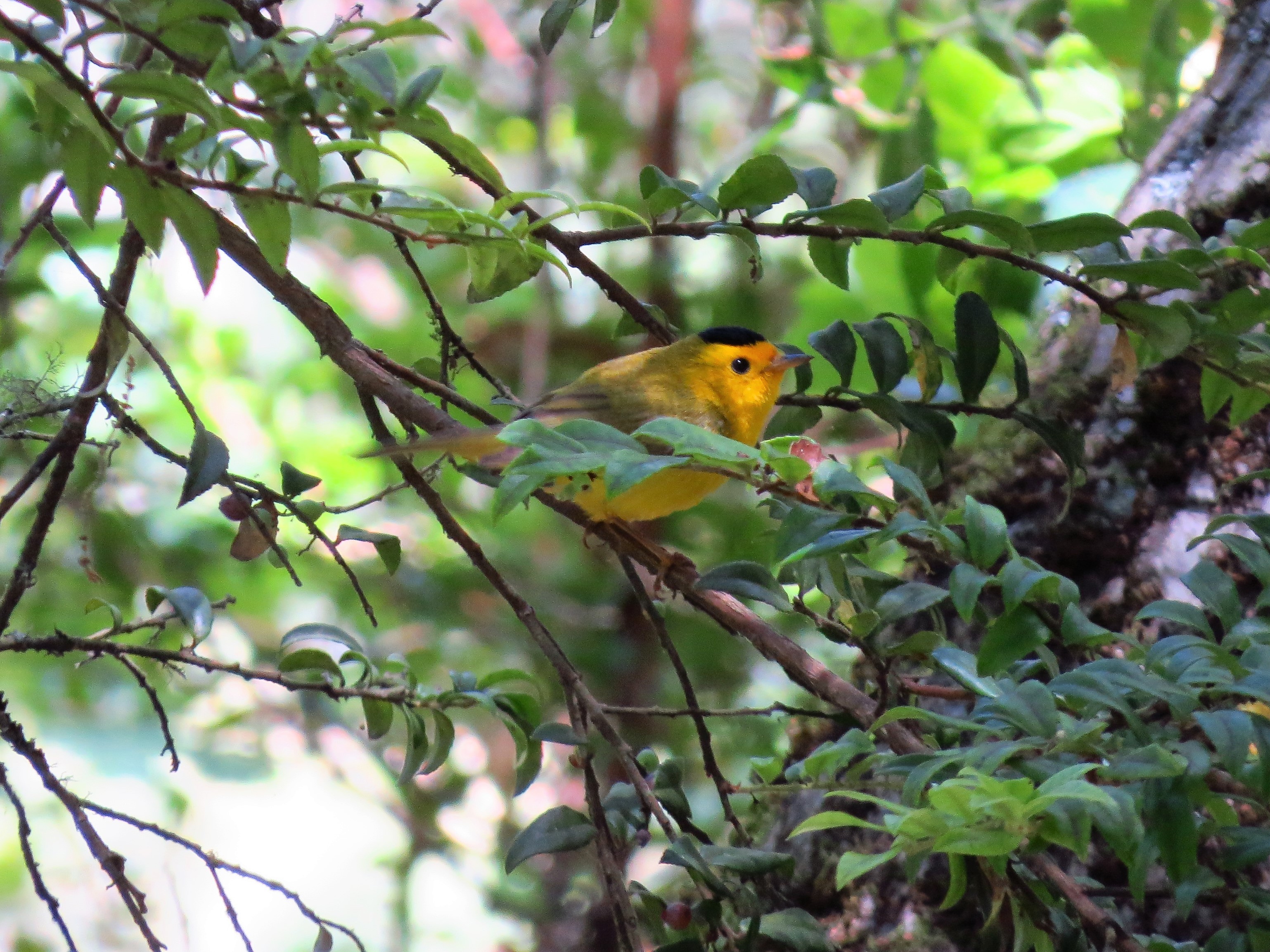
Wilson's Warbler

Wilson's Warbler
Huckleberry Botanic Regional Preserve, Oakland, California, USA
June 2020
Member of the Wood Warbler Family
§A Confusion of Warblers§

~True Bird Fact~ Most songbirds leave the nest for good once they've fledged. Wilson's Warblers, on the other hand, often return for a night or two. Failure to launch? 


Named for and by:


Alexander Wilson
(1766 – 1813)

Called The Father of American Ornithology, and the second only to Audubon in terms of American Ornithology Importance, and that's just in the first sentence of his wikipedia page! Wilson was born in Scotland and his first profession was as a weaver. He took an early interest in poetry and wrote ballads, pastoral pieces, and satirical works about the plight of weavers. These satirical poems were evidently so biting, that he was arrested for a 'libelous and inflammatory' poem about a mill owner. Here's an excerpt, in the original Scots:

Wha cou’d believe a chiel sae trig
|Wad cheat us o’ a bodle?
Or that sae fair a gowden wig
Contained sae black a noddle?
But Shark beneath a sleekest smile
Conceals his fiercest girning;
And, like his neighbours of the Nile,
Devours wi’ little warning
By night or day.

I guess you had to be there. He was also, it should be noted, that he was a very bad weaver, and eventually quit and moved to America, after languishing in poverty.

His career turned to teaching, and eventually he met the naturalist William Bartram, who awakened his true passion. Birds! He resolved to publish illustrations of every bird in North America. He did pretty good at this task, at least better than his weaving, traveling widely, and eventually publishing a nine volume work, including 268 birds, 26 of which were new to his audience of western naturalists. He died young from, and I quote "dysentery, overwork, and chronic poverty." He seems like he was a pretty cool dude, and has a lot of birds named after him. He also seems to have been a direct inspiration for Audubon himself, both in his style of illustrating and his publication.


Wilson's illustration of Red-bellied, Pileated, and... Ivory-billed Woodpeckers

However, bird fans, I am not content to let this topic rest here. There's been a lot of debate in the bird world lately about eponyms and honorifics, and whether birds should really be named for their 'discoverers'. I try to make a little point of this each time I profile a naturalist- that these birds were not truly "discovered", only given new, western names. There were people here before them, and the birds were plenty discovered already. And some of the people who have birds named after them turn out to be truly heinous. There's a lot of overlap, it turns out, between ideas of discovery and exploration and ideas of colonialism and manifest destiny. This includes some naturalists I've written about here, and frankly, I didn't know how bad they were. This is my bad, but racism doesn't often make it into the wikipedia summary, it turns out.

There's been one major recent success for this movement, the renaming of McCown's Longspur to Thick-billed Longspur. This one was named after a confederate general (yikes emoji). So yes, some bird names might be changing, if they are named after particularly bad people. But you can also make the broader argument that it's much simpler to just keep bird names descriptive and do away with honorifics all together. The naming of species after a western discoverer is inherently a colonialist practice. And while we'll lose some potentially 'good ones' like Wilson here, his contributions to birding will not be erased if he no longer has the birds directly named after him. (Although again, who knows, about Wilson. I'm not about to read a whole biography looking for problematic elements). If you agree with this view point, there's a petition that you can sign. I have. Maybe in the future we'll just call this bird the "green black-capt flycatcher", as Wilson originally called it in 1811. Well. Maybe we won't call it that. But something else. Stay tuned.

Wednesday, July 25, 2018

Eastern Bluebird


Eastern Bluebird
Cochran Mill Park, Palmetto, Georgia, USA
April 2018
Member of the Thrush Family
§A Mutation of Thrushes§
State Bird of Missouri and New York★

~true bird fact~ Interesting conservation history here- this bird really struggled in the early 20th century as a result of competition from more aggressive introduced European species, like the European Starling and the House Sparrow (curse you again, Shakespeare-bird-lunatic). Since these are all hole-nesting birds, the more aggressive species often beat out the Bluebird for spots. In the 1960's an effort was started to create bluebird trails and bluebird specific nesting boxes, accessible only to them and not their competitors. As a result, bluebirds have made a real comeback, but almost all of them live and nest in one of these man-made boxes. Perhaps this great effort was made because, quoth wikipeida "The bright-blue breeding plumage of the male, easily observed on a wire or open perch, makes this species a favorite of birders." No. Citation. Provided.

A real hat-wearer
Has strong feelings on the superiority of the East vs. the West coast
Presents well initially (as a friend/employee/partner), but often will let you down over the long term as his natural habits and personality come out


Sunday, May 6, 2018

Yellow-crowned Night Heron


Yellow-crowned Night Heron aka. Crab-eater
Hugh Taylor Birch State Park, Fort Lauderdale, Florida, USA 
April 2018 
Member of the Egrets, Herons, and Bitterns Family 
§A Pose of Herons§

~true bird fact~ These bad boys occasionally eat turtles, being able to do so because of special stomach acid that eats through their shells. This digestion prowess probably also helps with the crabs that make up a much greater portion of his diet. Apologies to all turt-lovers out there.

~real bird history~ The Caribbean once had it's own species of Night Heron called the Bermuda Night Heron. It was driven to extinction in the 17th century, during colonization of the islands. Yellow-crowned Night Herons were introduced to the islands in the 1970s as a response to a wildly out of control crab population boom. This attempt has been largely successful for all involved (except the crabs, perhaps).

Loves crabs so much that everyone buys him stuff with crabs on it for his birthday. All home decorations are crab-related
A low achiever, but content with that
Has a weird, old uncle on the West Coast that he never talks to, but that will one day leave him 
an enormous inheritance


Wednesday, February 21, 2018

Wood Duck


Wood Duck aka. Carolina Duck
Mountain View Cemetery, Oakland, California, USA
February 2018
Member of the Duck, Goose, and Swan Family
§A Flush of Ducks
§


{Etymology Corner} Wood Duck is slang for a sucker or rube (I would argue infrequently used). Apparently it's 70's era lingo from the used car salesman community. No information presents itself on how this originated/why it would make sense.

~true bird fact~ A very different kind of duck from what we usually see, at least physiologically. Wood Ducks have sharply clawed feet, which they use to perch in trees near water. Wood Ducklings are born into nest cavities and have to leap up to 50 feet into the ground or water and can do so without injury. So all those videos of people 'helping' baby ducks by catching them as they jump out of their nest can go take a hike as far as I'm concerned.

You know that quote about 'dance like no one's watching'? Wood Duck always acts like someone's watching him.
Master of the celebrity encounter name drop
Gets a lot of his food at the farmer's market


 How Endangered Were They? A distinctly North American species, Wood Ducks never had much of a range outside of the USA and Canada (they're in other places now because they were popular ornamental birds). This was bad news for Wood Ducks during the height of American expansionism. They were actually on the verge of serious trouble by the late 19th century, both because of loss of habitat, and because of hunting, mainly for their feathers (the infamous 19th century fancy hat industry strikes again).

Happily, Wood Ducks are doing much better now, because at that crucial moment, some sweeping government regulation was enacted to protect them. The 1918 Migratory Bird Treaty Act declared them a protected species, and, along with the introduction of constructed nesting boxes, enabled them to bounce back. You know who else helped? Beavers, who also have a rebounding population, and happen to naturally make perfect Wood Duck habitats. So thanks beavers, and thanks reasonable regulations, for making this bird alive. And of course, zero thanks to our current president, who is choosing to roll back the Migratory Bird Treaty Act's protections for birds after 100 years of success stories like this. Hopefully this move loses him the bird vote.

Thursday, June 8, 2017

American Flamingo


American Flamingo aka. Caribbean Flamingo
Ardastra Gardens, Nassau, New Providence, The Bahamas
April 2017
Member of the Flamingo Family
§A Colony of Flamingos§
The Most Widespread Flamingo
State Bird of Gujarat, India

~true bird facts~ This is one weird bird, so there's a lot of cool facts about them. Problem is, you probably already know most of them. Here's some cool things you already know about flamingos:

We've all learned this one at some point- they've got that distinctive pink color because of the brine shrimp and algae that comprises much of their diet. Much like our friend the Roseate Spoonbill, their feathers would be grey without this supplement.

Thanks to their recent brush with virality you probably also know why they stand on one leg. It's because of the alignment of their hip and knee joints- they balance perfectly in the center of the bird when bent, meaning that standing this way actually uses almost no energy. It's also a way to regulate body temperature. Important for large animals that don't sweat.

You might've also seen their entertaining synchronized walking-dancing thing they do. It looks like this (these are not American Flamingos, but rather Chilean). It's a mating/pairing ritual, but no one is really sure how the birds decide exactly. It has to do with when they move in unison and when they stop.

One thing you might not know is that Flamingo tongues were considered to be a prized delicacy in ancient Rome. Why do we know so much stuff about Flamingos? I can only assume it's because they're big and cool looking.

Easily upset stomach
Likes to complain
Beauty-product based pyramid marketing scheme
High self esteem, has a high bar for others

Wednesday, April 5, 2017

The Definitive State Bird Power Ranking pt.2

Welcome back bird fans, blog fans, and fans of any and all power rankings and internet lists. Last week we started our countdown of the best state birds. If you want the stinkers, we got em' all list time, go read that one. This week it's only the creme de la birds, the top 14. Where will your state fall, dear reader, and who will be crowned best state bird? As with last time we'll be ranking on uniqueness, awesomeness, and general representative feel. Away we go!


14. Northern Flicker
State Bird of: Alabama
 
Finally someone is giving some attention to another family of birds. Alabama gets what you've gotta do to really get high up in the rankings. Northern Flicker is a member of the woodpecker family, and is the only woodpecker to get such recognition. They deserve it too, being extremely cool looking in flight and easy to identify. Interestingly, Northern Flickers have major color differences in their east and west coast variations, but are still considered the be the same bird. Alabama refers to their bird by one of its many, many colloquial names: The Yellowhammer. And that's kinda where we run into the problem. I just finished gushing about this bird, and I was all ready to give it a really high spot in the countdown, but then I read that the yellowhammer name comes from the nickname for Alabaman soldiers in the civil war. Frankly, this bird would be way lower if I knew this last week. Although it's a great bird, and this associate is totally not his fault, it's way past time to pick a new symbol.

13. California Gull
State Bird of: Utah

I was all set to award this gull last place when I was looking through the state birds. The issues are obvious. Sure, you get to be the only state with a gull as a state bird, but number one, you're an inland state, not associated with gulls, and number two, most prominently, your state bird is named after another state. Then, I dug a little further and found out that the California Gull was named the state bird as an act of thanks after these gulls devoured a bunch of locusts that would've otherwise caused massive crop damage. That's a great story, and feels very Utah. In this context the bird is slightly religiously-tinged, very white, and revered for an event that may not have happened. Still, the optics are just bad enough for the bird to slide in at 14th place. It doesn't help that gulls are obnoxious.

12. Lark Bunting
State Bird of: Colorado

Credit where credit is due, Colorado introduced me to a bird I've never seen or heard of. That's kind of the problem though, isn't it? The Lark Bunting is fairly indistinct, being a small, black songbird with few defining qualities. Why is this the Colorado bird? No one can say. I do think it's got some of the Colorado spirit in that it's a real original, with no other birds in its immediate genus. It's family, however? Sparrows. Who names a sparrow their state bird? Nearly needless to say, it's not a Lark, which is a whole other family of birds.

11. Carolina Wren
State Bird of: South Carolina

The next several birds are all part of this group of fairly indistinct brown birds which all have some positive things going for them. Lacking interesting appearance or uniqueness of family to go on, we end up with the question of how to rank them. The place we end up is a really non-scientific 'how well does this bird represent his state' kind of situation. So here we are, at Carolina Wren. The essential question here is "how cool can a wren be?" I like that the bird has the state's name in it, but even that's not a bullseye since there's both a North and South Carolina. To make matters worse, this bird's Latin name means Wren of Louisiana, where it also lives. So that raises the question of why this bird is named the Carolina Wren at all. Small point deduction for me feeling like I could never identify one with certainty.

10. Brown Thrasher
State Bird of: Georgia

Do they really fight snakes? Can't find any corroborating evidence, but Audubon doesn't lie. Pay attention Florida, Arkansas, and the 4 other states that chose the Northern Mockingbird- this is how you do it if you want to choose a bird in the mockingbird family. Just find one that no one else has claimed yet. Grey Catbird was right there, guys. Personally, Brown Thrasher seems like a good Georgian bird to me. He knows over a thousand songs, the most of any bird. They're territorial and will even attack humans if necessary. Georgia has also shown some decent bird pride, naming their now-defunct pro hockey team after the Thrasher. This is the first bird that I'm honestly sad to have to put this far down. It's a good bird.

9. Hermit Thrush
State Bird of: Vermont
 
You might be wondering how this is the member of the thrush family that made it the furthest, defeating the Robin and two types of Bluebirds. It's just another small, brown bird, right? What you have here is a real master class in choosing the bird that best fits your state. Vermont is one of the least populous states (49th) and most densely forested, making it a natural home for hermits. His position as a Very Good Bird is largely cultural. The Hermit Thrush seems to be a bit of a muse for the artistically inclined. He's featured prominently in poems by Amy Clampett and T.S. Eliot, and none other than Walt Whitman wrote extensively of the bird. There are also no less than 3 bands named for him. Perhaps this is because the Hermit Thrush's song is considered to be one of the most pleasing in nature, it's song conforming to human musical scales when other birdsong generally doesn't.


8. Cactus Wren
State Bird of: Arizona

The state bird of Arizona made it this far by looking very cool and living in cacti. Sometimes these nests use the natural spines of the cacti to protect the birds within. Well adapted to their desert climate, they almost never drink water, getting hydrated instead from moisture in their food. Bonus points for being only found in the Southwest. An excellent and distinctive bird choice. Significant multiplier for being a state bird that naturally nests in the state flower, the Saguaro cactus.

7. Purple Finch
State Bird of: New Hampshire

The Peterson guide goes a long way towards selling me on the Purple Finch, describing him as "a sparrow dipped in raspberry juice". The coloration is pretty distinctive, especially among North American birds. Unfortunately, it goes downhill from there. The Purple Finch is kind of a perennial loser, currently losing his territory to both the House Sparrow and House Finch, which, insultingly, kind of looks like a more boring version of him. This might incline some to give him a low place on the list, but to me, at this moment, it feels like we need an underdog. The Purple Finch says 'live free or die', even if he is currently doing more dying than living free these days. It helps his case that he's got a very narrow range of places that he might be found year round, which does include New Hampshire.

6. Baltimore Oriole
State Bird of: Maryland
 
What can I say, you can go a long way by having your bird be so interwoven into the fabric of your state. The bird was actually given its name for its resemblance to the family crest of Maryland's first governor, Lord Baltimore, who also gave his name to the state's capital. That's what I call state bird synergy. There's also the matter of the baseball team of the same name. Orioles are also delightful birds, always a pleasant surprise of color and movement. However, there's only so high that you can go as a little songbird. The top 5 is filled with real doozies.

5. Brown Pelican
State Bird of: Louisiana
 
Boom! Why did no one else think to claim this giant, idiosyncratic icon? Even the biggest bird novice knows what a pelican looks like, and for good reason. They're completely absurd looking. This is the kinda move that makes you realize the quality birds that were left on the shelf during this whole state-bird-naming affair. Brown Pelican represents Louisiana well with his scrappy, do-what-it-takes spirit, and his love of seafood. And the bird has been embraced by Louisiana, earning a coveted basketball team name. Excellent work, Louisiana. The only reason this bird is not higher is that it's quite common in just about any state with a coastline.

4. California Quail
State Bird of: California
 
Am I showing a little bit of home state bias by giving this quail the 4th place spot? I would argue no, I am not. California's quail 1) is the only quail to be given state bird status, 2) lives exclusively on the west coast, and 3) has the state name in his name. The only shade you could possibly throw this quail's way is that California is also home to the incredibly rare California Condor, the largest bird in the country, and how come he's not the state bird. Still, you would never want to hurt this bird's feelings by saying something like that. Just look at him! Much like California, he's on the leading edge of fashion with his hairstyle and outfit. He's even got the state's distinctive positive energy. Even cuter in person, the California Quail is a welcome, and not infrequent sighting all along the beautiful California coast. I love this quail and I love California.

3. Nene
State Bird of: Hawai'i

I almost feel like it's not fair for Alaska and Hawai'i to compete with the rest of the 50 states, just because they have such distinct and rich bird habitats compared to much of the mainland. Well, no one said this bird context had to be fair, but I think we can agree that most states could've done better. That being said, they didn't take the top spot. Now, on to our top 3. The Nene is the world's rarest goose, with wild numbers hovering around 2500, and it is only found naturally in Hawai'i. In fact, it's the only state bird that can only be found in its home state. It is also the rarest state bird. It even has an extinct relative, the Nene-nui, which was just like it except 4 times the size (!!!). Ancient, exotic, and endangered it epitomizes Hawai'i's natural beauty well. But are there other options in Hawai'i's embarrassment of bird riches which would've been just as good? Maybe, maybe not. The only thing about the Nene that holds it back is that at the end of the day it is a goose, which is not, like, the best type of bird.

2. Willow Ptarmigan
State Bird of: Alaska

This bird is bananas. If you haven't seen it and heard its amazing call, do yourself a favor and go watch this video now. While the Ptarmigan has a large range, Alaska is the only part of the US that it's found in, which is worth good points. Honestly though, it doesn't need em' simply on he strength of the bird alone. Uniquely adapted to their icy habitats, they have furry feathers on their feet and they grow white plumage for camouflage in the winter. This hearty winter warrior exemplifies the frontier spirit and esoteric nature of his represented state.

1. Greater Roadrunner
State Bird of: New Mexico

God what a cool bird. There's a part of me that wonders if my thus far unfulfilled desire to see this bird in the wild has anything to do with me giving him the top spot, but then I look at him again and any doubt fades away quickly. Not as quickly, however, as the roadrunner himself, who can get up to a whopping 24 miles per hour on foot, the fastest running speed for a flighted bird. He's the perfect bird for New Mexico too, a stark landscape characterized by cacti, highways, and wide open desert. Fittingly, he looks like a bird from another world or era. What really cements them as top bird on the power ranking is their cultural influence. Native Americans in the area believed Roadrunners warded away evil spirits, while indigenous peoples in Mexico thought of them as baby deliverers, ala. Stork in Europe. Also my actual favorite Loony Tune when I was a kid was the Roadrunner, who wordlessly outsmarted and outran his nemesis, the Coyote. In real life, I'm told, Roadrunners are one of the few things Coyotes won't eat. Congrats Roadrunner, maybe now that I've given you the trophy you'll finally show up for me. Like the coyote, I probably shouldn't count on it.

So, what did you think of my bird rankings? Was I too harsh on the birds that multiple states shared? Should chickens be allowed on the list? Should Alabama do something about their racist bird? What is your top state bird? Sound off in the comments, or on twitter! Thanks for reading birdfans.

Saturday, April 1, 2017

The Definitive State Bird Power Ranking pt.1

Last week's bird, Western Meadowlark, and his rivalry with Northern Cardinal got me thinking about state birds. Specifically it got me thinking about how many bad state birds there are. I mean, all birds are pretty good, but you gotta be kidding me with some of these choices. All the more reason, then, to honor the rare really good state birds. So what are the best state birds? The worst? You're about to find out. Birds will be judged on qualities of uniqueness, representation of their state, and general overall birdliness. Of course at amateurnithologist we want to be a resource to you, the blog consumer, and we know that what you really crave is this information delivered via reverse-order listacle. We'll start off with..

29. Ruffled Grouse
State Bird of: Pennsylvania
 
As much as I love a good grouse, you can't win if you don't play. Pennsylvania is the only state to not declare a state bird. The ruffled grouse is technically their 'State Game Bird', and it's the only representative they put forth. At least it's a good game bird (many other State Game Birds are hackneyed Turkeys), but the implication that the only good thing about birds is shooting them is enough for me to give it the lowest spot on the list.

28. American Robin
State Bird of: Connecticut, Michigan, Wisconsin
 
You might've noticed that we started at 29 instead of the 50 you might expect. You start to see the origin of this problem here, which is that many states share a state bird. I'm of the opinion that this is unacceptable. Choosing a state bird that was already claimed by another state is an admission of boringness and unawareness of what makes your state unique. And choosing the robin might be the most boring move of all. Aside from their place as harbingers of spring, and their cool blue eggs, they've got basically nothing going for them. They don't even look that cool, which seems to usually be the criteria for these multi-state birds.

27. Western Meadowlark
State Bird of: Kansas, Montana, Nebraska, North Dakota, Oregon, Wyoming
 
A stunning number of states decided they were best represented by a bird who has neglected right in his name, which is a perfect description for the way in which they handled their state bird naming responsibilities. He's a pretty bird with a nice song, and aside from that there's nothing to say about the Meadowlark. Fascinating only for true madmen who find slight taxonomical distinctions interesting.

26. Northern Cardinal
State Bird of: Illinois, Indiana, Kentucky, North Carolina, Ohio, Virginia, and West Virginia

I will grant you that this is an extremely cool looking bird, which goes a little ways towards explaining his dominant position as the chosen bird of the largest number of states. Still though, the only way 7 states choosing the same bird makes sense is if they weren't allowed to know what the other guys were picking. Imagine the embarrassment of showing up to a wedding in the same dress as someone else, and now imagine it's actually 7 people. But I get it, you wanted a cool looking state bird. The thing is, there's no shortage of attractive, colorful birds that aren't represented at all. Blue Jay? Not a state bird. Painted Bunting? Not a state bird. It boggles the mind.

25. Northern Mockingbird
State Bird of: Arkansas, Florida, Mississippi, Tennessee, Texas

I do like a mockingbird. They're clever, they mimic songs and sounds (one on my street does a great car alarm impression), and they have a cool swooping dive they do when looking for a mate. But FIVE STATES thought this was the bird that best represented them? Actually, sorry, it's 6 states, as this is also the former State Bird of South Carolina. Guessing he was involved in some kind of scandal and had to step down. One of the drabbest State Birds in appearance, he only makes it this high for his prominent place in our cultural landscape.

24. Ring-necked Pheasant
State Bird of: South Dakota

Now that we're truly through the most overplayed birds, we get to the interesting questions of what birds best represent their state. Well, we're almost there, since we've got another doesn't-really-count bird from South Dakota. While, yes, I was very excited to get a picture of the Ring-necked Pheasant a few months ago, it's not even a native bird. It's a game bird that was introduced for hunting and farming. How can you be a state bird if you're not native to the state you're representing? This feels like someone asked the governor to name a state bird and he just chose the one he likes to hunt the most.

23. Delaware Blue Hen
State Bird of: Delaware

You get some bonus points for having the name of your state in the bird name for sure. Yet here, near the bottom of the list is where the Delaware Blue Hen falls. It doesn't bother me that it's a chicken, or non-native in origin. Unlike the above-maligned pheasant, at least this bird has his origins in the state in question. And I think it's actually kind of cool to have a chicken for a state bird. The part where the Blue Hen loses me is that it gained its prominance, fame, and adoration primarily as a cockfighting bird. Hey guys, don't make birds fight each other, ok? Honoring the 'fightin' blue hens as the state bird seems like a tacit endorsement of bird fighting, and we're not cool with that here on amateurnithologist.

22. Eastern Goldfinch
State Bird of: New Jersey, Iowa
 
No one seems to have much to say about the Eastern Goldfinch, and that's because it fits into the large category of small, yellow birds that are a little bit fun to see. Seeing a goldfinch is nice, but lacks substance. It's like eating one potato chip. The seem like completely personality-less birds, or worse, birds with personalities I don't like. The fact that two states chose it as their state bird is a bit baffling to me. I also find it annoying to ID, knocking it down a spot or two.

21. Eastern Goldfinch again
State Bird of: Damn it Washington, how'd you screw this up?
 
Oh look who it is again, Eastern Goldfinch, aka. American Goldfinch, aka, in this case, Willow Goldfinch. You know what, you can't fool me, you're all the same bird. And I can tell because when I search for you on wikipedia, I get redirected to the American Goldfinch page. Don't try to sneak onto this list twice, Eastern Goldfinch. Even if it is technically a 'subspecies', I won't be fooled. Gets knocked down a spot on the list for this ruse. It was selected in 1951 by school children, which at least goes some way towards explaining why it was chosen so badly.

20. Eastern Bluebird
State Bird of: Missouri, New York

Managed to escape the penalty for being a duplicate for a while, as bluebirds are pretty cool birds. You get a lot of mileage out of being a symbol of happiness and spring. Easy to spot and pleasant to look at, the Eastern Bluebird is a good, but not great, state bird. It does evoke some personality and has a fairly unique coloration among North American birds. This could be much higher on the list if it weren't shared. If I were forced to choose, I'd give this bird to New York and make Missouri choose a new one.

19. Mountain Bluebird
State Bird of: Idaho, Nevada

Yes, it's another bluebird, but I feel like this one gets some bonus points for representing their state via the 'mountain' distinction. Doesn't a mountain bluebird just feel like Nevada? Honestly, to me it feels more like Colorado, but those two choices are fine too. Here we also get into the territory of the extent to which your state bird actually lives in your state, to the exclusion of other places. If you've got a bird that spans the entire country, it's less good by an order of magnitude than a bird that lives only in your state. That, to me, makes the Mountain Bluebird a better bird choice than the Eastern. Still, we're in doubling up territory here, and there's gotta be a penalty for that.

18. Black-capped Chickadee
State Bird of: Maine, Massachusetts
 
The final bird that double dips. From here on out we've only got states with unique birds (well, sort of, you'll see). The Black-capped Chickadee makes it further than the rest by being very cute. Well, that and it's got a neat trick for surviving the cold winter by dropping its body temperature and going into a kind of temporary bird-hibernation. That just feels very New England to me.

17. Common Loon
State Bird of: Minnesota

The next two birds are extremely cool and distinctive, and arguably are very good fits for their states. The problem? I would say they are more commonly associated with our North American neighbors than with us. The Common Loon is provincial bird of Ontario, it appears on Canadian currency (their 'Loonie' $1 coin, to be exact), and won the popular vote in the recent Canadian state bird elections (but still lost, aka pulling a Clinton). I know you can't really be expected to account for what other countries do, but this bird seems to be unambiguously, prominently Canadian. Maybe that makes sense, since you could argue that Minnesota is the most Canadian of the states.

16. Scissor-tailed Flycatcher

State Bird of: Oklahoma

Ok, I will grant you, that is a very good bird. But does that bird say 'Oklahoma' to you? An ideal state bird both exemplifies and demonstrates the best in a state. I would argue that the Scissor-tailed Flycatcher does only one of those things. This is not the typical Oklahoma experience, and anyone who looks at this bird can tell that it's primarily a Central American bird. Take a look at this range map. If I can only see a bird in my state 1/4 of the time, can it still represent my state? This one feels like the person in charge just chose the coolest looking bird that's been seen in Oklahoma and called it a day.

15. Rhode Island Red
State Bird of: What state do you think it's the state bird of?

The last bird that loses points on a technicality, we have the last of the 3 state birds that are technically not native to the country. Bred in Rhode Island in the late 19th century, this giant, rust-colored chicken has been a staple of meat and egg production ever since. It appears much higher on the list than his fellow chicken by virtue of not tacitly advocating animal cruelty (except the dairy industry, which, yes, there are problems). I'm factoring in the extra points for name-of-state in state bird, but this is accomplishment is somewhat diminished by the fact that you're more likely to see this bird in the grocery store freezer section than the wild. Rhode Island Reds enjoy stellar ratings on my literal favorite website Backyardchickens.com, at 93% favorable and a formidable 8th place in the Chickens category. Let's close out part 1 with some excerpts from reviews about this great chicken.

"I had trouble deciding between 4 1/2 stars or 5 stars on this breed. They are good chickens anyway, and I have no dislikes. Hope this helps!"

"They are mellow and just want to be loved on"

"She asserts herself but is not a bully"

"They are GREAT layers, but they have attacked a killed another chicken."

"want first food, first water, and plenty of personal space from the other chickens"

How Rhode Island is that, huh?

Anyway, we'll be back next week with the thrilling 14-1 list. Who is the top state bird?!? Part 2 is now live, so go find out now!

Thursday, February 23, 2017

Mute Swan


Mute Swan
Wetland's Edge Park, American Canyon, California, USA
Member of the Duck, Goose, and Swan Family
★The National Bird of Denmark
§A Bevy of Swans§


~true bird fact~ Mute Swans are not native to the United States and are considered a widely disliked invasive species. All Mute Swans in the states are descended from birds brought from overseas to decorate estates, zoos, and parks. They eat a ton of aquatic plants, making survival more difficult for other waterbirds, and are exceptionally aggressive, often attacking humans and pets. The attacks are no joke either, these are very big, strong birds, and a wing-beat is strong enough to break a person's arm. A quick google search was able to confirm that they have killed, but couldn't establish in what numbers.

~alternative bird fact~ Not so fast, say several advocacy groups. There are disputes about whether or not Mute Swans could actually be native to the US in some fashion (flying over from Russia, perhaps). "Save The Mute Swans" presented fossil evidence to this effect to the US Department of the Interior, but their claim was rejected. Mute swans continue to be the subject of culling efforts or even a kill-on-site species, especially on the West Coast, where they have not established themselves as fully.


~true bird myth~ The phrase 'swan song', comes from the Mute Swan, who is fairly quiet, although not silent, throughout his life (this is where his name comes from). The legend says that this bird is silent up until the moment of his death, at which point he sings an unbelievably beautiful song before expiring. Poignant stuff.

~true bird history~ Insanely, all Mute Swans are owned by the Queen of England. They were "Claimed by the Crown" in the 12th century and the ownership is retained to this day, although it's not really used for much other than some weird annual Swan ceremony.


~haven't had enough true bird facts yet?~ This is also the lead character in The Ugly Duckling.