Showing posts with label Birds that Don't Count. Show all posts

Friday, July 16, 2021

Chilean Flamingo

Chilean Flamingo (Fernando)

Coyote Hills Regional Park, Fremont, California, USA
April 2021
Member of the Flamingo Family
§A Flamboyance of Flamingos§

~True Bird Fact~ If you've never heard of flamingos before, here are some quick and fun flamingo facts: Fact 1: Flamingos have the greatest leg to body ratio of any bird. Fact 2: Flamingos get their distinctive pink coloration from their diet of algae and brine shrimp, which both have a lot of this reddish-pinkish pigment, beta carotene. Fact 3: Flamingo tongues were considered a delicacy in ancient Egypt.

But really, I should probably use this space to talk about why there is a Chilean Flamingo in the Bay Area, right? Let's get some things out of the way- he's the only one of his kind ANYWHERE near here. His usual range is mostly in Chile ('natch), which is 6000 miles away. He probably didn't just get lost. He's also probably not from a zoo, since he isn't banded. His name is Fernando and he just kind of hangs out. 

Birders speculate that he might be from a private collection, but my favorite theory is that it's actually an escapee from Marine World, an amusement park that used to be in the area. Apparently the animals were transported by boat from the Hayward area up to their new home in Vallejo, providing him his opportunity to break free. There have been reports of sightings going all the way back to the 70's, which work with this timeline. Either way, he is clearly not a 'wild bird', so he sadly 'doesn't count' for birders. Really though, I think there should be more excitement for this. On the Wikipedia page for Chilean Flamingos there's a whole section about one who escaped and became a local celebrity in Great Salt Lake area. Step up Bay Area, there's a Flamingo here. We don't know how long we'll have him, and we're unlikely to see his kind here ever again. So show some respect!

Saturday, May 7, 2016

Light Brahma


Light Brahma aka. Brahma Pootra aka. Burnham aka. Gray Chittagong aka. Shanghai
Castello di Amorosa, Calistoga, California, USA
January 2016
Member of the Junglefowl Family
§A Brood of Chickens§

~true bird fact~ The Brahma, along with another feather-footed chicken called the Cochin brought about a chicken craze in the 1850's in the US and UK that was called HEN FEVER. During this time, he was nicknamed The King of All Poulty (!!!). Perhaps this came from his regal bearing, or, more likely, because he gets to be up to 18 pounds, making him the second largest chicken breed. Many hipsters have hen fever these days as well, so I hope they're still using this terrific nickname.

Gentle-hearted, but project toughness
Gives generously of his considerable wealth
Secretly just wants to be taken care of, pampered
Loves rich foods


Once again we bring you selected Excerpts from customer reviews of the Brahma on BackyardChickens.com. Your favorite feature and mine...

Bird Reviews
Rated #16 in chickens (of approx. 170 breeds), with a 94% positive rating. There are 113+ reviews of this chicken.

"If I were starting my flock over, I'd consider having all Brahmas"

"I love that they are big girls, and their feathered feet"

"Gentle, lovey, wants you to hold her"

"Sometimes her fluffy feet get dirty. A small price to pay to look fancy everyday!"

"I brought her in the house yesterday and fed her peanuts on the couch!!!"

"She thinks she's a dog, and I just love her."

"He loves to snuggle. When I go outside and sit down he immediately will jump on my lap along with the lady brahmas. One day I was standing in the coop and someone was pecking my shoe and then they started tugging on my pant leg! I looked down and Aggie, the rooster, was pulling on me. We made eye contact, he stopped and stood completely still until I picked him up and snuggled with him. I cannot stress enough what a good bird he is. It honestly amazes me. The other day I gave him a bath and be stood still nearly the entire time."

Thursday, November 5, 2015

Domestic Greylag Goose


Domestic Greylag Goose
Kennedy Park, Napa, California, USA
October 2015
Member of the Ducks, Geese, and Swans Family
§A Skein of Geese§

~true bird fact~ Remember our African Goose from a few weeks ago? And how he was a descendant of the Swan Goose? Well, even if you don't, that's what happened. Anyway, this fancy gentleman here is the domestic form of the Greylag Goose, which is the species from which almost all domestic geese originate. All of them except those that came from the Swan Goose. Anyway, now that we've got our goose family tree straight, here's an interesting fact- The Greylag Goose was one of the first animals to be domesticated by humans. It happened at least 3000 years ago, and the ancient Egyptians are responsible.

~true bird myth~ This goose has held cultural significance for over 5000 years. It was considered a symbol of several gods and goddesses throughout history, including Ishtar, goddess of fertility in Sumeria, the sun god, Ra in Egypt, and Aphrodite, goddess of love in Rome. In fact, Geese have long held a sexual connotation, and Goose fat was once a major aphrodisiac.

~true bird history~ Konrad Lorenz, a German scientist who did seriously important research on the biological process of imprinting, used these Geese in his studies. Basically he postulated that many creatures form an intense and instinctual emotional bond with the first moving thing they see upon being born, and proved this theory by becoming surrogate mother to a flock of Geese. Lorenz's work was not only significant, but he also conducted it extremely ethically, only using natural settings and conducting his experiments in a non-invasive way. Unfortunately he was also a member of the Nazi party... as most Germans were during WWII, whether they wanted to be or not. After the war he did say he regretted the decision. An extremely important figure in the development of behavioral psychology, your blog author personally learned about this story during his undergrad days.


Thursday, October 22, 2015

African Goose


African Goose
Kennedy Park, Napa, California, USA
October 2015
Member of the Ducks, Geese, and Swans Family
§A Gaggle of Geese§

~true bird fact~  This bird is a domestic form of the Swan Goose, a bird that is actually not native to Africa, but rather Russia, China, and Kazakhstan. In his native countries, he is listed as vulnerable due to habitat loss and excessive hunting. Every year around 60,000 birds come to breed around the lower Yangtze River area, which may be nearly the entire wild population.


As this is a domestic bird, we get to return to one of my personal favorite features,

Bird Reviews (brought to you by backyardchickens.com- maybe they'll pay me some day if I keep mentioning them)

Rated #10 in Geese, with a 67% positive rating.

"She follows me around, jumps in my lap, gives me goose kisses"

"They are very intimidating to predators. They scared away a raccoon"

"hates everyone that isn't me"

"I always wanted an attack goose now I have one!"

"I must say when I first saw these geese in person I instantly fell in love with them"

"they bite everyone and everything"
  
"don't take too kindly to visitors"

Monday, May 11, 2015

Roosters of Key West

Key West has a lot of Chickens. Estimates are that over 2000 birds live on the 2x4 mile island. Locals are divided on the chicken issue- they add a lot of charm and character, but they are undeniably annoying at times. Regardless of what they think, there's not a lot that people can do about the chickens- they're currently a protected species. It is illegal to 'harm or harass' a chicken in Key West. Why are there so many roosters, and what type are they? Well, it seems likely that most of the roosters are the result of people releasing their chickens once cockfighting was outlawed. The sport used to be a big deal, especially in Cuba, and before the cold war, there was a major chicken trade. This means these chickens are probably mostly 'American Game' or 'Cubalaya' birds, but intermixed with other breeds that people had originally brought to the islands for food and eggs. They've interbred and have been feralized, to the point where it would be fair to just call them the Key West breed. Some have suggested the name Key West Gypsy Chicken, which is what I think I'll go with. Let's take a look at some specimens.


Feels unconnected to his past and his people's suffering. Not sure what to do with conflicted feelings about his privilege.


Gets asked for advice by younger chickens in the community. Often recommends folk remedies.


Pursuing a modeling/acting career. Big fish in a small pond.


Tough as nails. Doesn't mess around when it comes to her kids. The kids are cute, but a little rambunctious. You admire her pugnaciousness, but are not sure what message it's sending to the chicks about how to solve their own problems later in life.

Key West Gypsy Chicken
Key West, Florida, USA
April 2015
Member of the Junglefowl Family
§A Peep of Chicks§

~true bird fact~ They say Key West has fewer cockroaches than many other tropical destinations because these chickens keep the numbers down. I did not see any while I was there, so I have to assume it was due to the chickens.

Tuesday, March 31, 2015

Black Leghorn Chicken


Black Leghorn aka. Livorno Chicken aka. Italian Chicken (possibly a Valdarno Chicken, but seems less likely. Either way, it is a chicken from Italy)
Mission de San Juan Bautista, California, USA
February 2015
Member of the Junglefowl Family
§A Flock of Chickens§

~true bird fact~ Actually, rather than try to summarize what I've learned about this chicken, you should probably just click on this link to theleghornclub.com. It is truly an experience.

~true Mission de San Juan Bautista fact~ Famous for being the Mission in Alfred Hitchcock's Vertigo, it is now overwhelmed with chickens. The town once celebrated their iconic free roaming chickens, including emblazoning them on souvenirs and holding an annual festival and chicken parade. As they are wont to do, people took the whole chicken thing too far, and it became common for unwanted chickens to just be dropped off in the town. It is now a constant battle to keep chicken numbers down.

Formerly imprisoned in a chicken farm, escaped to freedom.... flew the coop, if you will
Fearless
Inspires others with his example, advocates for chicken's rights
Embraces expressions of culture through traditional art forms (singing, painting, short plays)


Tuesday, February 25, 2014

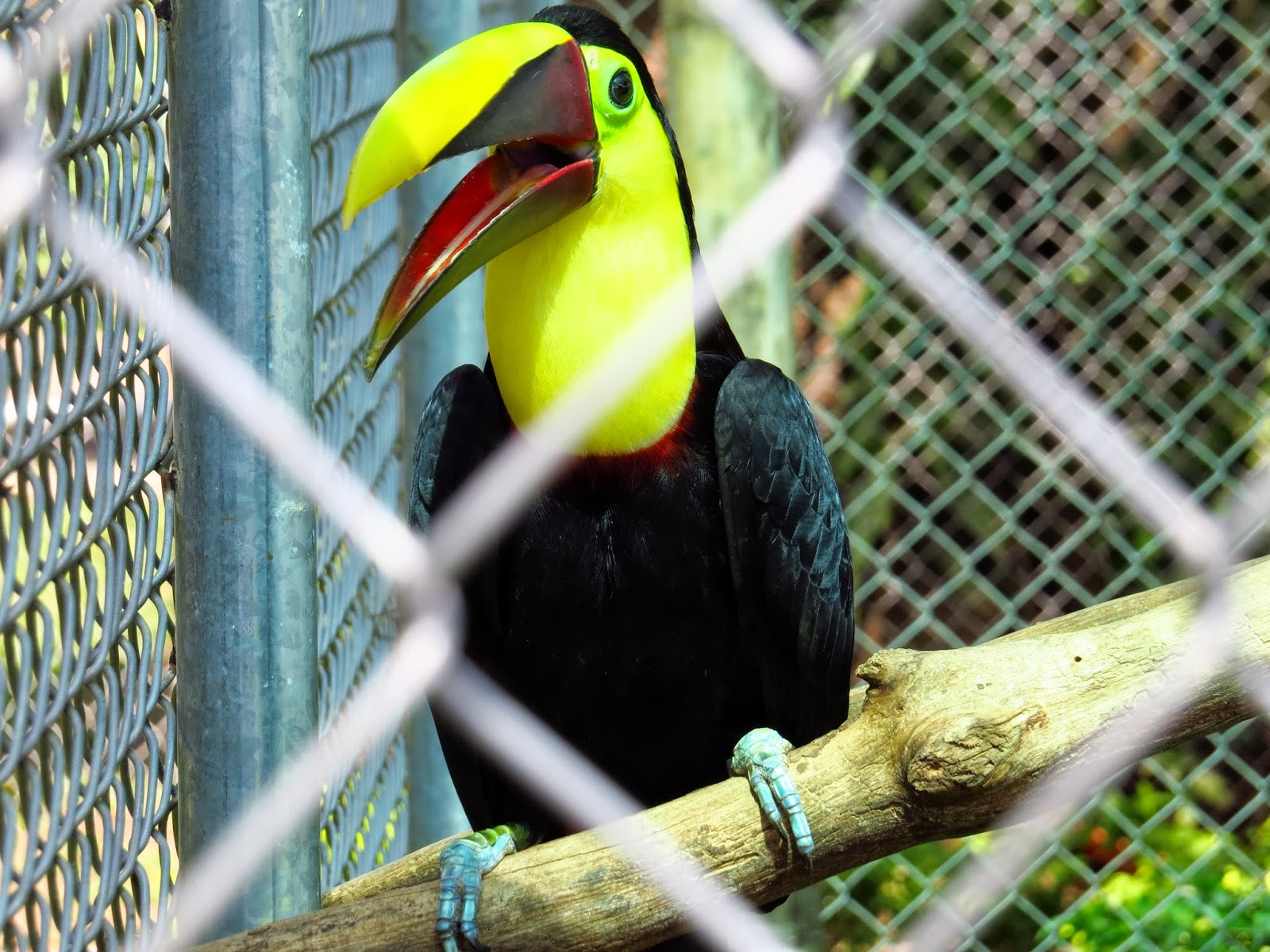
Keel-billed Toucan


Keel-billed Toucan aka. Sulfur-breasted Toucan aka. Rainbow-billed Toucan
Guanacaste, Costa Rica
Member of the Toucan Family
§A Rookery of Toucans§

★National Bird of Belize★

~true bird fact~ So what's the deal with the way this bird looks? Well, he's got a very specific environmental niche and he's basically built from head to toe to take advantage of it. Toucans are jungle birds and as such are built to fly only short distances (hence their short wings), spend a lot of time in trees (they have two toes facing backward and two facing forward, an uncommon adaptation known as zyglodactylic feet), and eat lots of fruit (that bill). It's about as long as the rest of his whole body and it gives him an advantage in reaching into the hollows of trees as well as plucking hard to get fruit. But that's not all! It's much, much lighter than it looks and extremely strong. Toucans use it for social play (mock dueling and throwing fruit to one another). Because of the unusual porous structure of the keratin that makes up the bill, it's also good for regulating body temperatures. Also, it's not a 'nose' and toucans don't 'follow' it to 'fruit loops'.

A really good friend. You want to be better friends with him right away because he seems like such a great guy
Can always find a new way to look at something
Questionable taste in women
That whole bill thing might be fake

PSA- In keeping with the integrity of this blog, I will point out that this guy was spotted not in the wild, but (clearly) in an animal shelter. Therefor he 'does not count' for birding purposes. Still, I think he's cool enough that he's worth bringing to you, the reader. Love this toucan you guys, cause it's the only one you've got. Don't question a good thing.

Also, he is not a parrot. I screwed up my 'parrot month' thing by posting the first parrot too early. He's kinda on theme still, I think.

Tuesday, December 3, 2013

Common Ostrich

African Ostrich
Ostrichland USA, Solvang, California, USA
Member of the Ostrich Family
§A Pride of Ostriches§

~true bird fact~ Ostriches cannot fly. Okay fine, I'll give you more than that. Because they cannot fly, ostrich wings have lost many of the properties of 'normal' bird wings. Specifically, they are no longer formed into the familiar blade-like shape that flighted birds have because the feathers filaments don't have a hook anymore. Unlike other bird feathers, ostrich feathers feel soft and fluffy, and are used exclusively for insulation. Well, used by the ostriches exclusively for that. Humans use them for feather dusters.

Male (left)
A little bit of a neat freak
Pouts silently when he doesn't get his way
An armchair intellectual
Talented cook

Female (right)
loses things all the time
Very into exercising
Excessive hashtag user (ie. #FitOstriches #EatMyDust #NotSorryHaters)
Sometimes doesn't pay attention to conversations she's having


Tuesday, August 27, 2013

Black Star Chicken

Black Star Chicken aka. Black Sex-Link Chicken aka. The Last Thing You Thought Would Come Up When You Searched for "Sex Link" on Wikipedia
Berkeley, California, USA
Member of the Junglefowl Family
*true chicken fact* Kept as pets and as sources of food, Chickens are ★the most numerous bird on the planet★, with a population of over 24 billion. They were first domesticated on the Indian Subcontinent around 8000 years ago for the purpose of cockfighting. Sadly we have not treated The Chicken any better since then. Most Chickens in the world are probably suffering horrifically.


*true Black Star fact* Not recognized as a 'true breed' by either the birding or poultry industries, Black Stars are cross-breeds, bred in such a way that a chick's gender is apparent from birth. This is why she is called Sex-Link. Having differently colored chicks makes the sorting process easier.

§A Brood of Chickens§

Has a funny accent that is vaguely familiar, but unplaceable
Fusses over you like a close friend's mom
Actually has been forced to flee her home country because of a horrible civil war or something, don't you feel bad for making fun of her accent now?
Has some kind of messed-up views of the world, but only because she has been through so much
Big ups to www.mypetchicken.com (a literal, real website) for help on the birds facts today.

Tuesday, April 23, 2013

Birds of The California Academy of Sciences

Rufous-crowned Tanager, South American Rainforest, Persuasive

Today's entry will be about birds that "Don't Count". What does this mean, exactly? Well, one component of bird watching that we don't really dabble with here at Amateurnithologist is the concept of a 'Life List', a list containing all the birds you've ever seen. The goal being, obviously, to make like a pokemon trainer and catch em' all.

Red-legged Honeycreeper (female), South and Central American Rainforest and Forest, Meticulous

While your bird blogger does not have a life list, he does have this blog. And this blog has standards, oh yes it does. Standards like 'not writing about a bird I do not have a picture of' and 'not including pictures I have taken myself'. This weekend I saw a magnificent golden eagle up close, he is almost certainly a god among birds, but I will not be writing an entry about him until I can take a picture.

Red-legged Honeycreeper (male), South and Central American Rainforest and Forest, A Wizard

Another example of a standard I have developed: A bird does not count unless you see it in the wild. I haven't ever seen a serious birder talk about this issue, but that's probably because I've done zero investigation ("zero investigation" is our motto here at Amateurnithologist).  For myself, the logic behind this rule is that a bird in captigivty removes a vital component of the birding process, that of The Hunt. The feeling of accomplishment that one gets when finding A Bird of Importance. Also, seeing a bird in captivity always kinda bums me out.


Bay-headed Tanager, South American Low and High Mountain Forest, Pandering

However, as an enjoyer of all things avian, it's not like I'm gonna not take a picture if I see some cool bird. So what to do with these images? Well, this I guess. Rather than do an in-depth profile, I'll simply share the bird's name, origin, and one adjective that might describe him. In this way I hope to separate this entry from what I usually do, while still honoring these incredible birds. We walk a thin line.

Common Ostrich (Juvenile), African Savannah, Precocious

With a perspective, your Amateurnithologist.

African Penguin, South African Beaches and Islands, Brusque

All of today's birds were photographed at the California Academy of Sciences, in beautiful San Francisco, California. They are loved and taken care of very well there, so maybe go see them?