Sunday, August 20, 2023

Ruffed Grouse


Ruffed Grouse aka. Patridgde, aka. Pheasant, aka. Prairie Chicken (all colloq., inaccurate) aka. Thunder-chicken

East Glacier Park, Montana, USA
August 2023
Member of the Turkey, Grouse, and Partridge Family
§A Pack of Grouse§
★The State Game Bird of Pennsylvania★ (Ranked the worst state bird by this website, due to not being a state bird (Pennsylvania does not have one)
★The most widely distributed game bird in North America★

~True Bird Fact~ They are described as an "immensely popular game bird" by allaboutbirds.org, and I see no reason to argue with that characterization, given that they appear to have an enormous organization named after them. Yes, you heard me, The Roughed Grouse Society exists, and appears to have an extremely slick website, and a history of working with state governments to improve forest management to create more appropriate grouse habitats. 

Yes, these are hunters, which is not really my thing, but I think the lesson to take here is that a bird species thrives when attention and care is paid to it, although maybe not for ideal reasons in this case. Anyway, this aforementioned website is filled with great quotes. Like this one, about the birds comfort with humans "they can still be killed with a canoe paddle or thrown stones in Minnesota wilderness forests, and are not considered much of a sporting bird in western mountains and north into Canada due to their confiding “fool-hen” nature."

And this one about Ruffed Grouse chicks "The chicks are precocial, which means that as soon as they have dried following hatching they are ready to leave the nest and start feeding themselves. Grouse chicks are not much larger than a man’s thumb when they leave the nest. They are surprisingly mobile and may be moving farther than 1/4 mile a day by the time they are 3 or 4 days old. They begin flying when about 5 days old, and resemble giant bumble bees in flight."

I also learned that "Ruffed Grouse are almost exclusively “flower-eaters,” living on the dormant flower buds or catkins of trees such as the aspens, birches, cherries, ironwood and filberts. Extensive feeding upon flower-buds in apple orchards caused Ruffed Grouse to be placed on the list of bountied animals in some New England states at one time."

Man, what a great website.

So anyway, I went to Montana, to Glacier National Park specifically, to continue my bucket list dream of visiting all the National Parks. Didn't actually get that many birds there, due to not really taking a birds-first approach, but I did get some, that I'll be posting in the coming (months? years?). I did also capture some strange non-bird animals, that maybe you'd have a passing interest in. Like this one

Moose (Shiras subspecies)

Fishercap Lake, Glacier National Park, Swiftcurrent, Montana, USA
August 2023
Member of the Deer Family
§A Herd of Moose§
★Largest and Heaviest Member of the Deer Family
★

{Etymology Corner} from the Algonquin "Moosh" from the Innu people. Meaning "stripper and eater of bark"

Sunday, February 19, 2023

Dark-eyed Junco


Dark-eyed Junco (aka. Oregon Junco)
Point Lobos State Natural Reserve, Carmel-by-the-sea, California, USA
February 2022
Member of the American Sparrow Family
§A Quarrel of Sparrows§ 

~True Bird Fact~ Truly baffling that I haven't blogged this guy yet since I see him everywhere. Something between never bothering to blog him because I think I already have and never bothering to take a picture because I think I don't need one. Still, one of our cutest little guys. This bird is subject to a debate that is baffling to the amateur bird enjoyer like myself. See, this bird is described everywhere as having an 'extremely variable' appearance. What does this mean? It means that depending on the 'sub-species' the bird looks entirely different.

Map illustration by Borja Mila from the National Museum of Natural Science in Madrid

Take a look at this. Does this look like the same bird to you? Now keep in mind that I've never known ornithologists to not tell me that two almost identical (please see all seagulls for example) birds were actually different, and we have a real mystery on our hands. This article sort of explains it- scientists believe that this bird is involved in very rapid speciation. That is, it's turning into lots of different birds, right before our eyes (at least compared to the scale of time these things usually happen according to). I have to assume it's only a matter of time before they spin this bad boy off into like 14 different birds, half of which are nearly identical. Until then, I'll enjoy my local Dark-eyed Juncos without having to worry too much.

Two left feet
Never uses a public restroom
Always picks a little piece of tall grass and caries it with her when she goes walking
Swears by grinding her own spices over using the pre-ground kind

Friday, December 30, 2022

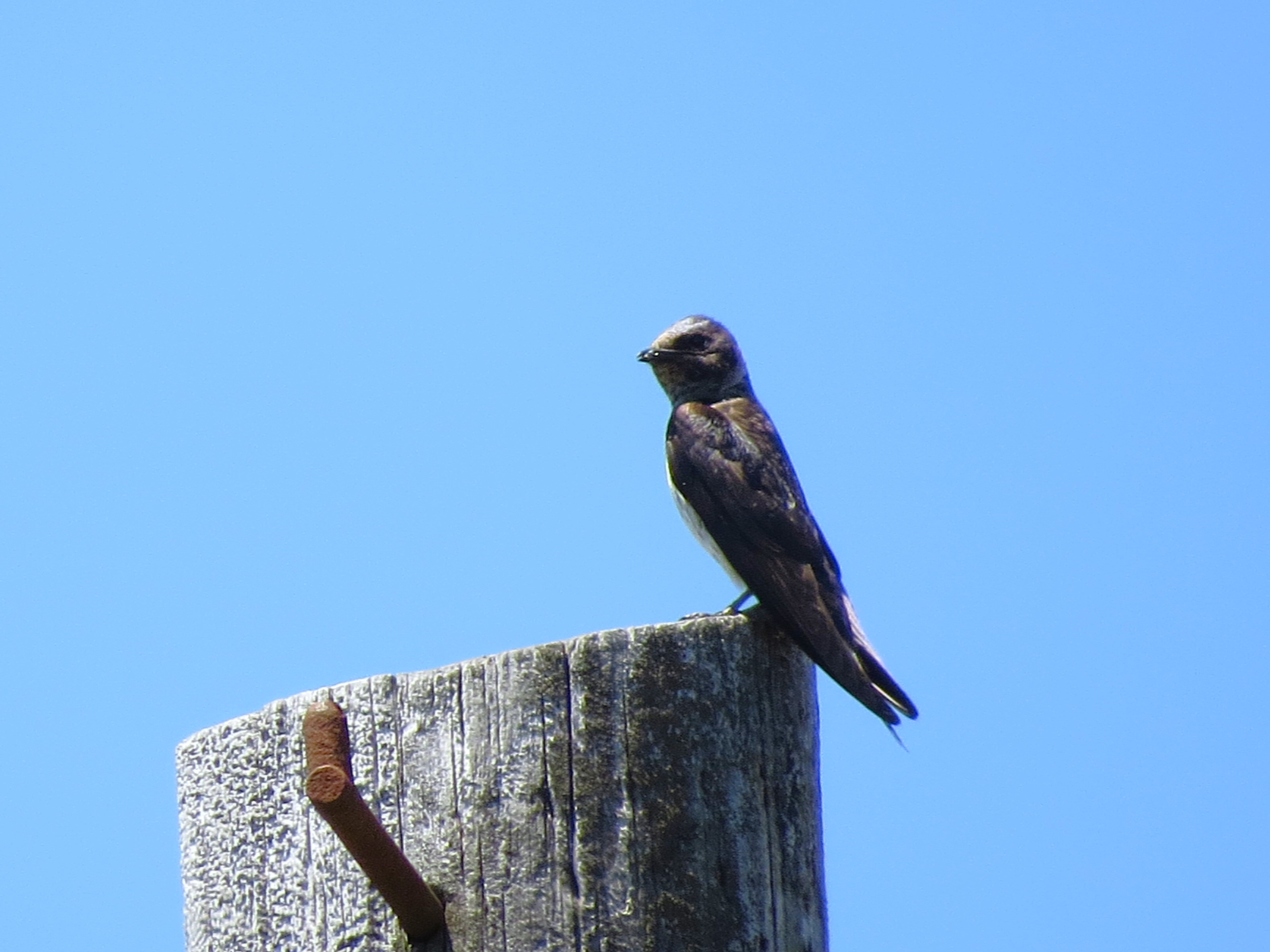
Purple Martin


Purple Martin
Vollmer Peak, Orinda, California, USA
July 2022
Member of the Swallow Family
§A Gulp of Swallows§ (dubious about this claim)
★The Largest North American Swallow★

{Etymology Corner} So, when I was preparing this blog I stopped for a moment and thought 'why are they called Martins instead of, you know, Swallows, like all the other members of the Swallow Family. So, as you do, I googled it, for the blog. The answer is interesting enough that I'm just going to fully quote The Online Etymology Dictionary directly"

Martin (n.) kind of swallow-like bird (Chelidon urbica), 1580s (earlier in diminutive form maretinet, mid-15c.), from Old French martin, which is apparently from the masc. proper name Martin in some sense. Writers in 17c. said it was named for St. Martin of Tours (d. 397 C.E.), patron saint of France, whose festival day (Martinmas) is Nov. 11, about the time the birds are said to depart for winter. But OED says the naming "may have been purely arbitrary," and Century Dictionary says "the name has no specific meaning ...." Usually with a qualifying term: the common house-martin is so called because it nests under the eaves of houses. The American purple martin is so called by 1804.

So named after, literally, the name Martin, or maybe just nothing. Amazing work language, you're doing great.


~True Bird Fact~ Purple Martins have a rare and interesting relationship with humans, having developed, over the centuries an almost symbiotic relationship with us. Purple Martins are almost 100% reliant on humans for the creation and maintenance of their nests. The bird migrates between North and South American, and Native peoples in pre-colonial times would hang up hollowed out gourds for nests. The people get a bird that eats tons of insects that would otherwise be eating crops, and the birds get a home. The practice of building and keeping up Martin nests continues to this day, although there is concern that it's becoming less popular with young people (Millennials are killing Martins with their lattes and avocado toast! (I am being sarcastic here)). There are not many birds with a whole non-profit dedicated to their continued existence, but this bird has one. Cool stuff, Martin!


So this is my last blog of the year. Usually I do some kind of year in review post, outlining the best birds, best posts, etc. Well, this year, as you might have noticed, we have had a grand total of 3 blogs, coming in well under my own goal of doing one a month. What can I say, this is the year my son went from 3 to  4 and my daughter went from 0 to 1. It's been a bear, folks, but hopefully, next year will be more like a bird, which is to say I'll do more bird watching and blog more birds in the new year. Best wishes, Amateurnithologist signing off for 2022. 

Saturday, July 30, 2022

Black-bellied Whistling Duck


Black-bellied Whistling Duck, fka Black-bellied Tree Duck

Green Cay Nature Center and Wetlands, Florida, USA
April 2022
Member of the Ducks, Geese, and Swans Family
§A Brace of Ducks§

{Etymology Corner} I don't usually mention this, but the Latin name of this duck is Dendrocygna autumnalis, which translates roughly into Autumnal Tree-swan. I think that's a great name, it is a very autumnal looking bird.

~True Bird Fact~ Fascinating bird, with behavior that is very unique for ducks- ready for some bullet points? Cause this duck needs bullet points

  • Does whistle
  • Does nest in trees (in South America, where the duck is most commonly found, it nests in palm trees. Boy I'd like to see that)
  • Does form monogamous pair bonds
  • Has increased it's North American population by 6% per year from 1966 to 2019, and they expand northward every year. They used to be a rare bird, but now are quite common in southern states. If things continue at this rate, soon the only life this continent will sustain will be Black-bellied Whistling Ducks, and honestly, that's fine.

What a cool duck, huh? Well, anyway, that's all for today... Unless you'd like to talk about how this is my first blog post since January. Two this year! How did this happen? Well, to be honest, I had a second kid (as recounted here), and boy, does that take a lot of time up. Birding time has been minimal, but not as minimal as looking-through-photos time and sitting-down-to-write-a-blog time. Still, I am resolved to revive this blog, so I'm going to make a commitment to catch up on my blogging and come out with at least a total of 10 this year, to match my last year's total. I can do 10, right? That's super easy. Lots more birds to come. 

Hugs and kisses, 

The Amateurnithologist