Thursday, November 19, 2020

Pigeon Guillemot


Pigeon Guillemot
Soberanes Point, Carmel-by-the-Sea, California, USA
August 2020
Member of the Auks, Murres, and Puffins Family
§A Bazaar of Guillemots§

{Etymology Corner} First, Guillemot is pronounced guil·le·mot, which was not at all how I thought it was pronounced. I was saying it like it was, like, a French word, but I don't speak French, so probably wrong twice. Turns out my guess is not completely baseless, because this is a word of French origin. It's a diminutive of the French name William, Guillaume. Why are these birds called 'Little Willams'? No information available. Apparently the 'pigeon' part comes because other Guillemots  were colloquially known as Greenland Doves. I guess the shape and size is sort of pigeon-like? 

~True Bird Fact~ Quite socially advanced for a little sea bird. Guillemots hunt cooperatively. You may know them from cool scenes from Planet Earth where they're coordinating with dolphins or seagulls to corral a bunch of bait-fish using bubbles trapped in their feathers. This is one example, but I know I've seen others. They also pair bond, and engage in romantic behavior with their partners, like singing together, or playfully chasing one another under water. I am sad to report that Guillemots CAN divorce.

Lots of PDA, makes you uncomfortable, but you're kind of impressed
Surprising athleticism
Always does a little bit more than necessary


PS- I got partially took these Guillemot pictures while kayaking off the coast of Monterrey, so here, as a bonus, is a cute picture of an otter. Hang in there baby!


Sunday, October 18, 2020

Good Birds, Bad Pics: Mono Lake Edition

 Hello bird fans! As you might have known from my Grouse Grousing last month, I recently took a trip to Mono Lake. It was a wonderful trip, but to be honest, not as bird-bountiful as I might've wanted. It was a little early to catch the big migrations, but still, it's away from home, and that means new birds. Just not, like, a lot of new birds. And certainly not cooperative new birds. So below I present to you some of the finds that I'm happiest about having seen, even if I didn't exactly nail it in the picture department. These days it feels like the busy amateur birder should feel pretty good about having even tried, right?

Clark's Nutcracker
Mono Lake County Park, Lee Vining, California, USA
July 2020
Member of the Crows and Jays Family
§A Jar of Nutcrackers§ (the other ones are worse)

~True Bird Fact~ Yup, he's named after That Clark, of Lewis and Clark fame. I'm not going to do a naturalist profile in this one. I just did one of those. Go read about how birds shouldn't be named after these guys anyway.

Picture Crime: Far away, in shadow. Basically you can barely see it well enough to ID.

Wilson's Phalarope
Mono Lake Tufa State Natural Preserve, Lee Vining, California, USA
July 2020
Member of the Sandpipers and Phalaropes Family
§A Dopping of Phalaropes§
The Largest Phalaropes★ (of...3)

[Etymology Corner] Phalarope, that's a weird word, huh? It comes from the Latin name of the bird, and it breaks down to mean Coot-footed. So this bird is named after having lobed feet, similar to a coot. Ironically, this member of the Phalarope genus actually doesn't even have the lobed feet. Pretty messed up that the birds have similar feet but one is named after the other. If only the cards had been dealt a different way, perhaps the coot would've been named Phalarope-footed (but this would cause a time paradox, unfortunately). 

~True Bird Fact~ Unlike most birds, the female is the dominant member of the species. She is larger, more colorful, and males watch the nest while she is out finding more partners. Girlboss!

Picture Crime: Far away, in a group, breeding plumage appears to have not quite come all the way in yet. Other birds nearby confuse me and make me less confident in my ID. They could be juveniles, non-breeding birds, or even non-breeding Red-necked Phalaropes.

Brewer's Sparrow
Gem Lake Trail, June Lake, California, USA
July 2020
Member of the American Sparrows Family
§A Ubiquity of Sparrows§

~Interesting Bird Facts?~ None. Hey, it's named after that same guy from Brewer's Blackbird. That's something, I guess.

Picture Crime: Obstructed behind a branch. Slightly out of focus. Sparrow, so, inherently boring. I already forgot which one it is. 

Well, thanks for slogging through those medium pictures. Still, it's 3 birds I didn't know before, and sort of know now. See you next time when we get into some of the birds I got slightly better shots of.

Friday, September 25, 2020

Sooty Grouse

Sooty Grouse
Gem Lake Trail, June Lake, California, USA
July 2020
Member of the Turkey, Grouse, and Partridge Family
§A Covey of Grouse§

~True Bird Fact~ The species split recently (2006) from the Dusky Grouse, this bird used to be called the Blue Grouse. Just terrific naming all around.

You know, shockingly, there's not a lot of interesting facts about this grouse. I found it kind of interesting that they largely eat pine needles in winter, and that the kind of pine tree available is basically what determines their range. Is that interesting to anyone? There was one 'fun fact' available online about how many feathers their tail has (15-22, when usually in grouse the number is not variable. Amusing!), one fact about how many eggs they have in a clutch (up to 15, which is, I guess, more than you'd think), one of the facts was that they are the 3rd largest grouse in North America (incredible. impressive). Oh well, I still like them.


 All right, let's get to the ~fake bird facts~ then 

Often ridden into war by smaller birds
Very fastidious about her feathers, what with the whole 'sooty' thing, you know?
Prefers a home with many roommates
Truly does not mind that she doesn't have any super interesting ~true bird facts~ about her


Saturday, August 22, 2020

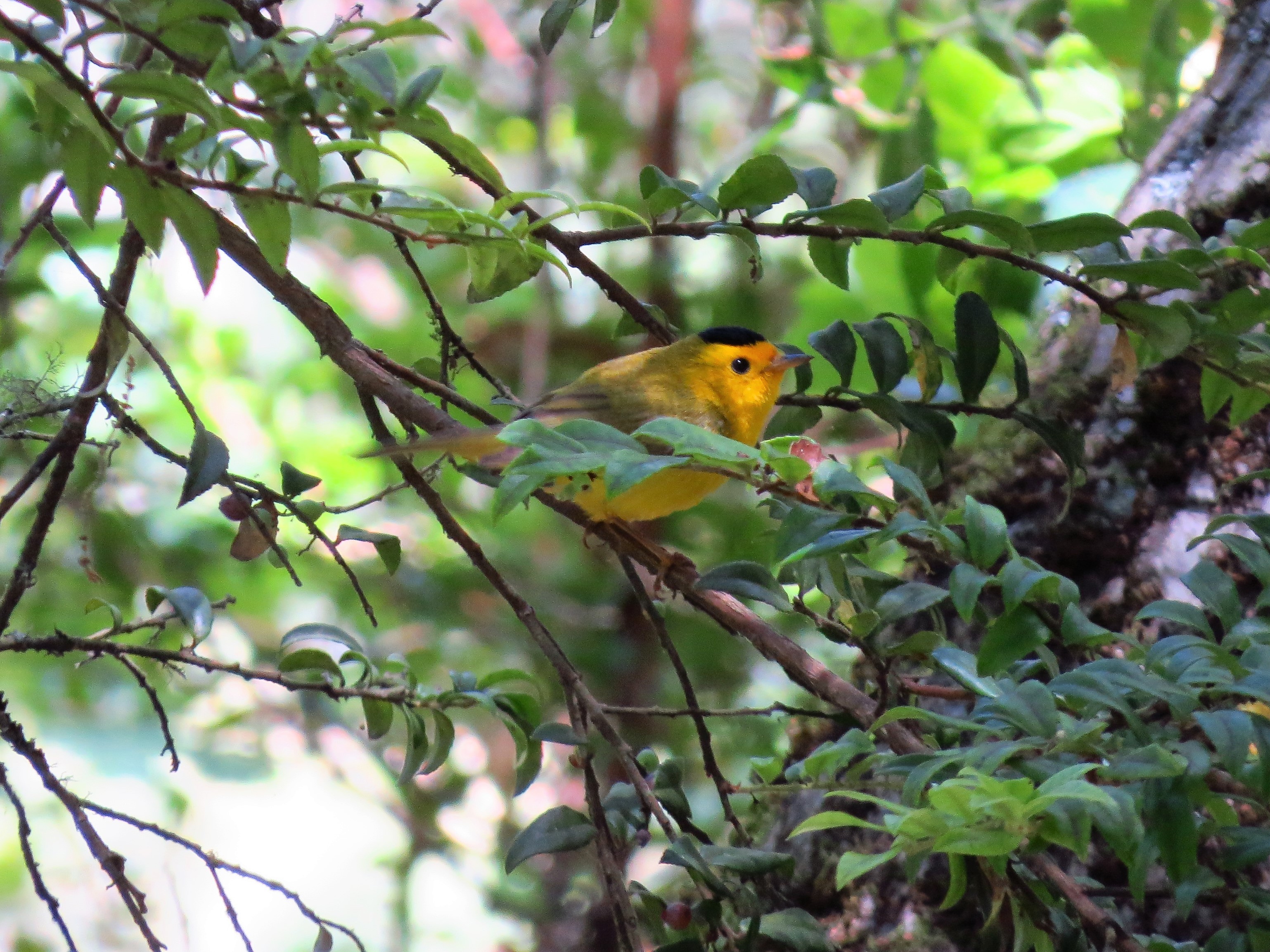
Wilson's Warbler

Wilson's Warbler
Huckleberry Botanic Regional Preserve, Oakland, California, USA
June 2020
Member of the Wood Warbler Family
§A Confusion of Warblers§

~True Bird Fact~ Most songbirds leave the nest for good once they've fledged. Wilson's Warblers, on the other hand, often return for a night or two. Failure to launch? 


Named for and by:


Alexander Wilson
(1766 – 1813)

Called The Father of American Ornithology, and the second only to Audubon in terms of American Ornithology Importance, and that's just in the first sentence of his wikipedia page! Wilson was born in Scotland and his first profession was as a weaver. He took an early interest in poetry and wrote ballads, pastoral pieces, and satirical works about the plight of weavers. These satirical poems were evidently so biting, that he was arrested for a 'libelous and inflammatory' poem about a mill owner. Here's an excerpt, in the original Scots:

Wha cou’d believe a chiel sae trig
|Wad cheat us o’ a bodle?
Or that sae fair a gowden wig
Contained sae black a noddle?
But Shark beneath a sleekest smile
Conceals his fiercest girning;
And, like his neighbours of the Nile,
Devours wi’ little warning
By night or day.

I guess you had to be there. He was also, it should be noted, that he was a very bad weaver, and eventually quit and moved to America, after languishing in poverty.

His career turned to teaching, and eventually he met the naturalist William Bartram, who awakened his true passion. Birds! He resolved to publish illustrations of every bird in North America. He did pretty good at this task, at least better than his weaving, traveling widely, and eventually publishing a nine volume work, including 268 birds, 26 of which were new to his audience of western naturalists. He died young from, and I quote "dysentery, overwork, and chronic poverty." He seems like he was a pretty cool dude, and has a lot of birds named after him. He also seems to have been a direct inspiration for Audubon himself, both in his style of illustrating and his publication.


Wilson's illustration of Red-bellied, Pileated, and... Ivory-billed Woodpeckers

However, bird fans, I am not content to let this topic rest here. There's been a lot of debate in the bird world lately about eponyms and honorifics, and whether birds should really be named for their 'discoverers'. I try to make a little point of this each time I profile a naturalist- that these birds were not truly "discovered", only given new, western names. There were people here before them, and the birds were plenty discovered already. And some of the people who have birds named after them turn out to be truly heinous. There's a lot of overlap, it turns out, between ideas of discovery and exploration and ideas of colonialism and manifest destiny. This includes some naturalists I've written about here, and frankly, I didn't know how bad they were. This is my bad, but racism doesn't often make it into the wikipedia summary, it turns out.

There's been one major recent success for this movement, the renaming of McCown's Longspur to Thick-billed Longspur. This one was named after a confederate general (yikes emoji). So yes, some bird names might be changing, if they are named after particularly bad people. But you can also make the broader argument that it's much simpler to just keep bird names descriptive and do away with honorifics all together. The naming of species after a western discoverer is inherently a colonialist practice. And while we'll lose some potentially 'good ones' like Wilson here, his contributions to birding will not be erased if he no longer has the birds directly named after him. (Although again, who knows, about Wilson. I'm not about to read a whole biography looking for problematic elements). If you agree with this view point, there's a petition that you can sign. I have. Maybe in the future we'll just call this bird the "green black-capt flycatcher", as Wilson originally called it in 1811. Well. Maybe we won't call it that. But something else. Stay tuned.