Wednesday, October 7, 2015

Eurasian Collared-Dove


Eurasian Collared Dove
Natural Bridges State Beach, Santa Cruz, California, USA
September 2015
Member of the Dove and Pigeon Family
§A Dole of Doves§


{Etymology Corner} Well, it's a dove native to Eurasian and it has this collar, so it appears to be case closed. Not so fast, gentle blog reader, there's more. We're finally delving (perhaps inadvisably) into the world of scientific names for this one. Streptopeleia decaocto is her name, and there are some interesting notes here. The first part, Stepto-whatever is just Latin for "Collared Dove". However, Decaocto is a name of Greek Mythological origin. She was a servant girl whose life was so terrible that the gods turned her into a dove so she could fly away from her whole existence. Thanks gods. It is said that this Dove's mournful cry is her weeping (you know the cry, you confuse it for an owl). Wikipedia disagrees, however, stating that Decaocto was chosen because it is phonologically similar to the coo-COO-coo cry. Uhhh... nice try, but I'm going to stick with the myth.


~true bird fact~ This bird, as you may have gathered from the name, is not a native species. It came to the US through the Bahamas after a pet store was robbed in the 80's and some of the birds escaped (of course a pet store in the Bahamas was robbed in the 80's). By 1982 the bird was spotted in Florida, and, spreading quickly, it was all the way in California by 2001. Now the bird is nearly everywhere in the states, some heading as far north as Alaska. The theory is that the Collared Dove was able to expand her range so quickly because she is filling a biological niche left by the extinction of the Carrier Pigeon. I, for one, am really proud of the Collared Dove and take a pro Collared Dove stance. Sometimes you just come upon a bird with a real interesting narrative. Or even two in this case. It's always a nice surprise.


Wednesday, September 30, 2015

Elegant Tern


Elegant Tern
Mitchell Cove, Santa Cruz, California, USA
September 2015
Member of the Gull, Tern, and Skimmer Family
§A Cotillion of Terns§

~true bird fact~ Unlike many Terns, this Elegant gentleman is not very aggressive. Instead he builds his nest in the company of other birds that are more likely to drive away intruders, like our friend Heerman's Gull. An Elegant Tern doesn't like to get his hands dirty, that's what 'The Help' is for.

Classically trained in manners and scholastics
Makes a lot of little 'jokes' about his name. They're not really jokes, he thinks of himself as quite elegant
Can't stand the Royal Tern. A good way to get fired is to confuse the two of them
Spends a lot of money on beauty products

Wednesday, September 23, 2015

Snowy Plover and Chick


Snowy Plover aka. Western Snowy Plover
Coal Oil Point Reserve, Isla Vista, California, USA
July 2015
Member of the Lapwing and Plover Family
§A Brace of Plovers§
★North America's Smallest Plover

~true bird fact~ Young snowy plovers can leave the nest an amazing 3 hours after hatching, and are already capable at that point of running, swimming, and catching food. They still need the experience and brooding of their parent, who at that point is generally a single dad, but they're extremely independent as bird chicks go. Oh, you might be wondering if these precocious bird chicks are cute or not. Well..

Yes. The answer is yes.

How endangered are they? Like the Burrowing Owl, and the California Condor, the Snowy Plover is one of California's most well known endangered birds. They are designated as 'Threatened' by the Endangered Species Act, at least in their Western Population. They are a bird who makes their home on wide, flat expanses of sandy beach, mostly breeding in Southern California, and as you can imagine they run up against humanss fairly regularly. A number of concentrated conservation programs, led by the UC system, have brought Western Plovers back from the brink. I personally was able to see these plovers on a beautiful and active recreational beach near Santa Barbara, where signage, rope lines, and volunteers are all that protect the plover. It seems to be enough, as the program is a fairly dramatic success. Your blog author can never really tell why conservation for some birds really takes off the way it does, while others languish in obscurity, but it's always nice to see when it happens. Snowy Plovers are popular enough that they have a website dedicated to them, westernsnowyplover.org, which features an 11 minute video for kids, printable signs, and an extremely detailed recovery plan. Oh, and go watch that video, it's amazing.


Thursday, September 17, 2015

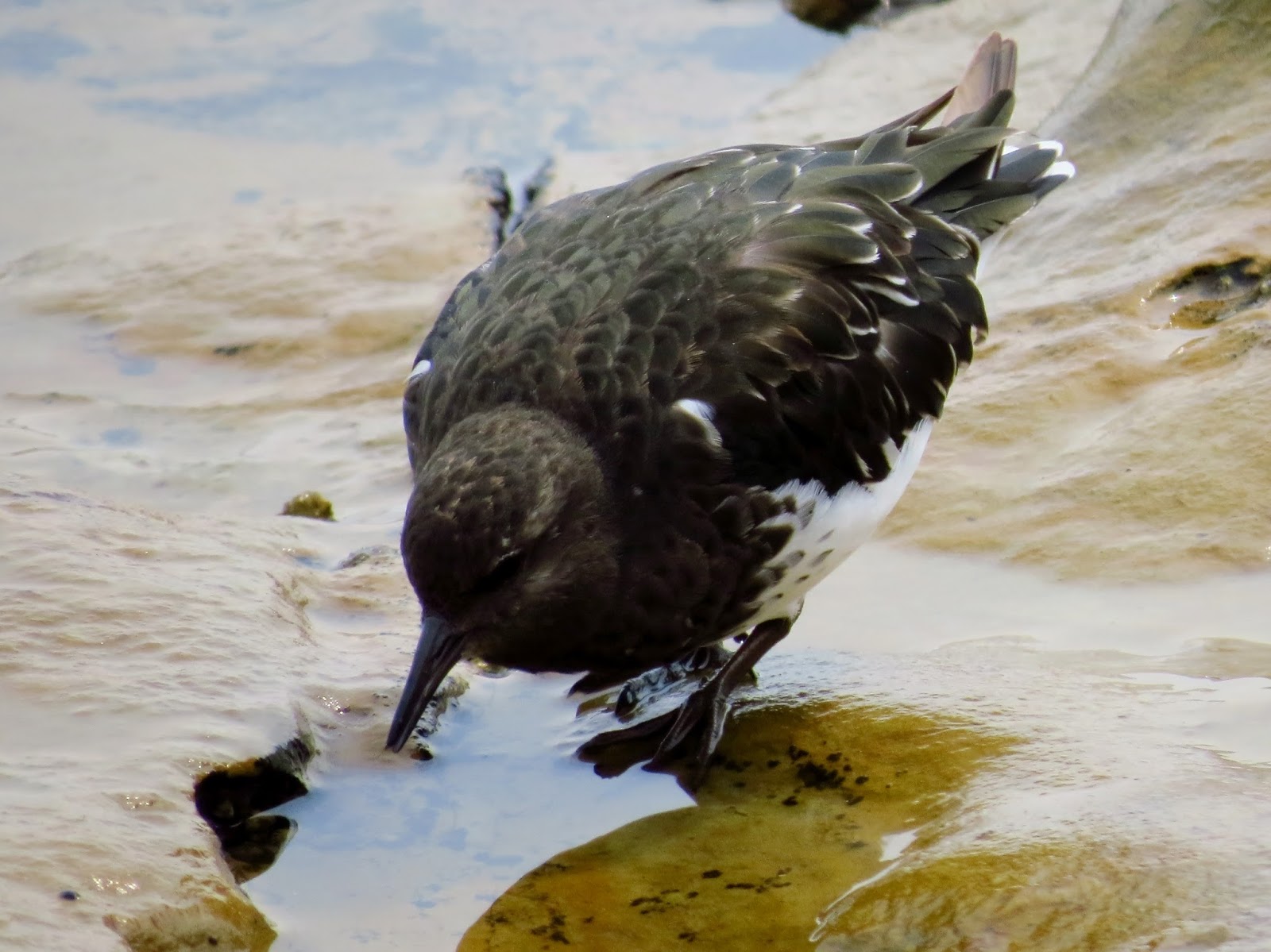
Black Turnstone


Black Turnstone
Natural Bridges State Beach, Santa Cruz, California, USA
September 2015
Member of the Sandpiper Family
§A Bind of Sandpipers§

{Etymology Corner} This is a very good name, since this bird hunts by using his unusually shaped beak (ed. note- it doesn't look that unusual to me..) to turn over stones. Also, it is a black bird. You almost couldn't do any better, but I'm a little disappointed he can't petrify things like a gorgon. 9/10


 ~true bird fact~ Females in a breeding pair often leave after just two weeks, leaving remaining parenting responsibilities to the father. It's hard being a single dad, especially when you inexplicably lack the ability to turn predators to stone.


Affectless
Cool as a cucumber
Wouldn't be comfortable relaxing or taking a day off
Doesn't often explain her actions